

 登录
登录
(
—But I don't think she looks good ______ red.
A.dressed; in
B.put on; wear
C.wearing; in
D.wear; put on
C
) 4.—I saw Ann ______ a green dress at the meeting.—But I don't think she looks good ______ red.
A.dressed; in
B.put on; wear
C.wearing; in
D.wear; put on
答案
C
解析
本题主要考查see的用法以及介词的用法。对于第一个空,see sb do sth表示“看见某人做某事”(强调看到动作的全过程),see sb doing sth表示“看见某人正在做某事”(强调看到动作正在进行)。根据语境“我在会议上看见Ann穿着绿色连衣裙”,这里强调看到Ann穿着绿色连衣裙这个状态,用see sb doing sth更合适,所以排除A(dressed是过去分词,不符合see的用法)和D(wear是动词原形,不符合see sb doing sth结构);对于第二个空,“in + 颜色”表示“穿着……颜色的衣服”,是固定搭配,而put on强调穿衣服的动作,wear强调穿衣服的状态,这里说“我觉得她穿红色不好看”,用in更合适,排除B(put on和wear都不符合此处语境)。
(
—They are ______ than romantic stories.
A.much more exciting
B.so more exciting
C.much more excited
D.so more excited
A
) 5.—What do you think of detective stories?—They are ______ than romantic stories.
A.much more exciting
B.so more exciting
C.much more excited
D.so more excited
答案
A
解析
首先,根据题目中的“than”可知,这里需要用比较级形式。而“exciting”是多音节形容词,其比较级形式为“more exciting”,并且可以用“much”来修饰,表示“更……得多”。另外,“excited”通常用来形容人的感受,而“exciting”用来形容事物的性质,这里描述的是“detective stories”(侦探故事),所以应该用“exciting”。接下来,我们逐一排除选项:B选项“so more exciting”中的“so”不能用于比较级前;C选项“much more excited”中的“excited”使用不当,应改为“exciting”;D选项“so more excited”同样存在“so”使用不当和“excited”使用不当的问题。因此,正确答案是A选项“much more exciting”。
(
A.found
B.was found
C.were found
D.was founded
B
) 6.Early this morning, the body of a young man ______ in the middle of a street.A.found
B.was found
C.were found
D.was founded
答案
B
解析
首先,根据句意“今天早上早些时候,一名年轻人的尸体在街道中央被发现了”,可知句子描述的是过去发生的事情,且主语the body of a young man是动作的承受者,因此应用一般过去时的被动语态,其结构为“was/were+过去分词”。其次,主语the body of a young man是单数,所以应用was,排除C项;find的过去分词是found,意为“发现”,而found作为动词原形时,意为“成立”,其过去分词是founded,排除D项。因此,正确答案是B项,即was found。
三、阅读填空
Mr Dawson was an old grouch(好抱怨的人). Kids knew not to go into his yard to pick a delicious a 1 , even off the ground because old Dawson, they said, would come after you a 2 .
One Friday, Janet went to town with her friend Amy. They had to walk by Dawson's house, but as they got close Janet saw him sitting on his front porch. She s 3 they cross over to the other side of the street. Like most of the children, she was scared of the old man.
Amy said not to w 4 , and they went on. When they got close enough, Dawson looked up with his usual frown(皱眉), but when he saw it was Amy, a big s 5 changed his face. "Hello, Amy. I see you've got a friend with you today."
Amy smiled back and told him where they would go. Dawson seemed very i 6 and asked more questions. He even offered them each a fresh-picked apple off his tree.
When they left his house, Janet asked Amy, "Everyone says he's an old grouch. Why was he so n 7 to us?"
Amy explained that when she first walked past his house he wasn't very friendly, but she always smiled at h 8 . It took a while, and one day he smiled b 9 at her.
Smiles are contagious(传染的) and s 10 are angry looks. Giving a smile away takes so little effort and time. We should try to be the ones that smile to others instead of showing the anger.
1.
6.
Mr Dawson was an old grouch(好抱怨的人). Kids knew not to go into his yard to pick a delicious a 1 , even off the ground because old Dawson, they said, would come after you a 2 .
One Friday, Janet went to town with her friend Amy. They had to walk by Dawson's house, but as they got close Janet saw him sitting on his front porch. She s 3 they cross over to the other side of the street. Like most of the children, she was scared of the old man.
Amy said not to w 4 , and they went on. When they got close enough, Dawson looked up with his usual frown(皱眉), but when he saw it was Amy, a big s 5 changed his face. "Hello, Amy. I see you've got a friend with you today."
Amy smiled back and told him where they would go. Dawson seemed very i 6 and asked more questions. He even offered them each a fresh-picked apple off his tree.
When they left his house, Janet asked Amy, "Everyone says he's an old grouch. Why was he so n 7 to us?"
Amy explained that when she first walked past his house he wasn't very friendly, but she always smiled at h 8 . It took a while, and one day he smiled b 9 at her.
Smiles are contagious(传染的) and s 10 are angry looks. Giving a smile away takes so little effort and time. We should try to be the ones that smile to others instead of showing the anger.
1.
apple
2. angrily
3. suggested
4. worry
5. smile
6.
interested
7. nice
8. him
9. back
10. so
答案
1. apple 2. angrily 3. suggested 4. worry 5. smile 6. interested 7. nice 8. him 9. back 10. so
解析
1. 根据后文“fresh-picked apple off his tree”及首字母a,可知是苹果,填apple。
2. 修饰“come after”,结合grouch性格,用副词“生气地”,填angrily。
3. Janet看到Dawson后建议过马路,过去时态,填suggested。
4. Amy让Janet不要担心,填worry。
5. 与“frown”对比,看到Amy后脸上是微笑,填smile。
6. 问更多问题表明感兴趣,修饰人用interested,填interested。
7. 与“grouch”对比,对他们友好,填nice。
8. 指代Dawson,介词后用宾格him,填him。
9. Amy一直微笑,Dawson最终回笑,填back。
10. “so+be动词+主语”表“……也一样”,填so。
2. 修饰“come after”,结合grouch性格,用副词“生气地”,填angrily。
3. Janet看到Dawson后建议过马路,过去时态,填suggested。
4. Amy让Janet不要担心,填worry。
5. 与“frown”对比,看到Amy后脸上是微笑,填smile。
6. 问更多问题表明感兴趣,修饰人用interested,填interested。
7. 与“grouch”对比,对他们友好,填nice。
8. 指代Dawson,介词后用宾格him,填him。
9. Amy一直微笑,Dawson最终回笑,填back。
10. “so+be动词+主语”表“……也一样”,填so。
四、任务型阅读
Rivers are the lifeblood of human civilizations. As one of the longest-lasting civilizations, China has a large number of rivers. A total of 45,203 rivers with a drainage area(流域面积) of more than 50 square kilometres run across the country, according to the National Bureau of Statistics.
The most famous ones are the Yangtze and Yellow Rivers. As the longest river in Asia and third longest in the world, the Yangtze River has a length of 6,300 kilometres. It originates from the Qinghai-Xizang Plateau(高原) and flows through 11 provincial-level administrative regions(省级行政区) before ending in the East China Sea. Second to the Yangtze River is the Yellow River, with a length of 5,464 kilometres as it flows from the west to the east of China.
Apart from its big number of natural rivers, China also has a lot of beautiful man-made rivers. The Grand Canal is one example. With a history of more than 2,500 years, the Grand Canal stretches(延伸) nearly 3,200 kilometres and connects the north and south of China.
Despite their different features, these rivers and canals continue to nourish(滋养) the Chinese people physically and culturally. They bring fertile(肥沃的) soil and enough irrigation(灌溉) water, which makes many areas "a land of fish and rice". Connecting China as a whole, the water network runs through geographical boundaries and provides people with convenient transportation, expanding trade and promoting economic growth. These rivers are immortalized(使名垂千古) in Chinese culture, as can be found in Chinese poetry, art, literature and folklore.
To protect these bodies of water, many measures have been taken in recent years. For example, in August the Ministry of Water Resources announced plans to bring back 700,000 hectares(公顷) of degraded natural forest and treat almost 1.4 million hectares of land suffering from desertification(沙漠化) by 2025.
Through these government measures, our rivers have seen many positive changes—birds flying above the wetlands and farmers happily harvesting on irrigated lands.
| Life flows through 1 | |
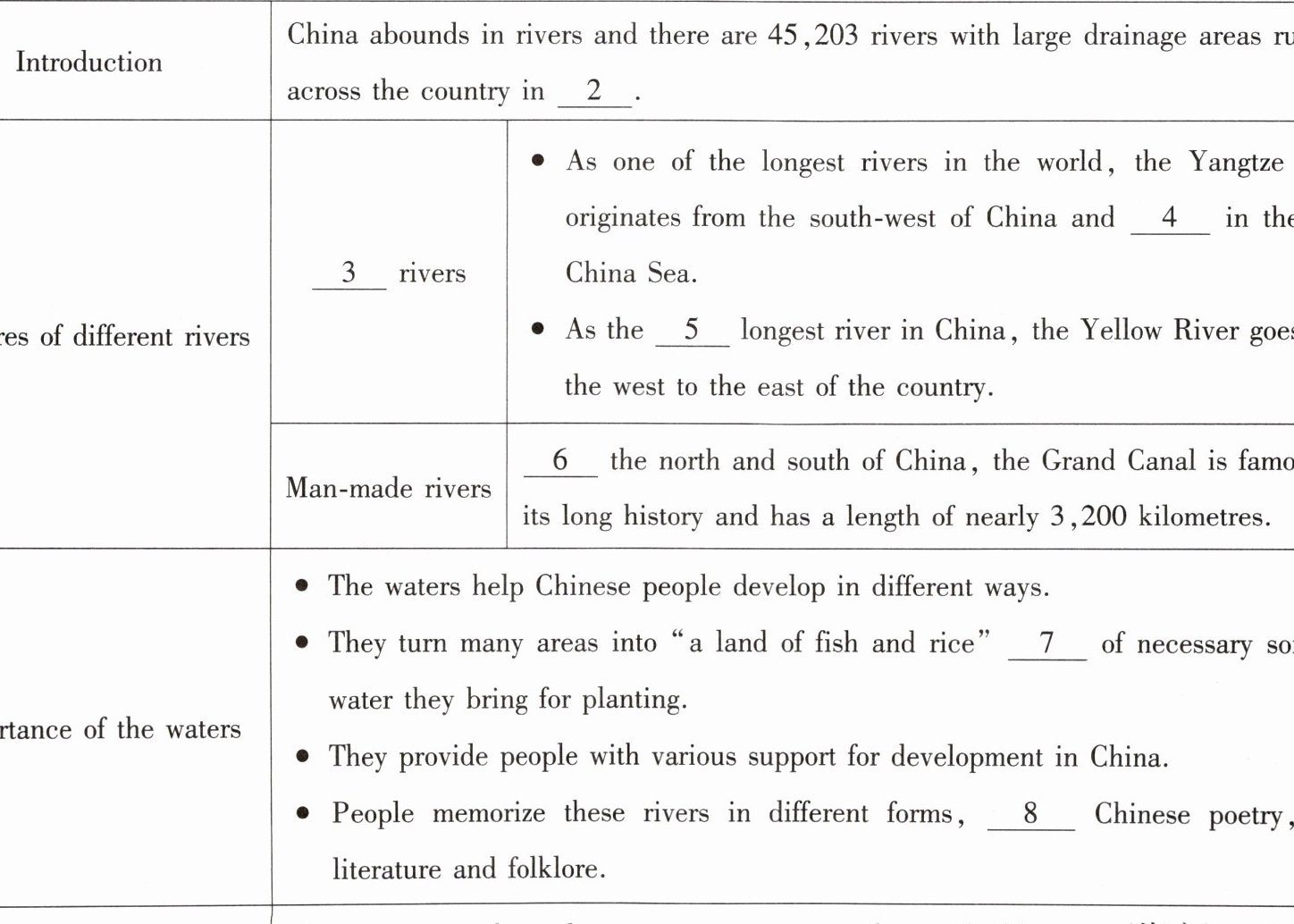
| Introduction | China abounds in rivers and there are 45,203 rivers with large drainage areas running across the country in 2. |
| Features of different rivers | 3 rivers | • As one of the longest rivers in the world, the Yangtze River originates from the south-west of China and 4 in the East China Sea. |
| | | • As the 5 longest river in China, the Yellow River goes from the west to the east of the country. |
| | Man-made rivers | 6 the north and south of China, the Grand Canal is famous for its long history and has a length of nearly 3,200 kilometres. |
| Importance of the waters | • The waters help Chinese people develop in different ways. | |
| | • They turn many areas into "a land of fish and rice" 7 of necessary soil and water they bring for planting. | |
| | • They provide people with various support for development in China. | |
| | • People memorize these rivers in different forms, 8 Chinese poetry, art, literature and folklore. | |
| | 9 of the waters | The government has taken measures to protect the invaluable assets(资产) in different ways. To our relief, our life is getting 10. | |
| 1. ______ 2. ______ 3. ______ 4. ______ 5. ______
| 6. ______ 7. ______ 8. ______ 9. ______ 10. ______
1.
6.
Rivers are the lifeblood of human civilizations. As one of the longest-lasting civilizations, China has a large number of rivers. A total of 45,203 rivers with a drainage area(流域面积) of more than 50 square kilometres run across the country, according to the National Bureau of Statistics.
The most famous ones are the Yangtze and Yellow Rivers. As the longest river in Asia and third longest in the world, the Yangtze River has a length of 6,300 kilometres. It originates from the Qinghai-Xizang Plateau(高原) and flows through 11 provincial-level administrative regions(省级行政区) before ending in the East China Sea. Second to the Yangtze River is the Yellow River, with a length of 5,464 kilometres as it flows from the west to the east of China.
Apart from its big number of natural rivers, China also has a lot of beautiful man-made rivers. The Grand Canal is one example. With a history of more than 2,500 years, the Grand Canal stretches(延伸) nearly 3,200 kilometres and connects the north and south of China.
Despite their different features, these rivers and canals continue to nourish(滋养) the Chinese people physically and culturally. They bring fertile(肥沃的) soil and enough irrigation(灌溉) water, which makes many areas "a land of fish and rice". Connecting China as a whole, the water network runs through geographical boundaries and provides people with convenient transportation, expanding trade and promoting economic growth. These rivers are immortalized(使名垂千古) in Chinese culture, as can be found in Chinese poetry, art, literature and folklore.
To protect these bodies of water, many measures have been taken in recent years. For example, in August the Ministry of Water Resources announced plans to bring back 700,000 hectares(公顷) of degraded natural forest and treat almost 1.4 million hectares of land suffering from desertification(沙漠化) by 2025.
Through these government measures, our rivers have seen many positive changes—birds flying above the wetlands and farmers happily harvesting on irrigated lands.
| Life flows through 1 | |
| Introduction | China abounds in rivers and there are 45,203 rivers with large drainage areas running across the country in 2. |
| Features of different rivers | 3 rivers | • As one of the longest rivers in the world, the Yangtze River originates from the south-west of China and 4 in the East China Sea. |
| | | • As the 5 longest river in China, the Yellow River goes from the west to the east of the country. |
| | Man-made rivers | 6 the north and south of China, the Grand Canal is famous for its long history and has a length of nearly 3,200 kilometres. |
| Importance of the waters | • The waters help Chinese people develop in different ways. | |
| | • They turn many areas into "a land of fish and rice" 7 of necessary soil and water they bring for planting. | |
| | • They provide people with various support for development in China. | |
| | • People memorize these rivers in different forms, 8 Chinese poetry, art, literature and folklore. | |
|
| 9 of the waters | The government has taken measures to protect the invaluable assets(资产) in different ways. To our relief, our life is getting 10. | || 1. ______ 2. ______ 3. ______ 4. ______ 5. ______
| 6. ______ 7. ______ 8. ______ 9. ______ 10. ______
1.
China's rivers
2. total
3. Natural
4. ends
5. second
6.
Connecting
7. because
8. like
9. Protection
10. better
答案
1. China's rivers 2. total 3. Natural 4. ends 5. second 6. Connecting 7. because 8. like 9. Protection 10. better
解析
1. 全文围绕中国河流展开,首句点明河流是文明命脉,故标题填"China's rivers"。
2. 原文提及"a total of 45,203 rivers",表格中"in 2"对应总数,填"total"。
3. 与"Man-made rivers"对应,长江、黄河为自然河流,填"Natural"。
4. 长江"ending in the East China Sea",主语三单,填"ends"。
5. 黄河"Second to the Yangtze River",为中国第二长,填"second"。
6. 大运河"connects the north and south",作状语用现在分词,填"Connecting"。
7. 河流带来土壤水源使地区成为鱼米之乡,表原因用"because"。
8. 举例诗歌等文化形式,填"like"。
9. 末段讲保护措施,填"Protection"。
10. 措施带来积极变化,生活变好,填"better"。
2. 原文提及"a total of 45,203 rivers",表格中"in 2"对应总数,填"total"。
3. 与"Man-made rivers"对应,长江、黄河为自然河流,填"Natural"。
4. 长江"ending in the East China Sea",主语三单,填"ends"。
5. 黄河"Second to the Yangtze River",为中国第二长,填"second"。
6. 大运河"connects the north and south",作状语用现在分词,填"Connecting"。
7. 河流带来土壤水源使地区成为鱼米之乡,表原因用"because"。
8. 举例诗歌等文化形式,填"like"。
9. 末段讲保护措施,填"Protection"。
10. 措施带来积极变化,生活变好,填"better"。
