

 登录
登录
三、阅读理解(每小题2分,共20分)
A
What custom (习俗) has something to do with colour on a certain American festival or a special day? Read the following and you'll find out!
| Colours | Representation | Customs during American festivals |
| ---- | ---- | ---- |
| Red | heat, life | Americans send red hearts to people they love on 14 February, Valentine’s Day. |
| Green | energy, envy | Many American people wear green on St Patrick’s Day, 17 March. |
| Violet | wishes, mystery | On Easter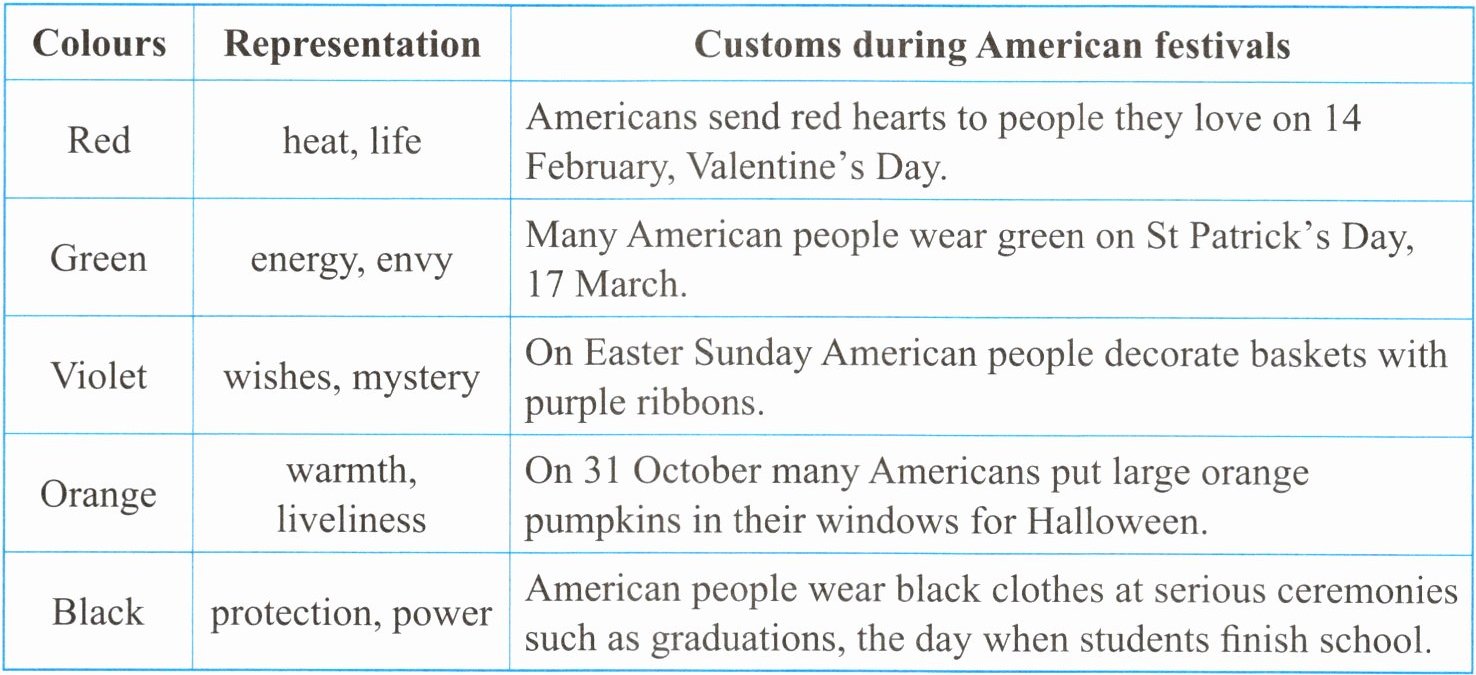 day American people decorate baskets with purple ribbons. |
| Orange | warmth, liveliness | On 31 October many Americans put large orange pumpkins in their windows for Halloween. |
| Black | protection, power | American people wear black clothes at serious ceremonies such as graduations, the day when students finish school. |
( ) 31. What colour do Americans prefer when they celebrate St Patrick’s Day?
A. Red.
B. Violet.
C. Green.
D. Orange.
( ) 32. How many festivals are mentioned in the form?
A. Two.
B. Three.
C. Four.
D. Five.
( ) 33. According to the form, which of the following is true?
A. Valentine’s Day falls on 14 March.
B. Red represents protection and power.
C. Orange is a special colour for Easter.
D. People wear black on their graduation day.
B
A
What custom (习俗) has something to do with colour on a certain American festival or a special day? Read the following and you'll find out!
| Colours | Representation | Customs during American festivals |
| ---- | ---- | ---- |
| Red | heat, life | Americans send red hearts to people they love on 14 February, Valentine’s Day. |
| Green | energy, envy | Many American people wear green on St Patrick’s Day, 17 March. |
| Violet | wishes, mystery | On Easter
day American people decorate baskets with purple ribbons. || Orange | warmth, liveliness | On 31 October many Americans put large orange pumpkins in their windows for Halloween. |
| Black | protection, power | American people wear black clothes at serious ceremonies such as graduations, the day when students finish school. |
( ) 31. What colour do Americans prefer when they celebrate St Patrick’s Day?
A. Red.
B. Violet.
C. Green.
D. Orange.
( ) 32. How many festivals are mentioned in the form?
A. Two.
B. Three.
C. Four.
D. Five.
( ) 33. According to the form, which of the following is true?
A. Valentine’s Day falls on 14 March.
B. Red represents protection and power.
C. Orange is a special colour for Easter.
D. People wear black on their graduation day.
B
答案
C
; C
; D
; C
; D
People have wondered about the nature of light and colour since ancient times. Once people thought that light came from the eye rather than coming into the eye. To see, light was projected (投射) from our eyes to illuminate (照亮) things as we look at them. Now we know that what we see is mostly reflected (被反射的) light. For example, the light from
the moon is reflected sunlight. Light comes from a light source, such as the sun, and either enters our eyes directly or after it has reflected off something.
In 1666 the English scientist Isaac Newton did an experiment with a glass prism (棱镜) and discovered that when sunlight passes through the prism, it separates into all of the visible colours. This clearly proved that light is made up of many different colours. The difference between colours is due to their wavelength. A prism separates light into different colours because each colour has a different wavelength. The angle (角度) at which a colour bends (折弯) in a prism depends on its wavelength. Colours with shorter wavelengths bend more than colours with longer wavelengths. This explains why red light bends less than yellow light. The reason is that red light has longer wavelength. Of the visible colours, violet light has the shortest wavelength, so it bends the most.
Further experiments proved that light could be mixed to form other colours. For example, red light mixed with yellow light creates an orange colour. Some colours, such as green light and magenta light, cancel each other out when mixed and result in a white light.
( ) 34. Now it is known that what we see is mostly ______.
A. moonlight B. sunlight
C. reflected light D. light from our eyes
( ) 35. What can we infer from Paragraph 2?
A. Light is made up of many different colours.
B. Different colours have different wavelengths.
C. Violet light has shorter wavelength than any other light, so it bends the most.
D. Red light bends less than violet light.
( ) 36. What is the main idea of the passage?
A. The nature of light and colour. B. Isaac Newton’s prism experiment.
C. The mixture of different colours. D. Wavelengths of different colours.
C
the moon is reflected sunlight. Light comes from a light source, such as the sun, and either enters our eyes directly or after it has reflected off something.
In 1666 the English scientist Isaac Newton did an experiment with a glass prism (棱镜) and discovered that when sunlight passes through the prism, it separates into all of the visible colours. This clearly proved that light is made up of many different colours. The difference between colours is due to their wavelength. A prism separates light into different colours because each colour has a different wavelength. The angle (角度) at which a colour bends (折弯) in a prism depends on its wavelength. Colours with shorter wavelengths bend more than colours with longer wavelengths. This explains why red light bends less than yellow light. The reason is that red light has longer wavelength. Of the visible colours, violet light has the shortest wavelength, so it bends the most.
Further experiments proved that light could be mixed to form other colours. For example, red light mixed with yellow light creates an orange colour. Some colours, such as green light and magenta light, cancel each other out when mixed and result in a white light.
( ) 34. Now it is known that what we see is mostly ______.
A. moonlight B. sunlight
C. reflected light D. light from our eyes
( ) 35. What can we infer from Paragraph 2?
A. Light is made up of many different colours.
B. Different colours have different wavelengths.
C. Violet light has shorter wavelength than any other light, so it bends the most.
D. Red light bends less than violet light.
( ) 36. What is the main idea of the passage?
A. The nature of light and colour. B. Isaac Newton’s prism experiment.
C. The mixture of different colours. D. Wavelengths of different colours.
C
答案
C
; D
; A
; D
; A
