

 登录
登录
十、植物也会有情绪吗?阅读短文,选择正确的答案。(10分)
Do plants have feelings?
Humans have feelings. Do plants have feelings too? A report says there is strong proof(证据) that plants do have “feelings”. They can feel things around them.
Scientists stimulate(刺激) the plants in different ways.
When someone waters a plant, the plant “feels” relaxed like a human.
In another test, a scientist hurts a plant. When that scientist walks near the plant, the plant reacts strongly. But when other scientists walk by, the plant does nothing. It only reacts when the “bad” scientist comes close.
In a different experiment(实验), a scientist put some shrimps(虾) into hot water. But the plants in another room react at the same time.
So, do plants really have feelings? You can try talking to your plants and see if that makes a difference(有影响).
(
A. Humans have feelings. B. Plants have no feelings. C. Plants have “feelings”.
(
A. When the scientist puts it into hot water.
B. When the scientist waters it.
C. When the scientist plants it.
(
A. 刺激 B. 反应 C. 记录
(
A. The plants and shrimps are in different places.
B. People put the plants into hot water.
C. The shrimps react to the plants.
(
A. In a storybook. B. In a cookbook. C. In a science magazine.
Do plants have feelings?
Humans have feelings. Do plants have feelings too? A report says there is strong proof(证据) that plants do have “feelings”. They can feel things around them.
Scientists stimulate(刺激) the plants in different ways.
When someone waters a plant, the plant “feels” relaxed like a human.
In another test, a scientist hurts a plant. When that scientist walks near the plant, the plant reacts strongly. But when other scientists walk by, the plant does nothing. It only reacts when the “bad” scientist comes close.
In a different experiment(实验), a scientist put some shrimps(虾) into hot water. But the plants in another room react at the same time.
So, do plants really have feelings? You can try talking to your plants and see if that makes a difference(有影响).
(
C
)1. What does the report tell us?A. Humans have feelings. B. Plants have no feelings. C. Plants have “feelings”.
(
B
)2. When does a plant feel relaxed like a human?A. When the scientist puts it into hot water.
B. When the scientist waters it.
C. When the scientist plants it.
(
B
)3. The word “reacts” means “”.A. 刺激 B. 反应 C. 记录
(
A
)4. Which is true according to Paragraph 5?A. The plants and shrimps are in different places.
B. People put the plants into hot water.
C. The shrimps react to the plants.
(
C
)5. Where can we read this passage?A. In a storybook. B. In a cookbook. C. In a science magazine.
答案
1.C 2.B 3.B 4.A 5.C
解析
1. 句意:报告告诉我们什么?
依据:A report says there is strong proof that plants do have “feelings”. They can feel things around them.
分析:报告说有证据表明植物有“感觉”,能对周围事物作出反应,故选 C。
2. 句意:植物什么时候像人一样感到放松?
依据:When someone waters a plant, the plant “feels” relaxed like a human.
分析:当给植物浇水时,它会感到放松,故选 B。
3. 句意:单词“reacts”的意思是“____”。
依据:In another test, a scientist hurts a plant. When that scientist walks near the plant, the plant reacts strongly. But when other scientists walk by, the plant does nothing.
分析:当其他科学家经过时,植物什么都不做。相反,当“坏”科学家靠近时,植物应会有“强烈”的举动,这是一种“反应”,故选 B。
4. 句意:根据第5段,哪一项是正确的?
依据:... a scientist put some shrimps into hot water. But the plants in another room react at the same time.
分析:虾和植物在不同的房间,故选 A。
5. 句意:我们可以在哪里读到这篇文章?
分析:文章主题是植物是否有感觉的科学发现,包含实验证据,最可能出现在科学杂志上,故选 C。
解析
1. 句意:报告告诉我们什么?
依据:A report says there is strong proof that plants do have “feelings”. They can feel things around them.
分析:报告说有证据表明植物有“感觉”,能对周围事物作出反应,故选 C。
2. 句意:植物什么时候像人一样感到放松?
依据:When someone waters a plant, the plant “feels” relaxed like a human.
分析:当给植物浇水时,它会感到放松,故选 B。
3. 句意:单词“reacts”的意思是“____”。
依据:In another test, a scientist hurts a plant. When that scientist walks near the plant, the plant reacts strongly. But when other scientists walk by, the plant does nothing.
分析:当其他科学家经过时,植物什么都不做。相反,当“坏”科学家靠近时,植物应会有“强烈”的举动,这是一种“反应”,故选 B。
4. 句意:根据第5段,哪一项是正确的?
依据:... a scientist put some shrimps into hot water. But the plants in another room react at the same time.
分析:虾和植物在不同的房间,故选 A。
5. 句意:我们可以在哪里读到这篇文章?
分析:文章主题是植物是否有感觉的科学发现,包含实验证据,最可能出现在科学杂志上,故选 C。
十一、Lily 是转来的新同学。请根据图片,帮 Lily 作自我介绍。(不少于5句话)(7分)
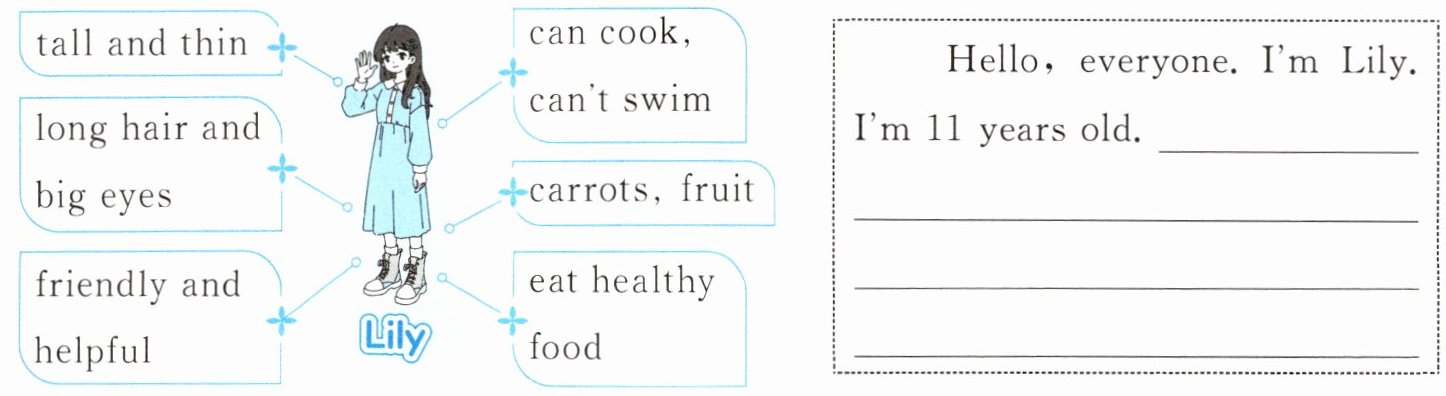
Hello, everyone. I'm Lily.
I'm 11 years old.
Hello, everyone. I'm Lily.
I'm 11 years old.
I am tall and thin with long hair and big eyes.
I am friendly and helpful.
I can cook, but I can't swim.
I like carrots and fruit, and I always eat healthy food. I'm happy to be your friend.
答案
示例:Hello, everyone. I'm Lily. I'm 11 years old. I am tall and thin with long hair and big eyes. I am friendly and helpful. I can cook, but I can't swim. I like carrots and fruit, and I always eat healthy food. I'm happy to be your friend.
解析
写作思路
1. 外貌描述:结合 tall and thin 和 long hair and big eyes 描述外貌;
2. 性格特点:用 friendly and helpful 描述性格;
3. 能力:结合 can cook 和 can't swim 说明特长和不足;
4. 饮食习惯:结合 eat healthy food、carrots、fruit 写健康饮食习惯;
5. 结尾可以加一句友好的表达,比如“I'm happy to be your friend.”。
注意事项
1. 覆盖思维导图里的所有关键信息(外貌、性格、能力、饮食习惯);
2. 描述外貌/性格用“I'm+形容词.”,描述能力用“I can/can't+动词原形.”;
3. 不少于5句话。
解析
写作思路
1. 外貌描述:结合 tall and thin 和 long hair and big eyes 描述外貌;
2. 性格特点:用 friendly and helpful 描述性格;
3. 能力:结合 can cook 和 can't swim 说明特长和不足;
4. 饮食习惯:结合 eat healthy food、carrots、fruit 写健康饮食习惯;
5. 结尾可以加一句友好的表达,比如“I'm happy to be your friend.”。
注意事项
1. 覆盖思维导图里的所有关键信息(外貌、性格、能力、饮食习惯);
2. 描述外貌/性格用“I'm+形容词.”,描述能力用“I can/can't+动词原形.”;
3. 不少于5句话。
