

 登录
登录
Ⅶ.连词成句。
1. often, strong, dangerous, winds, are (.)
2. day, a, tomorrow, be, it, fine, will (.)
3. of, be, weather, careful, bad (.)
4. on, there, fog, the, sea, is, often (.)
5. people, tell, trip, your, about (.)
1. often, strong, dangerous, winds, are (.)
2. day, a, tomorrow, be, it, fine, will (.)
3. of, be, weather, careful, bad (.)
4. on, there, fog, the, sea, is, often (.)
5. people, tell, trip, your, about (.)
答案
1. Strong winds are often dangerous.
2. It will be a fine day tomorrow.
3. Be careful of bad weather.
4. There is often fog on the sea.
5. Tell people about your trip.
2. It will be a fine day tomorrow.
3. Be careful of bad weather.
4. There is often fog on the sea.
5. Tell people about your trip.
解析
本题考查五年级上册核心句型的连词成句,解题时先判断句子类型,结合所学固定搭配、句型结构排序即可:
1. 为主系表结构陈述句,先确定主语strong winds,频度副词often放在be动词are之前,后接表语dangerous。
2. 为一般将来时陈述句,主语it后接will+动词原形be的结构,搭配a fine day,最后放时间状语tomorrow。
3. 为祈使句,用固定搭配be careful of,后接宾语bad weather。
4. 为there be句型陈述句,there is开头,频度副词often放在be动词后,接主语fog,最后接地点状语on the sea。
5. 为祈使句,动词tell开头,搭配固定结构tell sb. about sth. 组合词汇即可。
1. 为主系表结构陈述句,先确定主语strong winds,频度副词often放在be动词are之前,后接表语dangerous。
2. 为一般将来时陈述句,主语it后接will+动词原形be的结构,搭配a fine day,最后放时间状语tomorrow。
3. 为祈使句,用固定搭配be careful of,后接宾语bad weather。
4. 为there be句型陈述句,there is开头,频度副词often放在be动词后,接主语fog,最后接地点状语on the sea。
5. 为祈使句,动词tell开头,搭配固定结构tell sb. about sth. 组合词汇即可。
Ⅷ.学校板报出了极端天气的提示,请为它们匹配正确的句子。
1. 2. 3. 4.
A. There is heavy rain.
B. There is a strong wind.
C. There is heavy snow.
D. It is too hot.
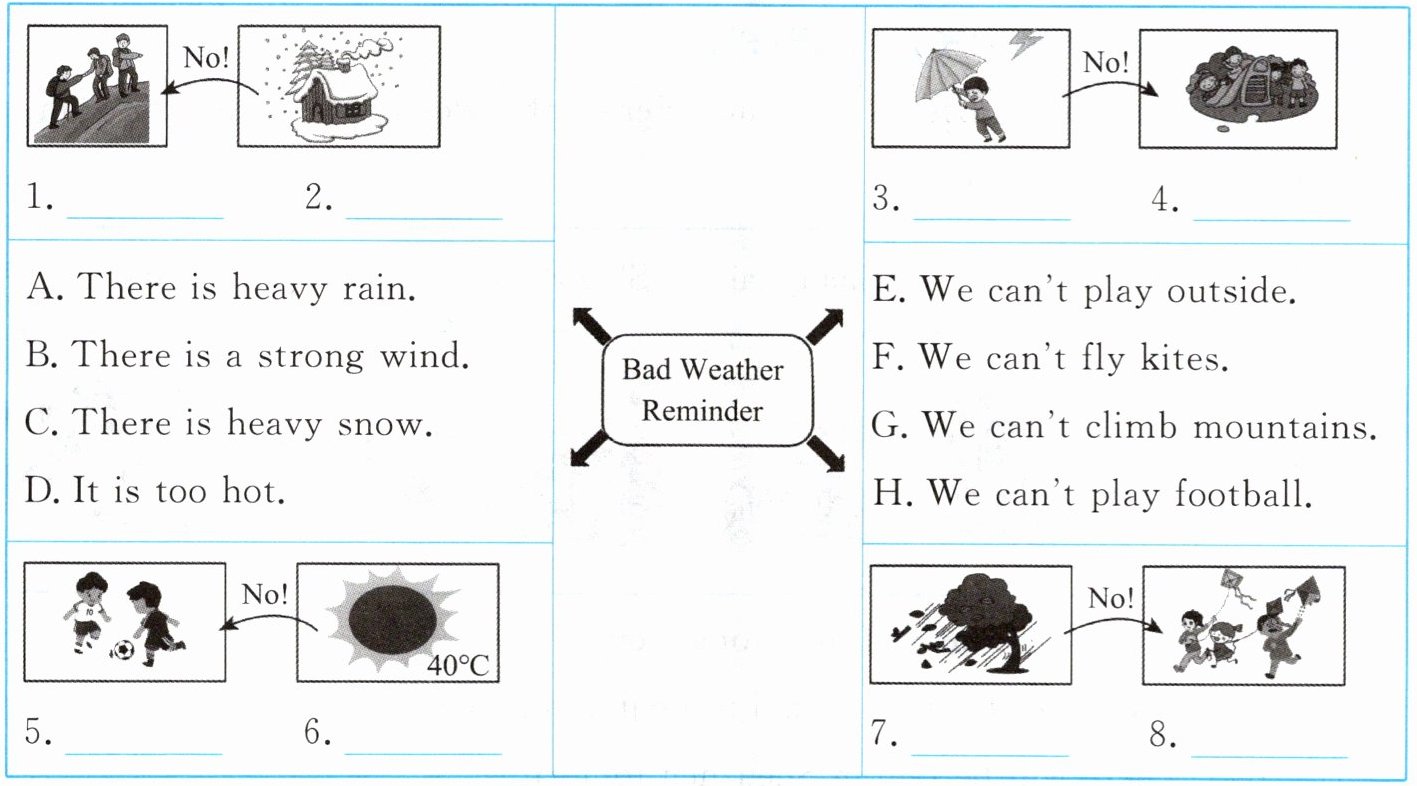
E. We can't play outside.
F. We can't fly kites.
G. We can't climb mountains.
H. We can't play football.
5. 6. 7. 8.
1. 2. 3. 4.
A. There is heavy rain.
B. There is a strong wind.
C. There is heavy snow.
D. It is too hot.
E. We can't play outside.
F. We can't fly kites.
G. We can't climb mountains.
H. We can't play football.
5. 6. 7. 8.
答案
1.G 2.C 3.A 4.E 5.H 6.D 7.B 8.F
解析
【解析】
1. 观察第1组图:左侧是登山的人物,标注No表示该行为被禁止,对应描述为“我们不能爬山”,匹配G选项。
2. 第1组右侧图是飘雪的房屋场景,对应描述“下大雪了”,匹配C选项。
3. 观察第2组图:左侧是打伞遇雷雨的场景,对应描述“下大雨了”,匹配A选项。
4. 第2组右侧图是小朋友们待在游乐区,标注No表示该行为被禁止,对应描述“我们不能在外面玩耍”,匹配E选项。
5. 观察第3组图:左侧是踢足球的人物,标注No表示该行为被禁止,对应描述“我们不能踢足球”,匹配H选项。
6. 第3组右侧图是显示40℃的烈日场景,对应描述“天气太热了”,匹配D选项。
7. 观察第4组图:左侧是被强风吹动的树木场景,对应描述“刮大风了”,匹配B选项。
8. 第4组右侧图是准备放风筝的人物,标注No表示该行为被禁止,对应描述“我们不能放风筝”,匹配F选项。
【答案】
1.G 2.C 3.A 4.E 5.H 6.D 7.B 8.F
【知识点】
图文匹配;情景交际;天气类词汇
【点评】
本题结合趣味插图考查极端天气场景和对应行为禁令的匹配,需要学生结合图片信息理解句意,将天气描述和禁止的户外活动一一对应,贴合生活实际,难度适中。
【难度系数】
0.8
1. 观察第1组图:左侧是登山的人物,标注No表示该行为被禁止,对应描述为“我们不能爬山”,匹配G选项。
2. 第1组右侧图是飘雪的房屋场景,对应描述“下大雪了”,匹配C选项。
3. 观察第2组图:左侧是打伞遇雷雨的场景,对应描述“下大雨了”,匹配A选项。
4. 第2组右侧图是小朋友们待在游乐区,标注No表示该行为被禁止,对应描述“我们不能在外面玩耍”,匹配E选项。
5. 观察第3组图:左侧是踢足球的人物,标注No表示该行为被禁止,对应描述“我们不能踢足球”,匹配H选项。
6. 第3组右侧图是显示40℃的烈日场景,对应描述“天气太热了”,匹配D选项。
7. 观察第4组图:左侧是被强风吹动的树木场景,对应描述“刮大风了”,匹配B选项。
8. 第4组右侧图是准备放风筝的人物,标注No表示该行为被禁止,对应描述“我们不能放风筝”,匹配F选项。
【答案】
1.G 2.C 3.A 4.E 5.H 6.D 7.B 8.F
【知识点】
图文匹配;情景交际;天气类词汇
【点评】
本题结合趣味插图考查极端天气场景和对应行为禁令的匹配,需要学生结合图片信息理解句意,将天气描述和禁止的户外活动一一对应,贴合生活实际,难度适中。
【难度系数】
0.8
Ⅸ.从方框中选择合适的选项,补全对话。
(Lily is in Sanya. She is on the phone with Jim. Jim is in Beijing.)
Lily: Hi, Jim! What's the weather like in Beijing?
Jim: 1. How about Sanya? 2.
Lily: No, it isn't. 3. There's a strong wind and heavy rain here.
Jim: Typhoon? That sounds really scary(吓人的)!
Lily: Yeah! We must be careful.
Jim: 4.
Lily: No, we can't. It's dangerous. Maybe the wind could hurt people. 5.
Jim: Oh! Be careful, Lily. I hope the typhoon passes soon and you can stay safe all the time.
Lily: OK. Thanks for caring(关怀), Jim.
A. Can you go outside?
B. It's a fine day today.
C. A typhoon(台风)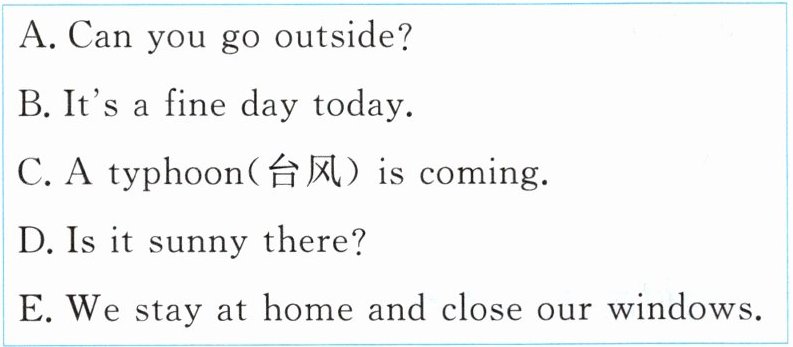 coming.
D. Is it sunny there?
E. We stay at home and close our windows.
(Lily is in Sanya. She is on the phone with Jim. Jim is in Beijing.)
Lily: Hi, Jim! What's the weather like in Beijing?
Jim: 1. How about Sanya? 2.
Lily: No, it isn't. 3. There's a strong wind and heavy rain here.
Jim: Typhoon? That sounds really scary(吓人的)!
Lily: Yeah! We must be careful.
Jim: 4.
Lily: No, we can't. It's dangerous. Maybe the wind could hurt people. 5.
Jim: Oh! Be careful, Lily. I hope the typhoon passes soon and you can stay safe all the time.
Lily: OK. Thanks for caring(关怀), Jim.
A. Can you go outside?
B. It's a fine day today.
C. A typhoon(台风)
coming.D. Is it sunny there?
E. We stay at home and close our windows.
答案
1. B 2. D 3. C 4. A 5. E
解析
我们结合对话上下文逻辑逐一匹配选项:
1. 第一空是Jim回应Lily询问北京天气的问题,B选项“今天天气很好”符合对天气的回答。
2. 第二空后Lily用“No, it isn't.”作答,说明此处是Is引导的一般疑问句,D选项“那里是晴天吗?”符合语境。
3. 第三空后提到当地有强风暴雨,后文Jim也提到了台风,C选项“台风要来了”可以衔接前后内容。
4. 第四空后Lily用“No, we can't.”作答,说明此处是Can引导的一般疑问句,A选项“你们能外出吗?”符合问答逻辑。
5. 第五空前提到台风天外出很危险,E选项“我们待在家里关上窗户”是对应的安全做法,符合语境。
1. 第一空是Jim回应Lily询问北京天气的问题,B选项“今天天气很好”符合对天气的回答。
2. 第二空后Lily用“No, it isn't.”作答,说明此处是Is引导的一般疑问句,D选项“那里是晴天吗?”符合语境。
3. 第三空后提到当地有强风暴雨,后文Jim也提到了台风,C选项“台风要来了”可以衔接前后内容。
4. 第四空后Lily用“No, we can't.”作答,说明此处是Can引导的一般疑问句,A选项“你们能外出吗?”符合问答逻辑。
5. 第五空前提到台风天外出很危险,E选项“我们待在家里关上窗户”是对应的安全做法,符合语境。
