

 登录
五、听录音,根据所听内容,完成表格。(听三遍)
Better changes, better me!
(1)
Looks • (2)
Abilities • knew few (4)
• was afraid of (5)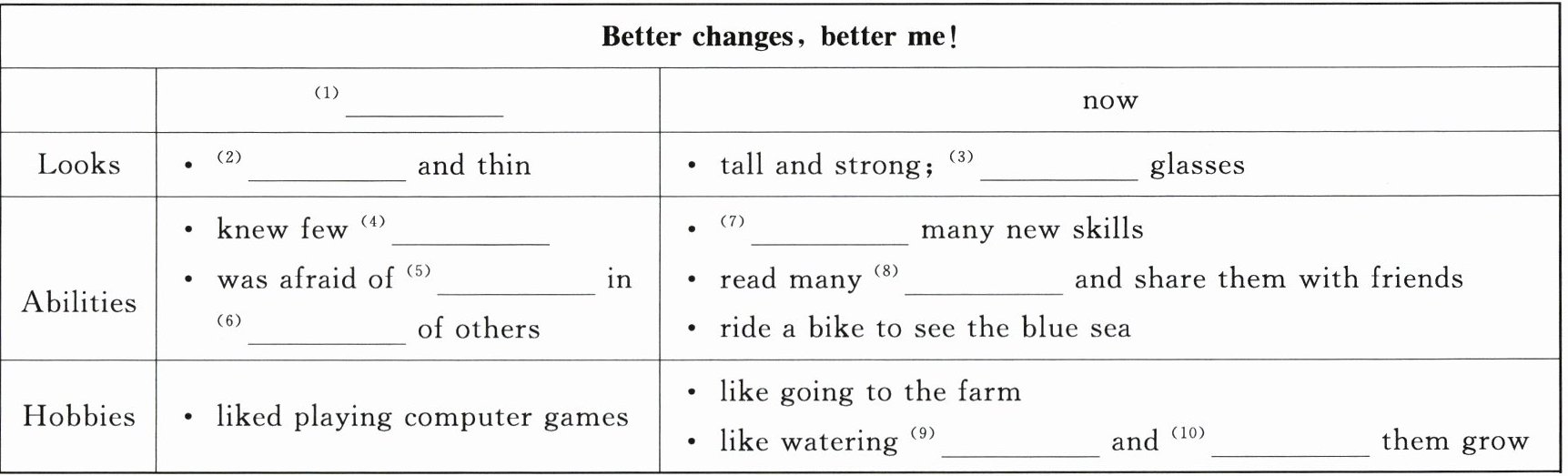 many new skills
• read many (8)
• ride a bike to see the blue sea
Hobbies • liked playing computer games • like going to the farm
• like watering (9)
Better changes, better me!
(1)
then
nowLooks • (2)
short
and thin • tall and strong;(3)wear
glassesAbilities • knew few (4)
words
• was afraid of (5)
speaking
in (6)front
of others • (7) many new skills• read many (8)
storybooks
and share them with friends• ride a bike to see the blue sea
Hobbies • liked playing computer games • like going to the farm
• like watering (9)
vegetables
and (10)watching
them grow答案
1. then 2. short 3. wear 4. words 5. speaking 6. front 7. learn 8. storybooks 9. vegetables 10. watching
六、从方框里选择合适的句子完成对话,将序号填在横线上。
A: Hi, Linda! (1)
B: Yes, I did. I went on a trip.
A: (2)
B: It was great! I visited a waste water plant(污水处理厂).
A: Sounds interesting! (3)
B: We watched how workers cleaned dirty water.
A: (4)
B: Sure! I learned clean water is very important. (5)
A: Great. We should reuse water.
B: You are right. (6)
A: Good idea!
A. Let's save water together.
B. What did you do there?
C. Did you have a special day last Sunday?
D. How was your trip?
E. Did you learn anything from the trip?
F. I shouldn't waste water from now on.
A: Hi, Linda! (1)
C
B: Yes, I did. I went on a trip.
A: (2)
D
B: It was great! I visited a waste water plant(污水处理厂).
A: Sounds interesting! (3)
B
B: We watched how workers cleaned dirty water.
A: (4)
E
B: Sure! I learned clean water is very important. (5)
F
A: Great. We should reuse water.
B: You are right. (6)
A
A: Good idea!
A. Let's save water together.
B. What did you do there?
C. Did you have a special day last Sunday?
D. How was your trip?
E. Did you learn anything from the trip?
F. I shouldn't waste water from now on.
答案
1. C 2. D 3. B 4. E 5. F 6. A
解析
【分析】
本题为补全对话题型,解题核心是结合上下文的问答逻辑匹配句子:首先根据答语的句式、内容,对应选择合适的问句或答句。1. 答语以“Yes, I did.”开头,说明问句是Did引导的一般疑问句,对应选项C;2. 答语是评价旅行的感受,对应询问旅行情况的选项D;3. 答语是在污水处理厂做的具体活动,对应询问活动内容的选项B;4. 答语提到从旅行中学习到的内容,对应询问是否有收获的选项E;5. 结合前文“水很重要”的表述,对应表达不浪费水的选项F;6. 答语是对建议的认可,对应提出节水建议的选项A。
【解析】
1. 根据答语“Yes, I did.”可知,此处需用Did引导的一般疑问句,选项C符合,故填C;
2. 根据答语“It was great!”可知,此处询问旅行的感受,选项D符合,故填D;
3. 根据答语“We watched how workers cleaned dirty water.”可知,此处询问在污水处理厂做的事,选项B符合,故填B;
4. 根据答语“Sure! I learned clean water is very important.”可知,此处询问是否从旅行中学到东西,选项E符合,故填E;
5. 结合前文提到的“水很重要”,此处表达自己不浪费水的想法,选项F符合,故填F;
6. 根据答语“Good idea!”可知,此处提出建议,选项A符合,故填A。
【答案】
1.C 2.D 3.B 4.E 5.F 6.A
【知识点】
情景交际、补全对话
【点评】
本题是基础的情景交际补全对话,考查学生日常对话的逻辑匹配能力,只需结合上下文的问答关系即可选出正确选项,难度较低。
【难度系数】
0.6
七、阅读理解。
A
Most children learn honesty from fairy tales. Pinocchio's nose grows longer when he lies. Stories tell children “Honesty is the best policy.” (1)
People lie because they want to hide mistakes. Everyone does something wrong from time to time. (2)
make an excuse. People often do this when they don't want to tell the truth. However, people sometimes tell a “white lie”. For example, if your friend has an ugly haircut, you can say it's special instead of “It looks terrible.” (3)
People lie for many reasons. (4)
(一)从方框中选择恰当的句子补全短文,使短文内容完整、连贯。(其中有一项多余)
A. These lies help keep good relationships.
B. Lying to keep the peace can have good results.
C. But people have no courage(勇气) to say they are wrong.
D. But people still lie for many reasons.
E. People lie to avoid difficulties.
(二)阅读短文,判断正(T)误(F)。
(
(
(
(
A
Most children learn honesty from fairy tales. Pinocchio's nose grows longer when he lies. Stories tell children “Honesty is the best policy.” (1)
D
People lie because they want to hide mistakes. Everyone does something wrong from time to time. (2)
C
For example, students may lie about not finishing homework, saying they leave it at home, just to avoid(避免) trouble. Sometimes people lie to get away from things they don't want to face. For example, if someone invites you to his party, you may not want to go. You maymake an excuse. People often do this when they don't want to tell the truth. However, people sometimes tell a “white lie”. For example, if your friend has an ugly haircut, you can say it's special instead of “It looks terrible.” (3)
A
People lie for many reasons. (4)
B
But lying to avoid trouble may bring more trouble in the end. If we know why people lie, we may lie less.(一)从方框中选择恰当的句子补全短文,使短文内容完整、连贯。(其中有一项多余)
A. These lies help keep good relationships.
B. Lying to keep the peace can have good results.
C. But people have no courage(勇气) to say they are wrong.
D. But people still lie for many reasons.
E. People lie to avoid difficulties.
(二)阅读短文,判断正(T)误(F)。
(
F
) 5. Pinocchio's nose grows longer when he tells the truth.(
F
) 6. Students may lie about not finishing homework to get praise.(
F
) 7. A “white lie” is always harmful to relationships.(
T
) 8. Lying to avoid trouble may cause more trouble in the end.答案
(一)1. D 2. C 3. A 4. B
(二)5. F 6. F 7. F 8. T
解析
【分析】
本题分为两部分解题:第一部分补全短文,需通读全文梳理段落逻辑,结合上下文的衔接关系匹配选项;第二部分判断正误,需定位原文细节,对比题干与原文表述的一致性,注意细节偷换、概念混淆等问题。
【解析】
(一)补全短文:
1. 第一段前半部分讲孩子从童话学习诚实,后半段转向人们撒谎的原因,为转折引出话题,对应选项D(But people still lie for many reasons.);
2. 第二段前半部分提到人们撒谎是想掩盖错误,下文举学生撒谎的例子,说明人们没勇气承认错误,对应选项C;
3. 第二段介绍“善意的谎言”的例子,对应选项A(These lies help keep good relationships.);
4. 第三段前半部分讲撒谎的原因,后半段讲撒谎避免麻烦的结果,对应选项B(Lying to keep the peace can have good results.)。
(二)判断正误:
5. 原文明确“Pinocchio's nose grows longer when he lies”,题干说“说实话”,表述错误,故F;
6. 原文提到学生撒谎是为了“avoid trouble”,题干说“get praise”,表述错误,故F;
7. 原文指出善意的谎言是为了维持好关系,题干说“有害”,表述错误,故F;
8. 原文明确“lying to avoid trouble may bring more trouble in the end”,题干表述一致,故T。
【答案】
(一)1. D 2. C 3. A 4. B;(二)5. F 6. F 7. F 8. T
【知识点】
英语阅读理解、补全短文、判断正误
【点评】
本题考查英语阅读理解的核心题型,要求学生掌握语篇逻辑分析和细节定位能力,需仔细梳理上下文关联与原文细节,避免概念混淆。
【难度系数】
0.6
