

 登录
阅读短文,用英文填空或回答问题。(请注意每小题的词数要求)
Every year, many visitors come to Beijing to see the Great Wall and the Palace Museum. Also, the hutongs often leave a very deep impression(深刻的印象) on them.
Most of Beijing's hutongs appeared between the 13th and 19th centuries during the Yuan, Ming and Qing dynasties. To help them keep control over the city, the emperors(皇帝) built the hutongs around courtyards. So, they could have their men stand at the entrances(入口) of the hutongs to keep an eye on people.
By connecting people's houses, the hutongs in fact connected people's lives, whether the rich's or the poor's. Because the houses in a courtyard were facing each other, the families there were an important part of each other's lives. They helped each other and shared the happiness and sadness of everyday life. Because of the hutongs, many courtyards joined together. This helped create a place of people working, playing and living together—a real community.
At the end of the Qing Dynasty, conditions in Beijing's hutongs went down as the country was facing many problems. People quickly built more new hutongs to house the growing population, but they didn't build them well. When the People's Republic of China was set up, the government worked hard to improve the conditions of the hutongs and make them better.
Nowadays, the hutongs are still an important part of the life in Beijing. And it's not surprising that visitors love them. People can walk through these hutongs and enjoy themselves. The hutongs connect not only Beijing's streets and houses but also its past and present.
46. The emperors built the hutongs to
47. Paragraph 3 mainly talks about
48. & 49. Fill in the blanks according to the passage.
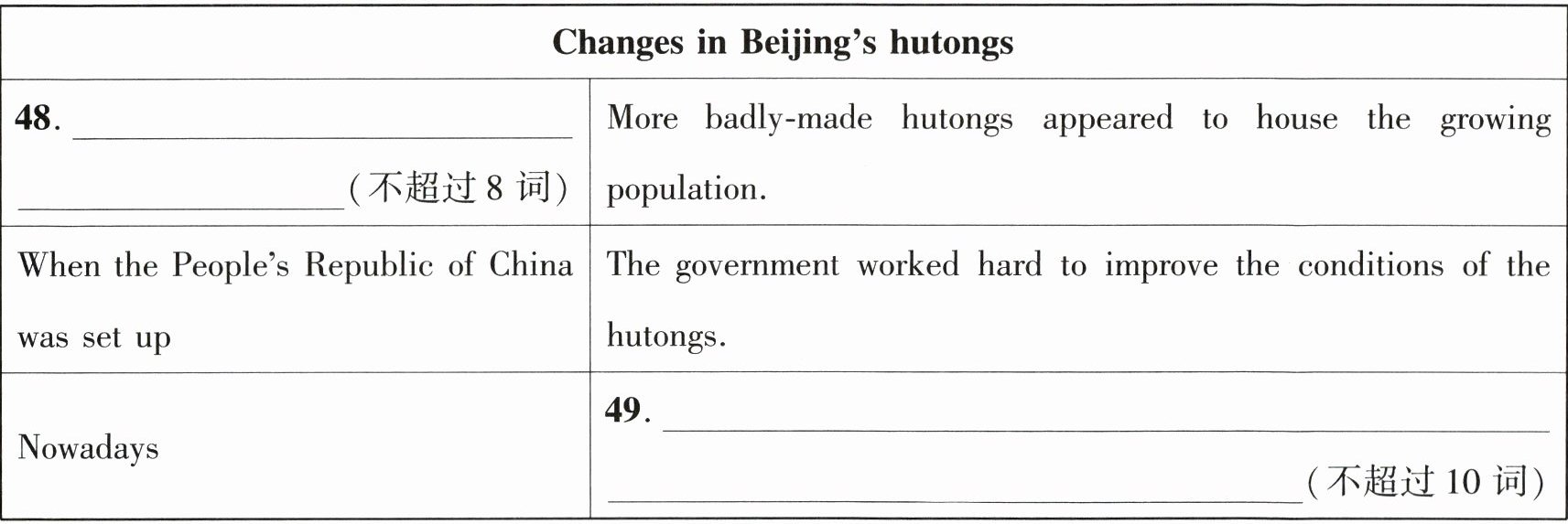
Changes in Beijing's hutongs
48.
When the People's Republic of China was set up | The government worked hard to improve the conditions of the hutongs.
Nowadays | 49.
50. What do you think of the hutongs? Use your own words.
Every year, many visitors come to Beijing to see the Great Wall and the Palace Museum. Also, the hutongs often leave a very deep impression(深刻的印象) on them.
Most of Beijing's hutongs appeared between the 13th and 19th centuries during the Yuan, Ming and Qing dynasties. To help them keep control over the city, the emperors(皇帝) built the hutongs around courtyards. So, they could have their men stand at the entrances(入口) of the hutongs to keep an eye on people.
By connecting people's houses, the hutongs in fact connected people's lives, whether the rich's or the poor's. Because the houses in a courtyard were facing each other, the families there were an important part of each other's lives. They helped each other and shared the happiness and sadness of everyday life. Because of the hutongs, many courtyards joined together. This helped create a place of people working, playing and living together—a real community.
At the end of the Qing Dynasty, conditions in Beijing's hutongs went down as the country was facing many problems. People quickly built more new hutongs to house the growing population, but they didn't build them well. When the People's Republic of China was set up, the government worked hard to improve the conditions of the hutongs and make them better.
Nowadays, the hutongs are still an important part of the life in Beijing. And it's not surprising that visitors love them. People can walk through these hutongs and enjoy themselves. The hutongs connect not only Beijing's streets and houses but also its past and present.
46. The emperors built the hutongs to
help them keep control over the city
.(不超过8词)47. Paragraph 3 mainly talks about
the role of hutongs in people’s lives
.(不超过8词)48. & 49. Fill in the blanks according to the passage.
Changes in Beijing's hutongs
48.
At the end of the Qing Dynasty
(不超过8词) | More badly-made hutongs appeared to house the growing population.When the People's Republic of China was set up | The government worked hard to improve the conditions of the hutongs.
Nowadays | 49.
Hutongs are still important to the life in Beijing.
(不超过10词)50. What do you think of the hutongs? Use your own words.
They are a precious symbol of Beijing's history and culture.
(不超过20词)答案
46. help them keep control over the city
47. the role of hutongs in people’s lives
48. At the end of the Qing Dynasty
49. Hutongs are still important to the life in Beijing./Hutongs connect Beijing’s past and present.
50. They are a precious symbol of Beijing’s history and culture./They show Beijing’s past and present./ They are great places for visitors.
解析
【分析】要完成48题,需定位到描述“劣质胡同出现以容纳增长人口”的时间,对应原文第四段开头;完成49题,需定位到“如今”对应的最后一段,提取关于胡同现状的关键信息,同时满足词数限制。
【解析】48题:根据原文第四段“At the end of the Qing Dynasty, conditions in Beijing's hutongs went down... People quickly built more new hutongs to house the growing population, but they didn't build them well.”,可知该事件发生在清末,即At the end of the Qing Dynasty,符合不超过8词的要求;49题:根据最后一段“Nowadays, the hutongs are still an important part of the life in Beijing.”,提取符合不超过10词的内容,即Hutongs are still important to Beijing's life。
【答案】48. At the end of the Qing Dynasty;49. Hutongs are still important to Beijing's life
【知识点】英语阅读理解、细节信息提取
【点评】本题考查对文章细节的定位与信息提取能力,需准确匹配题干与原文内容,注意词数限制,难度中等。
【难度系数】0.5
