

 登录
3. 汽车遇到意外情况时,紧急停车要经历司机的反应和制动两个过程,汽车在司机的反应过程中做匀速直线运动,在制动过程中做变速直线运动,如图3所示。若汽车在平直的公路上匀速行驶,紧急停车时,反应过程中所用的时间为0.5 s,汽车行驶了10 m;制动过程中所用的时间为2.5 s,制动过程中的平均速度为8 m/s。求:
(1)汽车在司机反应过程中的平均速度;
(2)汽车在制动过程中行驶的路程;
(3)紧急停车全程的平均速度。

(1)汽车在司机反应过程中的平均速度;
(2)汽车在制动过程中行驶的路程;
(3)紧急停车全程的平均速度。
答案
解:
(1) 汽车在司机反应过程中的平均速度:
$v_1 = \frac{s_1}{t_1} = \frac{10\ \mathrm{m}}{0.5\ \mathrm{s}} = 20\ \mathrm{m/s}$
(2) 汽车在制动过程中行驶的路程:
$s_2 = v_2 t_2 = 8\ \mathrm{m/s} × 2.5\ \mathrm{s} = 20\ \mathrm{m}$
(3) 紧急停车全程的总路程:
$s_{\mathrm{总}} = s_1 + s_2 = 10\ \mathrm{m} + 20\ \mathrm{m} = 30\ \mathrm{m}$
全程的总时间:
$t_{\mathrm{总}} = t_1 + t_2 = 0.5\ \mathrm{s} + 2.5\ \mathrm{s} = 3\ \mathrm{s}$
全程的平均速度:
$v_{\mathrm{总}} = \frac{s_{\mathrm{总}}}{t_{\mathrm{总}}} = \frac{30\ \mathrm{m}}{3\ \mathrm{s}} = 10\ \mathrm{m/s}$
答:(1) 汽车在司机反应过程中的平均速度为20 m/s;(2) 汽车在制动过程中行驶的路程为20 m;(3) 紧急停车全程的平均速度为10 m/s。
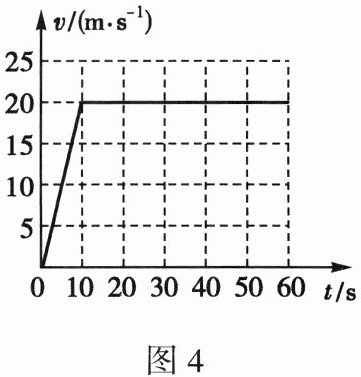
4.汽车出厂前要进行测试。某次测试中,汽车在公路上行驶,其v-t图像如图4所示,已知汽车在前10 s行驶了100 m,然后又沿直线匀速行驶了4 min。求:
(1)0~10 s内汽车的平均速度;
(2)汽车行驶的总路程;
(3)汽车行驶全程的平均速度。
(1)0~10 s内汽车的平均速度;
(2)汽车行驶的总路程;
(3)汽车行驶全程的平均速度。
答案
解:
(1) 0~10 s内汽车的平均速度:
$v_1 = \frac{s_1}{t_1} = \frac{100\ \mathrm{m}}{10\ \mathrm{s}} = 10\ \mathrm{m/s}$
(2) 由v-t图像可知,汽车匀速行驶的速度$v_2=20\ \mathrm{m/s}$,
匀速行驶的时间$t_2=4\ \mathrm{min}=4×60\ \mathrm{s}=240\ \mathrm{s}$,
匀速阶段行驶的路程:
$s_2 = v_2 t_2 = 20\ \mathrm{m/s} × 240\ \mathrm{s} = 4800\ \mathrm{m}$
汽车行驶的总路程:
$s = s_1 + s_2 = 100\ \mathrm{m} + 4800\ \mathrm{m} = 4900\ \mathrm{m}$
(3) 汽车行驶全程的总时间:
$t_{\mathrm{总}} = t_1 + t_2 = 10\ \mathrm{s} + 240\ \mathrm{s} = 250\ \mathrm{s}$
全程的平均速度:
$v_{\mathrm{总}} = \frac{s}{t_{\mathrm{总}}} = \frac{4900\ \mathrm{m}}{250\ \mathrm{s}} = 19.6\ \mathrm{m/s}$
答:(1) 0~10 s内汽车的平均速度为10 m/s;(2) 汽车行驶的总路程为4900 m;(3) 汽车行驶全程的平均速度为19.6 m/s。
