

 登录
Would sitting in heavy traffic for half an hour make you impatient? I suppose that even the calmest among us would easily say “Yes!” After all, patience fails everyone at some point or another.
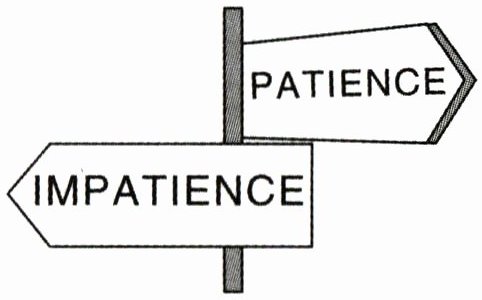
Great thinkers and poets have told us that patience is a virtue(美德). The idea suggests that people either have it or don’t, and that having it is always good. But as a behavioural scientist, I think about patience differently. To me, it’s far more interesting and useful to see patience as something we do rather than something we have—a process rather than just a virtue.
We all know the feelings: fingers-drumming on the table, legs shaking, nearly jumping out of our seats with a strong wish to end whatever makes us lose our cool. But why do we feel impatient? Dutch psychologist(心理学家)Marcel Zeolenberg created the phrase “feeling is for doing” to explain this. When we are impatient, our mind and body push us to fix the problem. For example, we might try to find a shortcut in traffic or politely end a friend’s long and boring speech.
Even though feeling impatient is normal, it can cause problems and lead to failure in serious situations. Therefore, it’s important for us to learn to deal with this feeling. The best method is to distract(使分散注意力)ourselves with other activities. Do you feel awful while you’re waiting for your exam results? Go out and play sports with your friends. This way, you’ll be able to stay calm and patient soon.
There’s still a lot we don’t know about patience, including why some people seem to find it easier than others. Luckily, patience can be developed when we learn to manage our feelings. It just takes a little time and practice.
(
A. By listing some facts.
B. By sharing personal experiences.
C. By raising a direct question.
D. By comparing different opinions.
(
A. It’s a process that can be managed.
B. It is most valuable under pressure.
C. It’s a special gift that few people have.
D. It is a virtue that everyone should have.
(
A. To describe patient behaviour.
B. To help explain the cause of impatience.
C. To introduce the importance of being patient.
D. To show a new method to deal with feelings.
(
A. It’s harder for people today to develop patience.
B. It only takes a little practice to manage feelings.
C. Taking exams can help students develop patience.
D. Paying attention to other tasks helps us calm down.
Great thinkers and poets have told us that patience is a virtue(美德). The idea suggests that people either have it or don’t, and that having it is always good. But as a behavioural scientist, I think about patience differently. To me, it’s far more interesting and useful to see patience as something we do rather than something we have—a process rather than just a virtue.
We all know the feelings: fingers-drumming on the table, legs shaking, nearly jumping out of our seats with a strong wish to end whatever makes us lose our cool. But why do we feel impatient? Dutch psychologist(心理学家)Marcel Zeolenberg created the phrase “feeling is for doing” to explain this. When we are impatient, our mind and body push us to fix the problem. For example, we might try to find a shortcut in traffic or politely end a friend’s long and boring speech.
Even though feeling impatient is normal, it can cause problems and lead to failure in serious situations. Therefore, it’s important for us to learn to deal with this feeling. The best method is to distract(使分散注意力)ourselves with other activities. Do you feel awful while you’re waiting for your exam results? Go out and play sports with your friends. This way, you’ll be able to stay calm and patient soon.
There’s still a lot we don’t know about patience, including why some people seem to find it easier than others. Luckily, patience can be developed when we learn to manage our feelings. It just takes a little time and practice.
(
C
)27. How is the topic introduced in the first paragraph?A. By listing some facts.
B. By sharing personal experiences.
C. By raising a direct question.
D. By comparing different opinions.
(
A
)28. What does the writer say about patience?A. It’s a process that can be managed.
B. It is most valuable under pressure.
C. It’s a special gift that few people have.
D. It is a virtue that everyone should have.
(
B
)29. Why is the Dutch psychologist mentioned in the third paragraph?A. To describe patient behaviour.
B. To help explain the cause of impatience.
C. To introduce the importance of being patient.
D. To show a new method to deal with feelings.
(
D
)30. Which of the following may the writer agree with?A. It’s harder for people today to develop patience.
B. It only takes a little practice to manage feelings.
C. Taking exams can help students develop patience.
D. Paying attention to other tasks helps us calm down.
答案
27. C 28. A 29. B 30. D
