

 登录
4. 如图,在$△ ABC$中, $∠ A = 60°$,在AC上截取$AD = AB$,$E$为$AB$上一点,且$BE = CD$,过点$E$作$BD$的垂线,分别交$BD$, $BC$于点$F$,$G$,连接$EC$交$BD$于点$H$.
(1)若$E$为$AB$的中点,$BD = 4$,求$BF$的长;
(2)求证:$FH = DH + \frac{1}{2}BE$.
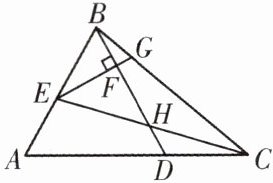
(1)若$E$为$AB$的中点,$BD = 4$,求$BF$的长;
(2)求证:$FH = DH + \frac{1}{2}BE$.
答案
(1)$\because ∠A = 60°,AD = AB$,
$\therefore △ABD$ 为等边三角形,
$\therefore AB = BD = 4$.
$\because E$ 为 $AB$ 的中点,
$\therefore BE = 2$.
在 $\mathrm{Rt}△EBF$ 中, $∠EBF = 60°$,
$\therefore ∠BEF = 30°$,
$\therefore BF = \frac{1}{2}BE = 1$.
(2)如图, 取 $FM = BF$, 由 $EF ⊥ BM, BF = FM$, 知 $BE = EM = CD$.
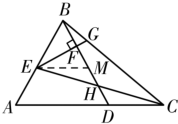
又$\because ∠BEF = ∠FEM = 30°$,
$\therefore ∠BEM = ∠A = 60°$,
$\therefore EM// AC$,
$\therefore ∠MEH = ∠HCD$.
在$△EMH$ 和$△CDH$ 中,
$\begin{cases}∠MEH = ∠DCH,\\∠EHM = ∠CHD,\\EM = CD,\end{cases}$
$\therefore △EMH≅△CDH(\mathrm{AAS})$,
$\therefore DH = HM$,
$\therefore FH = FM + MH = BF + DH = \frac{1}{2}BE + DH$.
5. 如图,$△ ABC$是等边三角形,$D$为$BC$边上一个动点($D$与$B,C$均不重合). $AD = AE$,$∠ DAE = 60°$,连接$CE$.
(1)求证:$CE$平分$∠ ACF$;
(2)若$AB = 2$,当四边形$ADCE$的周长取最小值时,求$BD$的长.
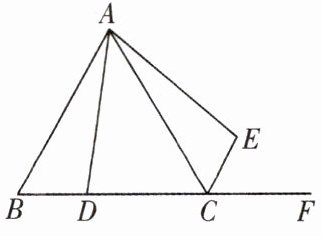
(1)求证:$CE$平分$∠ ACF$;
(2)若$AB = 2$,当四边形$ADCE$的周长取最小值时,求$BD$的长.
答案
(1)$\because △ABC$ 是等边三角形,
$\therefore AB = AC, ∠BAC = 60°$.
$\because ∠DAE = 60°,\therefore ∠BAD + ∠DAC = ∠CAE + ∠DAC$, 即$∠BAD = ∠CAE$.
在$△ABD$ 和$△ACE$ 中,
$\begin{cases}AB = AC,\\∠BAD = ∠CAE,\\AD = AE,\end{cases}$
$\therefore △ABD≅△ACE(\mathrm{SAS})$,
$\therefore ∠ABD = ∠ACE$.
$\because ∠ABD = ∠ACB = 60°$,
$\therefore ∠ACE = 60°, ∠ACF = 120°$,
$\therefore CE$ 平分$∠ACF$.
(2)$\because △ABD≅△ACE$,
$\therefore CE = BD$.
$\because △ABC$ 是等边三角形,
$\therefore AB = BC = AC = 2$,
$\therefore$ 四边形 $ADCE$ 的周长 $= CE + DC + AD + AE = BD + DC + 2AD = 2 + 2AD$.
根据垂线段最短, 故当 $AD ⊥ BC$ 时, $AD$ 值最小, 四边形 $ADCE$ 的周长取最小值,
此时,$\because AB = AC,\therefore BD = \frac{1}{2}BC = \frac{1}{2} × 2 = 1$.
即当 $BD = 1$ 时, 四边形 $ADCE$ 的周长取最小值.
例1 如图,在△ABC中,∠C=90°,∠B=15°,AB的垂直平分线交BC于点D,交AB于点E,若DB=10 cm,则AC=
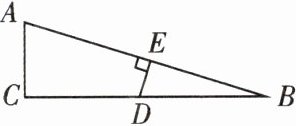
名师导引 将垂直平分线上的点与线段的两端点连接,可构造等腰三角形.
5 cm
.名师导引 将垂直平分线上的点与线段的两端点连接,可构造等腰三角形.
答案
5 cm(提示:连接AD)
变式训练 如图,在$Rt△ ABC$中,$∠ C=90°,∠ ABC=30°$,线段$AD$平分$∠ BAC$交$BC$于点$E$,又$BD// AC$.求证:
(1)$AE=BE$;
(2)$BC+CE=DE$.
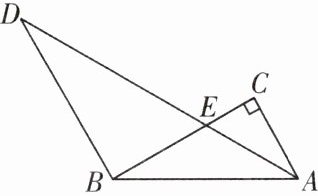
(1)$AE=BE$;
(2)$BC+CE=DE$.
答案
(1)$\because ∠ C=90°,∠ABC=30°$,
$\therefore ∠BAC=60°$.
$\because AD$平分$∠BAC$,
$\therefore ∠CAE=∠BAE=\frac{1}{2}∠BAC=30°$,
$\therefore ∠ABC=∠EAB,\therefore AE=BE$.
(2)$\because ∠C=90°,∠EAC=30°$,
$\therefore AE=2CE$.
$\because BD// AC$,
$\therefore ∠DBE=∠C=90°,∠D=∠EAC=30°$,
$\therefore DE=2BE$.
又$AE=BE$,
$\therefore DE=BE+AE=BE+2CE=BE+CE+CE=BC+CE$.
例2 如图,在等边三角形$ABC$中,$AB=6$,$P$是$AC$边上任意一点(与$A$,$C$两点不重合),$Q$是$CB$延长线上一点,$BQ=AP$,连接$PQ$交$AB$于点$D$,过点$P$作$PE ⊥ AB$于点$E$.当$∠ CQP=30°$时,求$AP$的长. 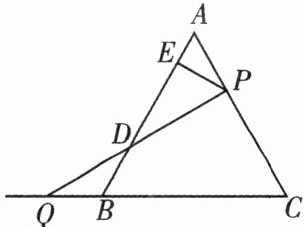
名师导引 观察图形,结合已知条件,充分利用等边三角形及含$30°$角的直角三角形的性质,建立有关线段的数量关系,也可通过添加辅助线构造全等三角形解决问题.
名师导引 观察图形,结合已知条件,充分利用等边三角形及含$30°$角的直角三角形的性质,建立有关线段的数量关系,也可通过添加辅助线构造全等三角形解决问题.
答案
作$PF// BC$交$AB$于点$F$(图略),
$\therefore ∠AFP=∠ABC,∠APF=∠C,∠PFD=∠QBD,∠FPD=∠BQD$.
$\because △ ABC$是等边三角形,
$\therefore ∠A=∠ABC=∠C=60°$,
$\therefore ∠AFP=60°,∠APF=60°$,
$\therefore △ AFP$是等边三角形,$\therefore AF=AP=PF$.
$\because PE⊥AB,\therefore AE=EF$.
$\because ∠CQP=30°,∠C=60°,\therefore ∠QPC=90°$,
$\therefore ∠DPA=90°,\therefore ∠ADP=30°. \therefore AD=2AP$.
$\therefore AD=2AF$.
即$DF+AF=2AF,\therefore DF=AF$.
$\because BQ=AP,\therefore BQ=FP$,
$\therefore △ PFD≌ △ QBD,\therefore FD=BD$.
$\therefore BD=DF=AF=\frac{1}{3}AB$.
$\because AB=6,\therefore AF=2,\therefore AP=2$.
