

 登录
登录
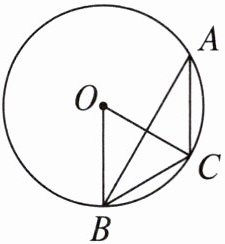
7. 如图,$\odot O$是$△ ABC$的外接圆,连接$OB$,$OC$,若$OB=BC$,$C$是$\overset{\frown}{AB}$的中点,求$∠ ABC$的度数.
答案
7. 解 如图,连接OA.

$\because OB=BC=OC$,
$\therefore△ OBC$是等边三角形,
$\therefore∠ BOC=60°$.
又C是$\overset{\frown}{AB}$的中点,
$\therefore∠ AOC=∠ BOC=60°$,
$\therefore∠ ABC=\frac{1}{2}∠ AOC=30°$.
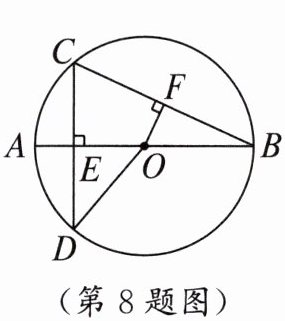
8. 如图,AB为$\odot O$的直径,弦$CD ⊥ AB$于点$E$,$OF ⊥ BC$于点$F$,$∠ BOF = 65°$,则$∠ AOD$的度数为(
A.$70°$
B.$65°$
C.$50°$
D.$45°$
(第8题图)
(第9题图)
C
).A.$70°$
B.$65°$
C.$50°$
D.$45°$
(第8题图)
(第9题图)
答案
8. C 解析 $\because OF⊥ BC,\therefore∠ BFO=90°$.
$\because∠ BOF=65°,\therefore∠ B=90°-65°=25°$.
$\because$弦$CD⊥ AB$,$AB$为$\odot O$的直径,
$\therefore\overset{\frown}{AC}=\overset{\frown}{AD},\therefore∠ AOD=2∠ B=50°$.故选C.
$\because∠ BOF=65°,\therefore∠ B=90°-65°=25°$.
$\because$弦$CD⊥ AB$,$AB$为$\odot O$的直径,
$\therefore\overset{\frown}{AC}=\overset{\frown}{AD},\therefore∠ AOD=2∠ B=50°$.故选C.
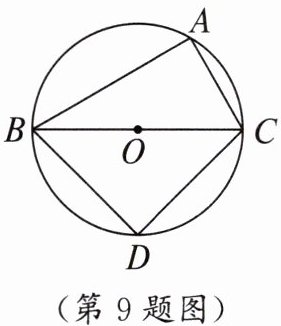
9.如图,A是$\odot O$上一点,BC是$\odot O$的直径,$AC=2$,$AB=4$,点D在$\odot O$上,且平分$\overset{\frown}{BC}$,则DC的长为(
A.$2\sqrt{2}$
B.$\sqrt{5}$
C.$2\sqrt{5}$
D.$\sqrt{10}$
D
).A.$2\sqrt{2}$
B.$\sqrt{5}$
C.$2\sqrt{5}$
D.$\sqrt{10}$
答案
9. D 解析 $\because BC$是$\odot O$的直径,
$\therefore∠ BAC=∠ BDC=90°$.
$\because AC=2,AB=4$,
$\therefore BC^2=AB^2+AC^2=4^2+2^2=20$.
$\because$点D在$\odot O$上,且平分$\overset{\frown}{BC}$,
$\therefore\overset{\frown}{CD}=\overset{\frown}{BD},\therefore CD=BD$.
在$\mathrm{Rt}△ BDC$中,$DC^2+BD^2=BC^2$,
$\therefore 2DC^2=20,\therefore DC=\sqrt{10}$.故选D.
$\therefore∠ BAC=∠ BDC=90°$.
$\because AC=2,AB=4$,
$\therefore BC^2=AB^2+AC^2=4^2+2^2=20$.
$\because$点D在$\odot O$上,且平分$\overset{\frown}{BC}$,
$\therefore\overset{\frown}{CD}=\overset{\frown}{BD},\therefore CD=BD$.
在$\mathrm{Rt}△ BDC$中,$DC^2+BD^2=BC^2$,
$\therefore 2DC^2=20,\therefore DC=\sqrt{10}$.故选D.
10.如图,BC是$\odot O$的直径,且$AC=AB$,$\overset{\frown}{AD}=\overset{\frown}{BD}$,则$∠ CBD$的度数为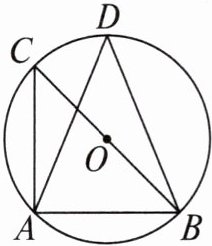
$22.5°$
。答案
10. $22.5°$ 解析 $\because\overset{\frown}{AD}=\overset{\frown}{BD}$,
$\therefore AD=BD,\therefore∠ DAB=∠ DBA$.
$\because BC$是$\odot O$的直径,$\therefore∠ CAB=90°$.
$\because AC=AB,\therefore∠ ACB=∠ ABC=45°$,
$\therefore∠ ADB=∠ ACB=45°$,
$\therefore∠ DAB=∠ DBA=67.5°$,
$\therefore∠ CBD = ∠ ABD - ∠ ABC = 67. 5°-45°=22.5°$.
$\therefore AD=BD,\therefore∠ DAB=∠ DBA$.
$\because BC$是$\odot O$的直径,$\therefore∠ CAB=90°$.
$\because AC=AB,\therefore∠ ACB=∠ ABC=45°$,
$\therefore∠ ADB=∠ ACB=45°$,
$\therefore∠ DAB=∠ DBA=67.5°$,
$\therefore∠ CBD = ∠ ABD - ∠ ABC = 67. 5°-45°=22.5°$.
11.如图,已知AB为$\odot O$的直径,CD是弦,且$AB ⊥ CD$于点E.连接AC,OC,BC.
(1)若$∠ ACO=25°$,求$∠ BCD$的度数;
(2)若$EB=4,AB=20$,求CD的长.
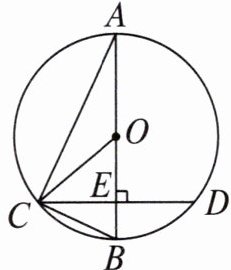
(1)若$∠ ACO=25°$,求$∠ BCD$的度数;
(2)若$EB=4,AB=20$,求CD的长.
答案
11. 解 (1)$\because OA,OC$均为$\odot O$的半径,
$\therefore OA=OC$.
$\because∠ ACO=25°$,
$\therefore∠ OAC=∠ ACO=25°$.
$\because AB$为$\odot O$的直径,
$\therefore∠ ACB=90°$,即$∠ OAC+∠ ABC=90°$.
又$AB⊥ CD$于点E,
$\therefore∠ BEC=90°$,即$∠ BCD+∠ ABC=90°$,
$\therefore∠ BCD=∠ OAC=25°$.
(2)$\because AB=20$,$AB$为$\odot O$的直径,
$\therefore OC=OB=10$.
$\because EB=4,\therefore OE=OB-EB=10-4=6$.
$\because AB⊥ CD$于点E,
$\therefore CE=DE$,且$△ OEC$为直角三角形.
在$\mathrm{Rt}△ OEC$中,根据勾股定理,得 $EC^2+OE^2=OC^2$,即 $EC^2+6^2=10^2,EC^2=100-36=64$,解得$EC=8$,$\therefore CD=2EC=2×8=16$.
$\therefore OA=OC$.
$\because∠ ACO=25°$,
$\therefore∠ OAC=∠ ACO=25°$.
$\because AB$为$\odot O$的直径,
$\therefore∠ ACB=90°$,即$∠ OAC+∠ ABC=90°$.
又$AB⊥ CD$于点E,
$\therefore∠ BEC=90°$,即$∠ BCD+∠ ABC=90°$,
$\therefore∠ BCD=∠ OAC=25°$.
(2)$\because AB=20$,$AB$为$\odot O$的直径,
$\therefore OC=OB=10$.
$\because EB=4,\therefore OE=OB-EB=10-4=6$.
$\because AB⊥ CD$于点E,
$\therefore CE=DE$,且$△ OEC$为直角三角形.
在$\mathrm{Rt}△ OEC$中,根据勾股定理,得 $EC^2+OE^2=OC^2$,即 $EC^2+6^2=10^2,EC^2=100-36=64$,解得$EC=8$,$\therefore CD=2EC=2×8=16$.
12. 如图,C为$\odot O$上一动点,$\odot O$的直径AB为10 cm,$∠ ACB$的平分线CD交$\odot O$于点D.
(1)若弦AC为6 cm,求BC,AD的长.
(2)当点C在$\odot O$上半部分运动时,试判断点D是否随着点C的变化而变化?请说明理由.
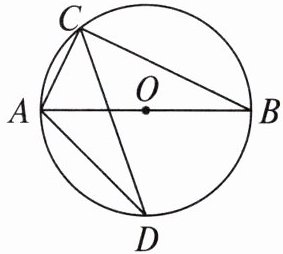
(1)若弦AC为6 cm,求BC,AD的长.
(2)当点C在$\odot O$上半部分运动时,试判断点D是否随着点C的变化而变化?请说明理由.
答案
12. 解 (1)连接OD,如图所示.

$\because AB$是$\odot O$的直径,
$\therefore∠ ACB=90°$.
$\because AB=10\ \mathrm{cm},AC=6\ \mathrm{cm},\therefore BC=8\ \mathrm{cm}$.
$\because CD$平分$∠ ACB$,
$\therefore∠ ACD=∠ BCD=\frac{1}{2}∠ ACB=45°$,
$\therefore∠ AOD = 2 ∠ ACD = 90°$,$∠ BOD = 2∠ BCD=90°$.
在$\mathrm{Rt}△ AOD$ 中, $AD = \sqrt{AO^2+OD^2} = \sqrt{5^2+5^2}=5\sqrt{2}\ (\mathrm{cm})$.
$\therefore BC$的长为$8\ \mathrm{cm}$,$AD$的长为$5\sqrt{2}\ \mathrm{cm}$.
(2)点D不随着点C的变化而变化. 理由如下:
$\because AB$是$\odot O$的直径,
$\therefore$在点C的运动过程中,$∠ ACB=90°$保持不变,
$\therefore∠ ACD=∠ BCD=45°$,$\therefore\overset{\frown}{AD}=\overset{\frown}{BD}$,
$\therefore$当点C在$\odot O$的上半部分运动时,点D不随着点C的变化而变化.
