

 登录
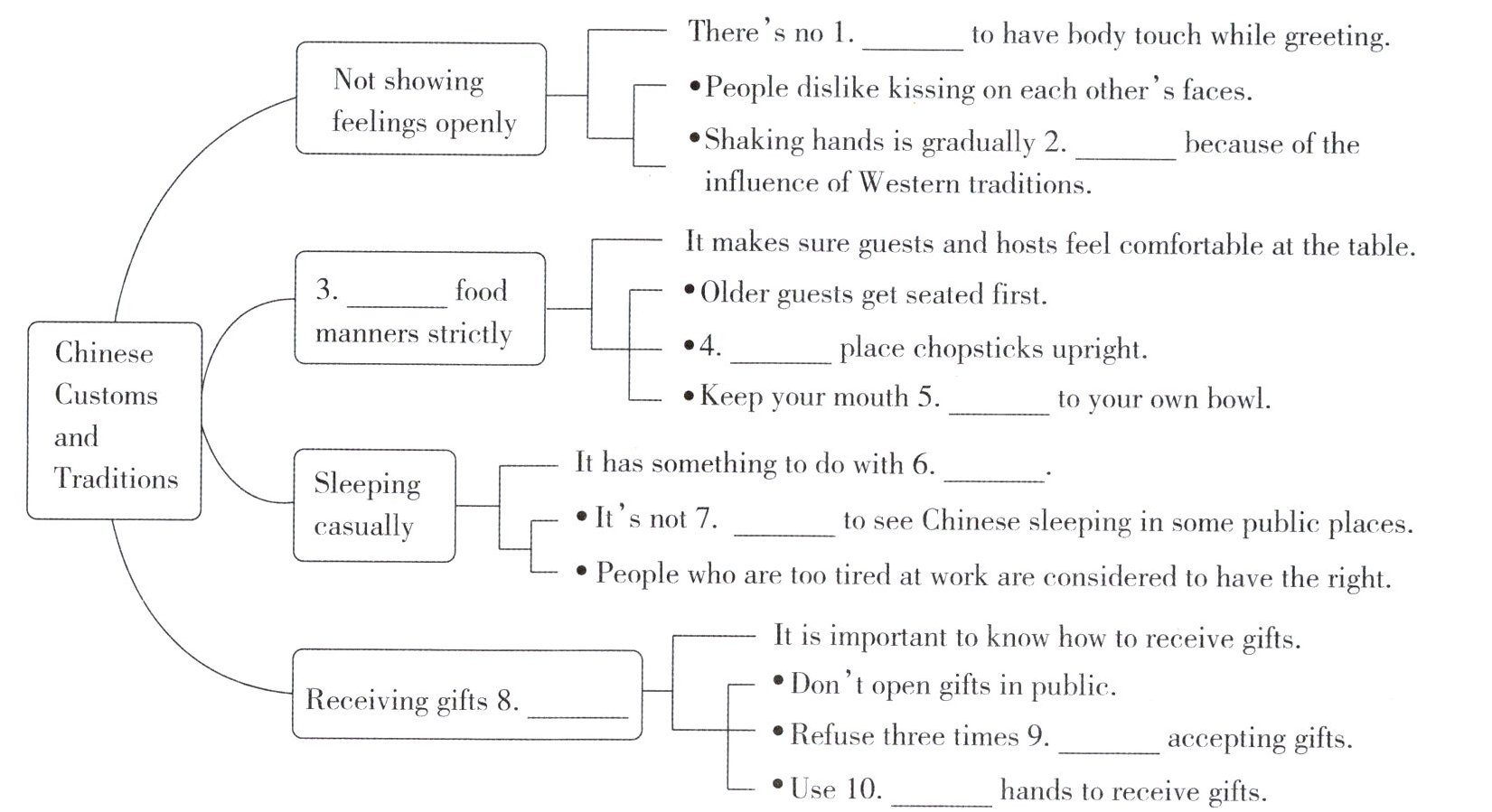
新考法 思维导图 Edward 将自己需要注意的礼仪制成了思维导图,我们帮他补充完整吧!(每空一词)
答案
1. need 解析:there is no need to do sth意为“没有必要做某事”。问候时不需要有身体接触。故填need。
2. accepted/acceptable/welcome/welcomed 解析:随着西方传统的影响,握手逐渐被人们接受,应用过去分词accepted与is构成被动语态。acceptable作形容词,意为“可接受的”,在本句中也符合语法。welcome以及welcomed也符合语法。故填accepted/acceptable/welcome/welcomed。
3. Following 解析:原文说餐桌礼仪“must be followed strictly”,思维导图小标题应为“Following food manners strictly”。故填Following。
4. Don't/Never 解析:原文说明筷子绝不能竖插在食物中,祈使句用Don't/Never place ...表达“不应放置”。故填Don't/Never。
5. close 解析:close to意为“靠近……”。吃饭时嘴应靠近自己的碗。故填close。
6. effort 解析:原文指出公共场合小睡不是懒惰的表现,而是努力工作的象征;have something to do with effort意为“与努力有关”。故填effort。
7. strange/surprising/unusual/uncommon 解析:中国人可随时随地短暂休息,因此在公共场所看到他们睡觉并不奇怪。strange符合句意;surprising、uncommon或unusual也可表示“不寻常的”。故填strange/surprising/unusual/uncommon。
8. politely/properly 解析:空处修饰动词receiving,应用副词;根据“不当众拆礼物、先婉拒再收下”等礼仪可知是“礼貌地/妥善地收礼”。故填politely/properly。
9. before 解析:先拒绝三次,最后才接受礼物,表示“在接受之前”,应用介词before。故填before。
10. both/two 解析:not ... with only one hand表示“不只用一只手”,即应使用双手;both hands和two hands都意为“两只手”。故填both/two。
Ⅱ. 尊师礼仪 Edward 在了解了中国人会在秋季开学的时候庆祝教师节,而且大家都非常尊重老师后,他想更加深入地了解中国人尊师的传统。
Chinese Teachers' Day is a festival celebrating the over 2,000-year tradition of respecting teachers and education in China.
The history of Teachers' Day dates back to the Han Dynasty. According to records, during the Han and Jin dynasties, on August 27 of the lunar calendar each year, on the birthday of Confucius (孔子), the emperor would go to the Confucius Temple and worship(敬拜) the great teacher, and would also invite royal teachers to dinner. And on that day, teachers enjoyed a one-day vacation and were given dried meat as gifts. Besides, the best teachers who were chosen from the whole country would be given 500 liang silver coins each as prizes. In the Qing Dynasty, well-performing teachers would be given official titles(头衔) or promoted to higher positions.
Normally, in ancient times, there was no fixed tuition fee(学费); the parents paid with money or food.
In private schools, teachers would receive money or gifts from the host family at certain festivals or at the beginning and end of each term. The festivals at which teachers received gifts were different in different areas, while the most valued ones were the Dragon Boat Festival, the Mid-Autumn Festival and Chinese New Year, as well as Confucius' birthday and the private teacher's birthday.
Among all the gift-giving festivals, the first meeting gift was a must. There was a tradition that when students met their teachers for the first time, they needed to kowtow(磕头) to Confucius' picture and then to their private teachers, before giving their teachers a "gift".
1. Which of the following is TRUE in ancient times according to the passage?
① Food could be used as tuition.
② On Confucius' birthday, teachers would have a day off.
③ The history of Teachers' Day started from the Han Dynasty.
④ Students didn't prepare gifts when meeting their teachers for the first time.
A. ①② B. ②③④ C. ①②③ D. ①③④
2. The underlined word "promoted" might mean "" in Chinese.
A. 赞美 B. 晋升 C. 促销 D. 宣传
3. What's the best title for the passage?
A. How to Respect Teachers B. The Greatest Teacher in China
C. Teachers' Day in Ancient China D. Tuition Fee in the Han Dynasty
答案
1. C 2. B 3. C
【语篇解读】本文是一篇说明文,介绍了中国古代的教师节以及古时候学生们尊师重道的传统礼节。
1. C 解析:细节理解题。根据“Among all the gift-giving festivals, the first meeting gift was a must.”可知,在古代,当学生初次拜见老师时,拜师礼是必不可少的。选项④错误。根据“The history of Teachers' Day ... Han Dynasty.”可知选项③正确。故选C。
2. B 解析:词义猜测题。根据“In the Qing Dynasty, well-performing teachers would be given official titles or promoted to higher positions.”可知,在清朝,表现良好的教师会晋升到更高的职位,故推测画线部分单词意为“晋升”。故选B。
3. C 解析:标题归纳题。通读全文可知,本文主要介绍了中国古时候的教师节及人们尊敬老师的礼节,故C项“Teachers' Day in Ancient China”最适合作本文标题。故选C。
