

 登录
登录
Ⅱ. Do a survey. 调查与汇报。
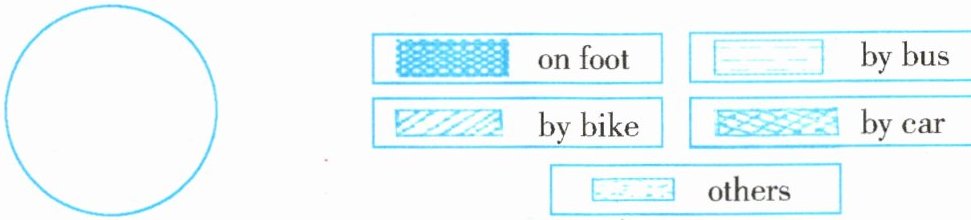
For reference:
—How do you go to school?
—I get there by the No. 1 bus. What about you?
—I get there on foot.
For reference:
—How do you go to school?
—I get there by the No. 1 bus. What about you?
—I get there on foot.
答案
This is a survey task about ways to go to school. Here is a sample answer:
I go to school on foot. Because my home is near the school. Tom goes to school by bike. He thinks it's good exercise. Lily goes to school by bus. Her home is a little far from the school. Jack goes to school by car. His parents think it's safer. Some other students may have different ways, like taking the subway, which we can call "others".
In summary, we have different ways to go to school according to our actual situations.
I go to school on foot. Because my home is near the school. Tom goes to school by bike. He thinks it's good exercise. Lily goes to school by bus. Her home is a little far from the school. Jack goes to school by car. His parents think it's safer. Some other students may have different ways, like taking the subway, which we can call "others".
In summary, we have different ways to go to school according to our actual situations.
解析
翻译:
Ⅱ. 做一项调查。调查与汇报。
参考示例:
—你怎么去上学?
—我坐1路公交车去那儿。你呢?
—我步行去那儿。
Ⅰ. Listen and judge. 听短文,判断正(√)误(×)。
(
(
(
(
(
(
×
)1. Amy’s uncle has a park.(
×
)2. Amy and Mike can’t get to the farm by subway.(
×
)3. Amy and Mike meet at eight o’clock.(
√
)4. Mike’s home is far from the park.(
√
)5. Mike will go to the park by bus.答案
由于没有提供听力短文内容,无法直接判断各题的正误。请您提供听力短文文本,以便我按照要求进行解答。
解析
翻译:
Ⅰ. 听一听,判一判。听短文,判断正(√)误(×)。
( )1. 埃米的叔叔有一个公园。
( )2. 埃米和迈克不能乘地铁去农场。
( )3. 埃米和迈克八点钟见面。
( )4. 迈克的家离公园很远。
( )5. 迈克将乘公共汽车去公园。
(
A.a
B.two
C.three
C
) 1.The traffic lights have ______ colours.A.a
B.two
C.three
答案
C
解析
根据人教版英语六年级上册Unit 2 "Ways to go to school" 内容,交通信号灯有红、黄、绿三种颜色,所以选C。
翻译:
( )1.交通信号灯有______种颜色。
A.一
B.二
C.三
翻译:
( )1.交通信号灯有______种颜色。
A.一
B.二
C.三
( ) 2.My home is not far. We can go
A.by plane
B.on foot
C.by train
B
.A.by plane
B.on foot
C.by train
答案
B
解析
题干提到“My home is not far”(我家不远),说明距离较短,因此应选择适合短距离的交通方式。
“on foot”(步行)适用于短距离,而“by plane”(乘飞机)和“by train”(乘火车)通常用于长距离,不符合题意。
翻译:
( )2.我家不远。我们可以______去。
A.坐飞机
B.步行
C.坐火车
“on foot”(步行)适用于短距离,而“by plane”(乘飞机)和“by train”(乘火车)通常用于长距离,不符合题意。
翻译:
( )2.我家不远。我们可以______去。
A.坐飞机
B.步行
C.坐火车
(
A.walking
B.running
C.jumping
A
) 3.I like ______, so I usually go to school on foot.A.walking
B.running
C.jumping
答案
A
解析
题干意为“我喜欢_____,所以我通常步行去学校”,“like”后接动词的-ing形式,表示喜欢做某事。根据“go to school on foot”(步行去学校)可知,这里应选择与步行相关的表达,“walking”(步行)符合题意。“running”是跑步,“jumping”是跳跃,均不符合。
翻译:
( )3.我喜欢______,所以我通常步行去上学。
A.步行
B.跑步
C.跳跃
翻译:
( )3.我喜欢______,所以我通常步行去上学。
A.步行
B.跑步
C.跳跃
( ) 4.
A.Go
B.Wait
C.Stop
A
at a green light.A.Go
B.Wait
C.Stop
答案
A
解析
根据六年级上册Unit 2关于交通规则的内容,绿灯时应通行,“Go at a green light.”是核心句型。选项A“Go”符合绿灯行的规则,B“Wait”对应黄灯,C“Stop”对应红灯。
翻译:
( ) 4.在绿灯时______。
A.通行
B.等待
C.停止
翻译:
( ) 4.在绿灯时______。
A.通行
B.等待
C.停止
(
—______.
A.I love China.
B.By plane.
C.Good idea.
B
) 5.—How can I get to the UK from China?—______.
A.I love China.
B.By plane.
C.Good idea.
答案
B
解析
问句询问从中国到英国的交通方式,A选项表达对中国的喜爱,C选项表示好主意,均与问题无关。B选项“By plane.”(乘飞机)是合理的交通方式,符合Unit 2关于出行方式的内容。
翻译:
( ) 5. —我怎样才能从中国到英国?
—______。
A. 我爱中国。
B. 乘飞机。
C. 好主意。
翻译:
( ) 5. —我怎样才能从中国到英国?
—______。
A. 我爱中国。
B. 乘飞机。
C. 好主意。
