

 登录
登录
三、阅读理解
In the solar system, Mars is more similar to Earth than the other planets.
The temperature on Mars is between -138℃ and 28℃. It is similar to that on Earth. Scientists find that there is water on Mars, too. But most of it is ice. Scientists also think that under Mars' north pole (极点), there might be warm areas for liquid water.
Mars is about 228 million kilometers away from the Sun while the distance from Earth to the Sun is about 150 million kilometers. That
means Mars is about 78 million kilometers farther from the Sun than Earth. But in universe that is not very far. In the universe, we use astronomical units (天文单位) to talk about distances. Earth is 1 astronomical unit from the Sun, and Mars is 1.5. That difference doesn't sound so big.
▲ The days on both planets are nearly the same length. Earth's day is 24 hours long, and Mars is only about half an hour longer. Besides, they both have seasonal changes. Earth has four seasons, and Mars also has its own different seasons.
Since Mars is quite similar to Earth, is there life on Mars? Scientists are still looking for that.
(
A. The highest temperature on Mars is 138 ℃.
B. Mars is closer to the Sun than Earth.
C. Most of water on Mars is ice.
D. There is 24 hours a day on Mars.
(
A. Mars is similar to Earth in distance from the Sun.
B. We use astronomical units to talk about distances in universe.
C. The distance from Mars to the Sun is about 228 million kilometers.
D. The distance from Earth to the Sun is about 150 million kilometers.
(
A. There are also some differences.
B. There are some other similar points.
C. How about the days on both planets?
D. How about the seasons on both planets?
(
A. 4. B. 5.
C. 6. D. 7.
(
In the solar system, Mars is more similar to Earth than the other planets.
The temperature on Mars is between -138℃ and 28℃. It is similar to that on Earth. Scientists find that there is water on Mars, too. But most of it is ice. Scientists also think that under Mars' north pole (极点), there might be warm areas for liquid water.
Mars is about 228 million kilometers away from the Sun while the distance from Earth to the Sun is about 150 million kilometers. That
means Mars is about 78 million kilometers farther from the Sun than Earth. But in universe that is not very far. In the universe, we use astronomical units (天文单位) to talk about distances. Earth is 1 astronomical unit from the Sun, and Mars is 1.5. That difference doesn't sound so big.
▲ The days on both planets are nearly the same length. Earth's day is 24 hours long, and Mars is only about half an hour longer. Besides, they both have seasonal changes. Earth has four seasons, and Mars also has its own different seasons.
Since Mars is quite similar to Earth, is there life on Mars? Scientists are still looking for that.
(
C
)31. What do scientists find about Mars?A. The highest temperature on Mars is 138 ℃.
B. Mars is closer to the Sun than Earth.
C. Most of water on Mars is ice.
D. There is 24 hours a day on Mars.
(
A
)32. What is the main idea of Paragraph 3?A. Mars is similar to Earth in distance from the Sun.
B. We use astronomical units to talk about distances in universe.
C. The distance from Mars to the Sun is about 228 million kilometers.
D. The distance from Earth to the Sun is about 150 million kilometers.
(
B
)33. Which of the following can be put in the ▲?A. There are also some differences.
B. There are some other similar points.
C. How about the days on both planets?
D. How about the seasons on both planets?
(
B
)34. How many ways are Mars similar to Earth in the text?A. 4. B. 5.
C. 6. D. 7.
(
C
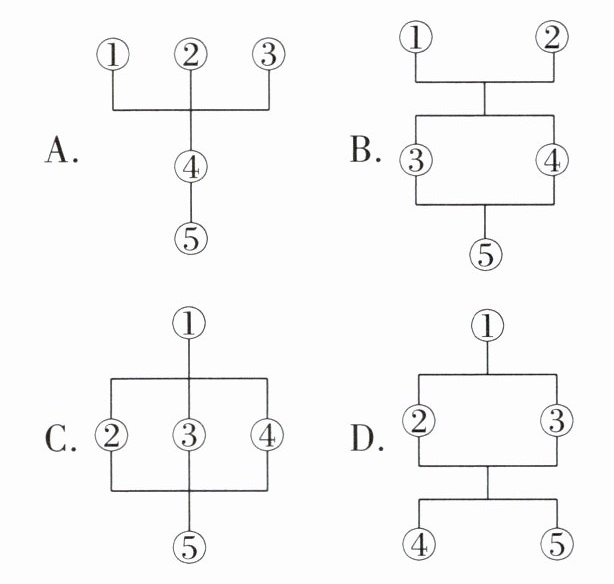
)35. What is the best structure (结构) for this text?答案
31. C 32. A 33. B 34. B 35. C
解析
【分析】
本题为英语阅读理解题,需结合原文内容逐一分析各题目:
1. 第31题:定位原文第二段,查找科学家对火星的发现,排除错误选项;
2. 第32题:概括第三段核心内容,明确段落主旨;
3. 第33题:根据空格后内容(昼夜长度、季节相似),判断空格处需引出其他相似点;
4. 第34题:统计原文中火星与地球的相似点数量;
5. 第35题:分析文章结构,匹配对应选项。
【解析】
31. 解析:根据第二段“Scientists find that there is water on Mars, too. But most of it is ice.”可知,火星上大部分水是冰,C正确;A选项火星最高温度是28℃,错误;B选项火星比地球离太阳更远,错误;D选项火星一天比地球长约半小时,错误,故选C。
32. 解析:第三段主要讲述火星与地球到太阳的距离,说明二者距离差异不大,主旨是火星与地球在距日距离上相似,故选A。
33. 解析:空格后内容提到“昼夜长度相近、都有季节变化”,均为火星与地球的相似点,故空格处应引出其他相似点,B符合;A侧重差异,C、D仅对应后续部分内容,不全面,故选B。
34. 解析:原文中火星与地球的相似点有:温度相似、都有水(大部分为冰)、距日距离相近、昼夜长度相近、都有季节变化,共5个,故选B。
35. 解析:文章结构为:①总起(火星比其他行星更像地球);②讲温度、水;③讲距日距离;④讲昼夜、季节;⑤提出疑问(火星是否有生命),对应选项C的结构,故选C。
【答案】
31.C 32.A 33.B 34.B 35.C
【知识点】
阅读理解、细节理解、主旨大意
【点评】
本题围绕火星与地球的相似点展开,考查学生的细节查找、主旨概括及逻辑推理能力,题型常规,需学生精准定位原文信息,把握文章结构。
【难度系数】
0.6
本题为英语阅读理解题,需结合原文内容逐一分析各题目:
1. 第31题:定位原文第二段,查找科学家对火星的发现,排除错误选项;
2. 第32题:概括第三段核心内容,明确段落主旨;
3. 第33题:根据空格后内容(昼夜长度、季节相似),判断空格处需引出其他相似点;
4. 第34题:统计原文中火星与地球的相似点数量;
5. 第35题:分析文章结构,匹配对应选项。
【解析】
31. 解析:根据第二段“Scientists find that there is water on Mars, too. But most of it is ice.”可知,火星上大部分水是冰,C正确;A选项火星最高温度是28℃,错误;B选项火星比地球离太阳更远,错误;D选项火星一天比地球长约半小时,错误,故选C。
32. 解析:第三段主要讲述火星与地球到太阳的距离,说明二者距离差异不大,主旨是火星与地球在距日距离上相似,故选A。
33. 解析:空格后内容提到“昼夜长度相近、都有季节变化”,均为火星与地球的相似点,故空格处应引出其他相似点,B符合;A侧重差异,C、D仅对应后续部分内容,不全面,故选B。
34. 解析:原文中火星与地球的相似点有:温度相似、都有水(大部分为冰)、距日距离相近、昼夜长度相近、都有季节变化,共5个,故选B。
35. 解析:文章结构为:①总起(火星比其他行星更像地球);②讲温度、水;③讲距日距离;④讲昼夜、季节;⑤提出疑问(火星是否有生命),对应选项C的结构,故选C。
【答案】
31.C 32.A 33.B 34.B 35.C
【知识点】
阅读理解、细节理解、主旨大意
【点评】
本题围绕火星与地球的相似点展开,考查学生的细节查找、主旨概括及逻辑推理能力,题型常规,需学生精准定位原文信息,把握文章结构。
【难度系数】
0.6
