

 登录
登录
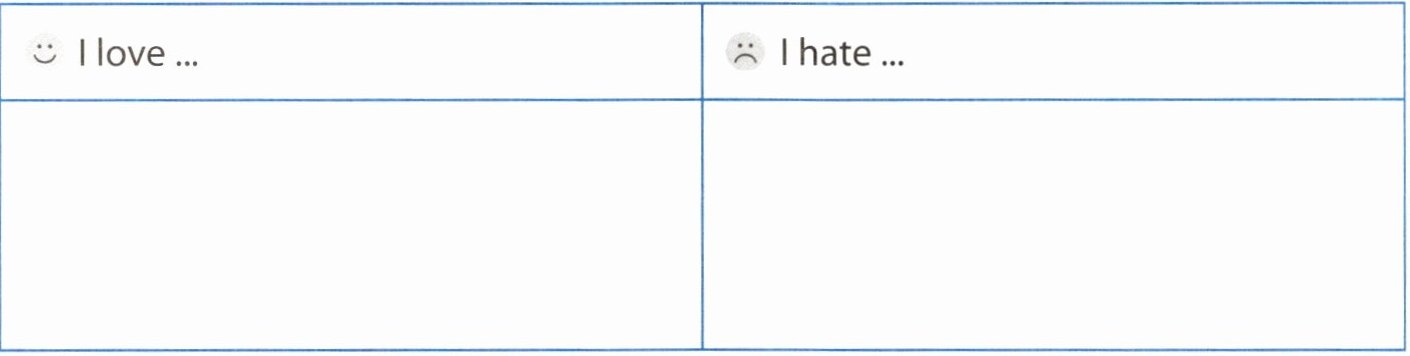
1 Put the following expressions in proper groups. 将以下表达方式进行分类。
I like ...
I enjoy ...
I don’t like ...
I am really into ...
My favourite thing is ...
I’m not crazy about ...
I can’t stand ...
I really dislike ...
I am a big fan of ...
I’m not fond of ...
... makes me happy.
... is not my cup of tea.
I like ...
I enjoy ...
I don’t like ...
I am really into ...
My favourite thing is ...
I’m not crazy about ...
I can’t stand ...
I really dislike ...
I am a big fan of ...
I’m not fond of ...
... makes me happy.
... is not my cup of tea.
答案
I love ...: I like ...; I enjoy ...; I am really into ...; My favourite thing is ...; I am a big fan of ...; ... makes me happy.
I hate ...: I don’t like ...; I’m not crazy about ...; I can’t stand ...; I really dislike ...; I’m not fond of ...; ... is not my cup of tea.
I hate ...: I don’t like ...; I’m not crazy about ...; I can’t stand ...; I really dislike ...; I’m not fond of ...; ... is not my cup of tea.
解析
【分析】本题要求将给定的英语表达按“喜爱类(对应I love...)”和“厌恶类(对应I hate...)”分组,解题时需先逐一明确每个表达的含义,判断其传递的是喜爱、热衷的正面情感,还是不喜欢、厌恶的负面情感,再对应归入两组即可。
【解析】先分析每个表达的情感倾向,再分组:
1. 正面(喜爱类)表达:I like...、I enjoy...、I am really into...、My favourite thing is...、I am a big fan of...、... makes me happy. 这些表达均传递喜爱、热衷的情感,归入I love...组;
2. 负面(厌恶类)表达:I don’t like...、I’m not crazy about...、I can’t stand...、I really dislike...、I’m not fond of...、... is not my cup of tea. 这些表达均传递不喜欢、厌恶的情感,归入I hate...组。
【答案】I love ...: I like ...; I enjoy ...; I am really into ...; My favourite thing is ...; I am a big fan of ...; ... makes me happy.
I hate ...: I don’t like ...; I’m not crazy about ...; I can’t stand ...; I really dislike ...; I’m not fond of ...; ... is not my cup of tea.
【知识点】英语情感表达分类;常用英语短语辨析
【点评】本题为英语基础应用类题目,考察学生对常用情感表达含义的理解,属于简单的分类题型,帮助学生积累日常情感表达的用法。
【难度系数】0.3
【解析】先分析每个表达的情感倾向,再分组:
1. 正面(喜爱类)表达:I like...、I enjoy...、I am really into...、My favourite thing is...、I am a big fan of...、... makes me happy. 这些表达均传递喜爱、热衷的情感,归入I love...组;
2. 负面(厌恶类)表达:I don’t like...、I’m not crazy about...、I can’t stand...、I really dislike...、I’m not fond of...、... is not my cup of tea. 这些表达均传递不喜欢、厌恶的情感,归入I hate...组。
【答案】I love ...: I like ...; I enjoy ...; I am really into ...; My favourite thing is ...; I am a big fan of ...; ... makes me happy.
I hate ...: I don’t like ...; I’m not crazy about ...; I can’t stand ...; I really dislike ...; I’m not fond of ...; ... is not my cup of tea.
【知识点】英语情感表达分类;常用英语短语辨析
【点评】本题为英语基础应用类题目,考察学生对常用情感表达含义的理解,属于简单的分类题型,帮助学生积累日常情感表达的用法。
【难度系数】0.3
2 Choose from sentences A to F to complete the conversation.
从方框中选择合适的句子补全对话,填写序号(A-F)。
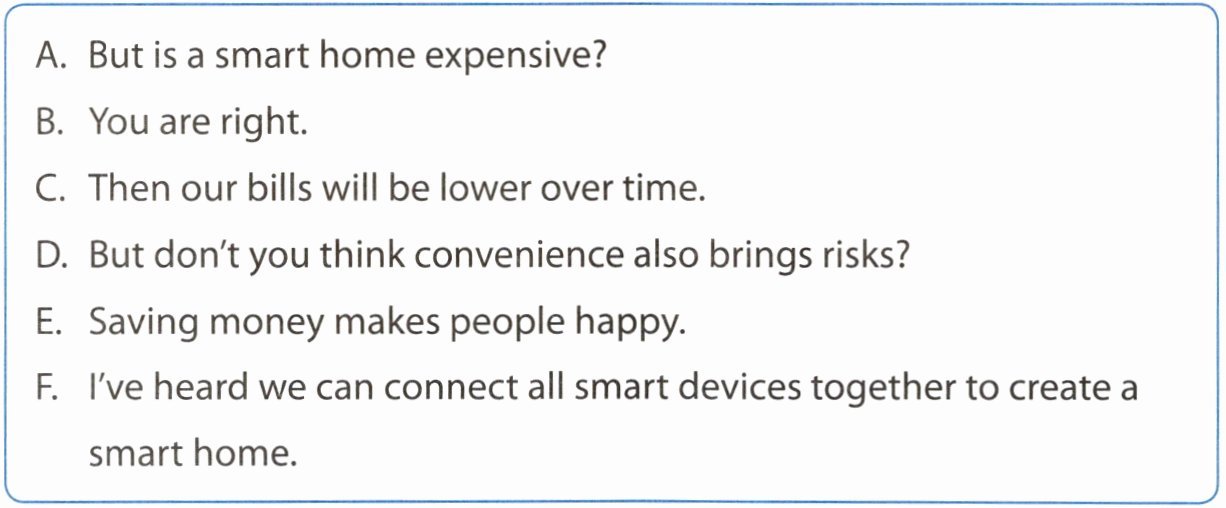
Lu Yao and Yiming are still talking to Dr Smith, the IT engineer at the Tech Expo.
Dr Smith: Above all, it can make your life easier. With a simple press, you can easily control everything from lighting to showering.
Lu Yao: (1)
Yiming: It sounds convenient. (2)
Dr Smith: (3)
Yiming: Well, Dr Smith, we might not worry about that in the future. (4)
Dr Smith: Although the cost of making a home smart can be pretty high, once it is set up, you can easily keep track of your energy and water usage.
Lu Yao: (5)
Dr Smith: Right. (6)
从方框中选择合适的句子补全对话,填写序号(A-F)。
Lu Yao and Yiming are still talking to Dr Smith, the IT engineer at the Tech Expo.
Dr Smith: Above all, it can make your life easier. With a simple press, you can easily control everything from lighting to showering.
Lu Yao: (1)
F
Yiming: It sounds convenient. (2)
D
For example, having one weak device means all are weak, especially the devices with personal information in them.Dr Smith: (3)
B
And we have worked on protecting them from being attacked.Yiming: Well, Dr Smith, we might not worry about that in the future. (4)
A
Dr Smith: Although the cost of making a home smart can be pretty high, once it is set up, you can easily keep track of your energy and water usage.
Lu Yao: (5)
C
Dr Smith: Right. (6)
E
答案
(1) F (2) D (3) B (4) A (5) C (6) E
解析
【分析】
补全对话需结合上下文的话题衔接、提问与回答的逻辑关系选择句子。先通读对话,明确讨论主题为智能家居的特点、风险、成本等,再逐一匹配每个空前后的语境:第一空承接智能家居便捷性的话题,选对应表述;第二空引出风险话题;第三空回应风险观点;第四空引出成本相关提问;第五空承接能源用水的话题;第六空呼应省钱的内容。
【解析】
根据对话逻辑逐一分析:
(1) 前文Dr Smith介绍智能家居的便捷性,F句“我听说我们可以连接所有智能设备打造智能家居”承接话题,符合语境;
(2) 前文Yiming觉得方便,后文举例说明设备弱带来的问题,D句“但你不觉得便利也带来风险吗?”引出风险话题,符合;
(3) Yiming提出风险,Dr Smith回应,B句“你是对的”表示认同,衔接自然;
(4) 后文Dr Smith提到成本高,A句“但智能家居贵吗?”是关于价格的提问,引出下文回答,正确;
(5) Dr Smith说能跟踪能源和用水,C句“然后我们的账单会随着时间降低”承接这一内容,符合;
(6) Dr Smith认同账单降低的说法,E句“省钱让人开心”呼应前文,完成对话。
【答案】
(1) F (2) D (3) B (4) A (5) C (6) E
【知识点】
补全对话、日常交际用语
【点评】
本题考查学生对对话语境的理解和日常交际用语的运用能力,需理清话题衔接与逻辑关系,难度适中。
【难度系数】
0.6
补全对话需结合上下文的话题衔接、提问与回答的逻辑关系选择句子。先通读对话,明确讨论主题为智能家居的特点、风险、成本等,再逐一匹配每个空前后的语境:第一空承接智能家居便捷性的话题,选对应表述;第二空引出风险话题;第三空回应风险观点;第四空引出成本相关提问;第五空承接能源用水的话题;第六空呼应省钱的内容。
【解析】
根据对话逻辑逐一分析:
(1) 前文Dr Smith介绍智能家居的便捷性,F句“我听说我们可以连接所有智能设备打造智能家居”承接话题,符合语境;
(2) 前文Yiming觉得方便,后文举例说明设备弱带来的问题,D句“但你不觉得便利也带来风险吗?”引出风险话题,符合;
(3) Yiming提出风险,Dr Smith回应,B句“你是对的”表示认同,衔接自然;
(4) 后文Dr Smith提到成本高,A句“但智能家居贵吗?”是关于价格的提问,引出下文回答,正确;
(5) Dr Smith说能跟踪能源和用水,C句“然后我们的账单会随着时间降低”承接这一内容,符合;
(6) Dr Smith认同账单降低的说法,E句“省钱让人开心”呼应前文,完成对话。
【答案】
(1) F (2) D (3) B (4) A (5) C (6) E
【知识点】
补全对话、日常交际用语
【点评】
本题考查学生对对话语境的理解和日常交际用语的运用能力,需理清话题衔接与逻辑关系,难度适中。
【难度系数】
0.6
