

 登录
听下面一段对话,回答第13至第15三个小题。
13. When will the singing competition be held?
A. This Monday.
B. This Friday.
C. This Saturday.
14. How often does John practise singing?
A. Once a week.
B. Twice a week.
C. Every day.
15. What do we know about John from the conversation?
A. He has joined a singing club at school.
B. He just began to learn how to write songs.
C. He will sing a pop song in the competition.
答案
13. B 14. A 15. A
第三节 你将听到一篇关于如何发现才能的短文。请用你所听到的内容,填写表格中所缺单词,每空限填一个单词。短文读两遍。
How to Find Your Hidden Talents
Firstly Think about your
Secondly Ask others. The people around you may see your talents more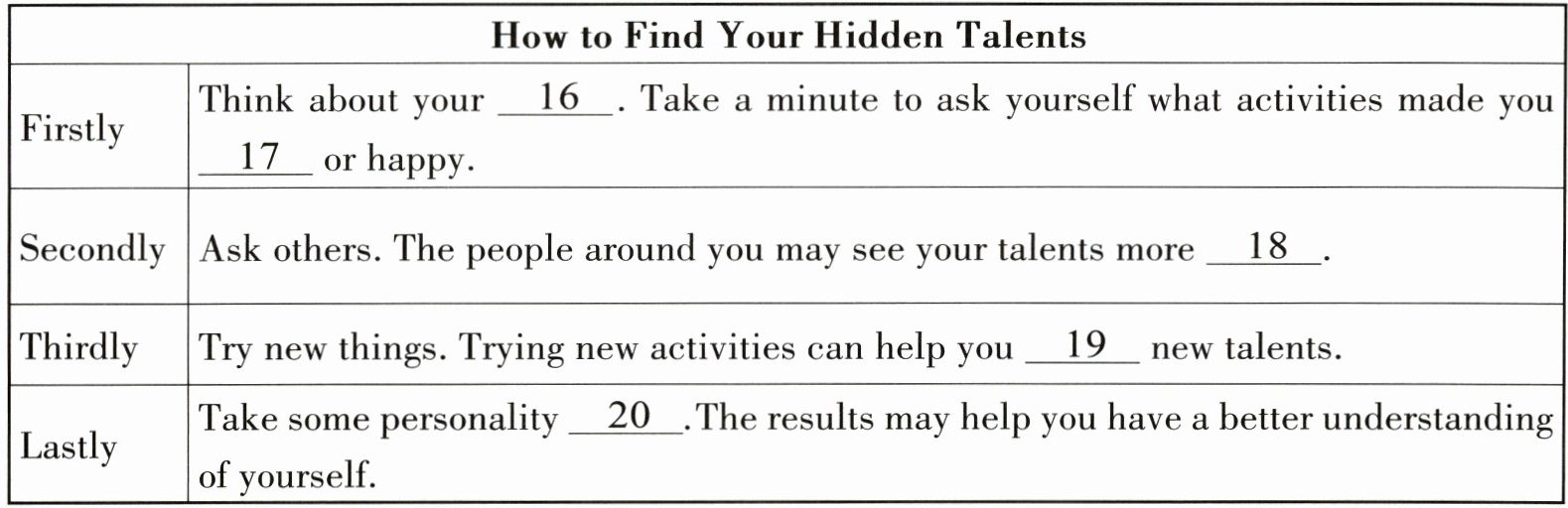
Thirdly Try new things. Trying new activities can help you
Lastly Take some personality
How to Find Your Hidden Talents
Firstly Think about your
past
16. Take a minute to ask yourself what activities made you proud
17 or happy.Secondly Ask others. The people around you may see your talents more
clearly
18. Thirdly Try new things. Trying new activities can help you
discover
19 new talents.Lastly Take some personality
tests
20. The results may help you have a better understanding of yourself.答案
16. past 17. proud 18. clearly 19. discover 20. tests
二、阅读理解(20小题,每小题2分,共40分)
阅读下面四篇语言材料,然后按文后要求做题。
A
Have you ever been to the Invention Museum? There are many interesting inventions here. Let’s take a close look at some of them!
Family Bicycle
In 1939, a man named Charles Steinlauf built a very strange bicycle. There is one seat at the front, one at the back with pedals(踏板), one at the top with pedals and a wheel, and a lower seat that holds a small sewing machine(缝纫机). The legs of the sewing machine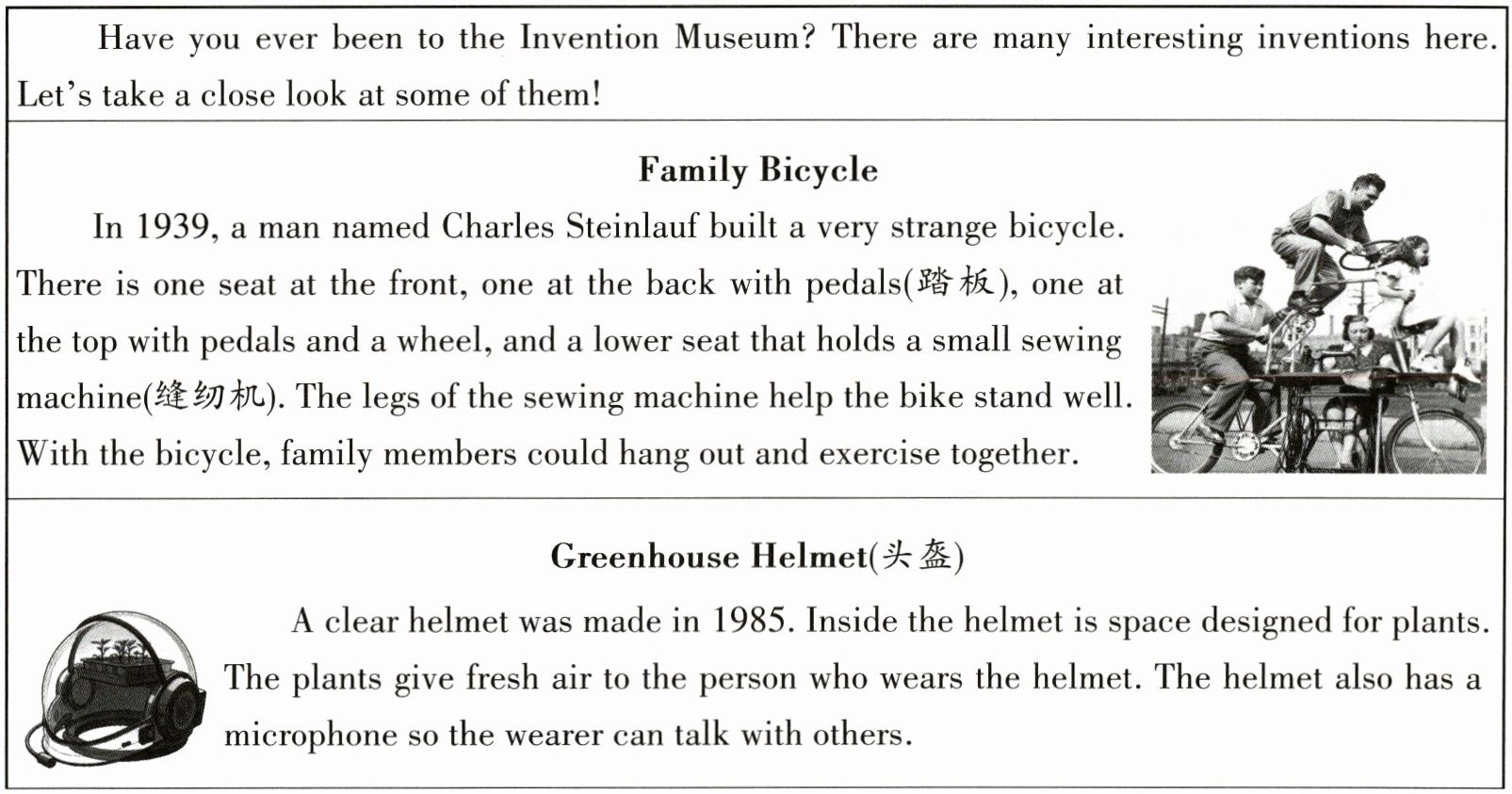 help the bike stand well. With the bicycle, family members could hang out and exercise together.
Greenhouse Helmet(头盔)
A clear helmet was made in 1985. Inside the helmet is space designed for plants. The plants give fresh air to the person who wears the helmet. The helmet also has a microphone so the wearer can talk with others.
(续表)
Tomatan
In 2015, a juice company made a robot backpack that could feed a runner tomatoes while he or she was running. The robot has a head that looks like a tomato, metal arms, and a box that holds six tomatoes. When the runner presses a key, the robot takes one tomato and brings it to the runner’s mouth.
A Robot That Learns
In 2023, an AI robot Figure 01 was built. It is thought to be the world’s first self-learning human-like robot for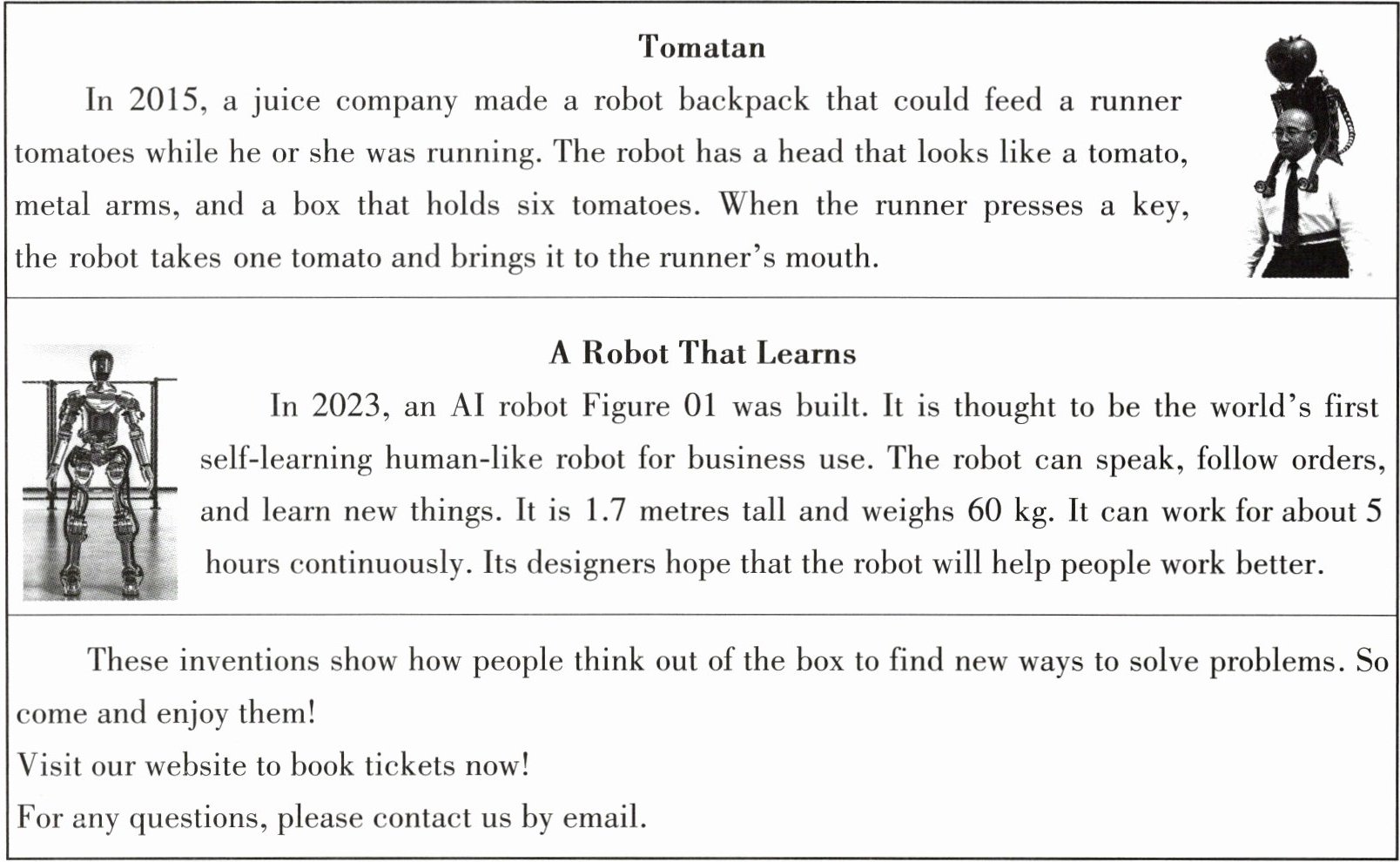 business use. The robot can speak, follow orders, and learn new things. It is 1.7 metres tall and weighs 60 kg. It can work for about 5 hours continuously. Its designers hope that the robot will help people work better.
These inventions show how people think out of the box to find new ways to solve problems. So come and enjoy them!
Visit our website to book tickets now!
For any questions, please contact us by email.
根据材料内容选择最佳答案。
21. Which family was most likely to buy the family bicycle in 1939?
A. A 4-person family who enjoyed reading.
B. A 5-person family who practised bike riding.
C. A 4-person family who loved outdoor exercise.
D. A 3-person family who needed a sewing machine.
22. What is special about the greenhouse helmet?
A. It was made to keep safe.
B. It has plants to give fresh air.
C. It was made of new clear material.
D. It has a microphone to sing songs with.
23. What was the AI robot designed for?
A. Growing plants.
B. Creating new bikes.
C. Helping people work better.
D. Feeding people while they are running.
24. Which invention was made to provide food?
A. Tomatan.
B. Family Bicycle.
C. A Robot That Learns.
D. Greenhouse Helmet.
25. What is the text?
A. A report.
B. A school notice.
C. A story.
D. An advertisement.
B
阅读下面四篇语言材料,然后按文后要求做题。
A
Have you ever been to the Invention Museum? There are many interesting inventions here. Let’s take a close look at some of them!
Family Bicycle
In 1939, a man named Charles Steinlauf built a very strange bicycle. There is one seat at the front, one at the back with pedals(踏板), one at the top with pedals and a wheel, and a lower seat that holds a small sewing machine(缝纫机). The legs of the sewing machine
help the bike stand well. With the bicycle, family members could hang out and exercise together.Greenhouse Helmet(头盔)
A clear helmet was made in 1985. Inside the helmet is space designed for plants. The plants give fresh air to the person who wears the helmet. The helmet also has a microphone so the wearer can talk with others.
(续表)
Tomatan
In 2015, a juice company made a robot backpack that could feed a runner tomatoes while he or she was running. The robot has a head that looks like a tomato, metal arms, and a box that holds six tomatoes. When the runner presses a key, the robot takes one tomato and brings it to the runner’s mouth.
A Robot That Learns
In 2023, an AI robot Figure 01 was built. It is thought to be the world’s first self-learning human-like robot for
business use. The robot can speak, follow orders, and learn new things. It is 1.7 metres tall and weighs 60 kg. It can work for about 5 hours continuously. Its designers hope that the robot will help people work better.These inventions show how people think out of the box to find new ways to solve problems. So come and enjoy them!
Visit our website to book tickets now!
For any questions, please contact us by email.
根据材料内容选择最佳答案。
21. Which family was most likely to buy the family bicycle in 1939?
A. A 4-person family who enjoyed reading.
B. A 5-person family who practised bike riding.
C. A 4-person family who loved outdoor exercise.
D. A 3-person family who needed a sewing machine.
22. What is special about the greenhouse helmet?
A. It was made to keep safe.
B. It has plants to give fresh air.
C. It was made of new clear material.
D. It has a microphone to sing songs with.
23. What was the AI robot designed for?
A. Growing plants.
B. Creating new bikes.
C. Helping people work better.
D. Feeding people while they are running.
24. Which invention was made to provide food?
A. Tomatan.
B. Family Bicycle.
C. A Robot That Learns.
D. Greenhouse Helmet.
25. What is the text?
A. A report.
B. A school notice.
C. A story.
D. An advertisement.
B
答案
21. C 22. B 23. C 24. A 25. D
解析
【分析】
本题是广告类阅读理解题,考查细节查找与文体判断能力。解题时需根据题干关键词(如发明名称、用途等)定位原文对应段落,将选项与原文信息逐一比对,排除不符选项,结合文本结尾的宣传语判断文体,从而得出正确答案。
【解析】
21. 定位Family Bicycle段落,原文提到该自行车“让家人可以一起外出和锻炼”,因此适合热爱户外锻炼的家庭。选项A(爱阅读)、B(练骑车)、D(需要缝纫机)均与原文描述不符,故选C。
22. 定位Greenhouse Helmet段落,原文明确该头盔的特殊设计是“内部有供植物生长的空间,植物能为佩戴者提供新鲜空气”,对应选项B;A(安全)、C(新材料)、D(麦克风用于唱歌)均未提及,排除。
23. 定位A Robot That Learns段落,原文指出设计师的期望是“帮助人们更好地工作”,这是该AI机器人的设计目的,对应选项C;A(种植物)、B(造自行车)、D(跑步时喂人)是其他发明的功能,排除。
24. 定位Tomatan段落,该发明的功能是“给跑步者喂番茄”,番茄是食物,因此是为提供食物设计的,对应选项A;其他发明无此功能,排除。
25. 文本结尾有“访问网站订票、联系邮箱咨询”的宣传语,符合广告特征,对应选项D;A(报告)、B(通知)、C(故事)均不符合,排除。
【答案】
21.C 22.B 23.C 24.A 25.D
【知识点】
阅读理解(细节理解)、广告文体辨析
【点评】
本题围绕博物馆的新奇发明以广告形式呈现,考查学生快速提取文本细节和判断文体的能力,题目难度较低,学生只要准确定位原文即可正确作答。
【难度系数】
0.7
