

 登录
Ⅴ. Complete the passage with the sentences in the box (one extra option), and answer the question.
A famous rule says only 7% of communication comes from words, while 38% is from tone and 55% is from body language. 23.
24.
While Mehrabian's research isn't wrong, his rule only applies to understanding feelings, not all communication. 26.
A. But this rule doesn't work for all communication.
B. Simple gestures couldn't replace vocabulary.
C. Real communication needs more than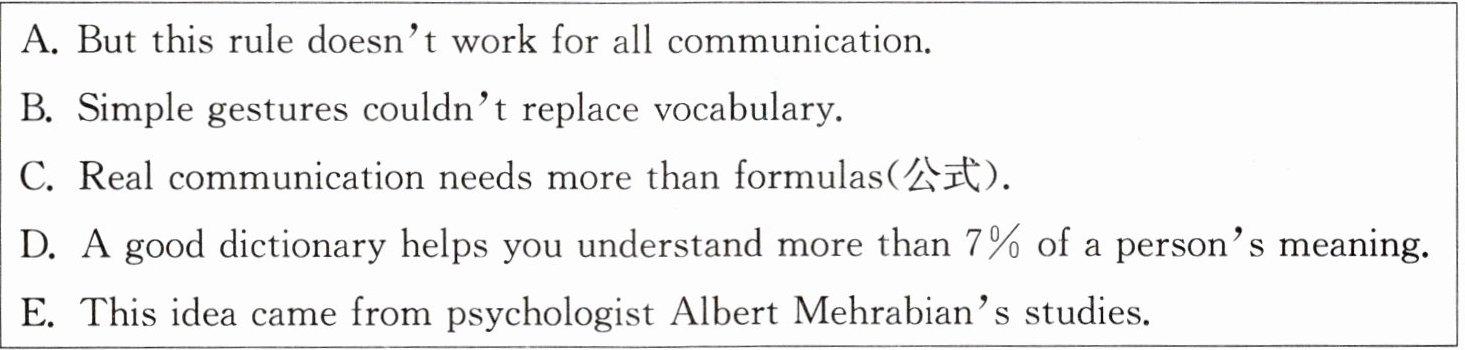 formulas(公式).
D. A good dictionary helps you understand more than 7% of a person's meaning.
E. This idea came from psychologist Albert Mehrabian's studies.
27. Why CAN'T the rule explain all types of communication? (Answer within 20 words)
A famous rule says only 7% of communication comes from words, while 38% is from tone and 55% is from body language. 23.
E
In the studies, people judged emotions mainly by voice tones and facial expressions.24.
A
Imagine a maths class where the teacher only makes sounds and gestures(手势), then you wouldn't learn 93% of the lesson! 25. B
Also, if words were so unimportant, why do we need to learn foreign languages?While Mehrabian's research isn't wrong, his rule only applies to understanding feelings, not all communication. 26.
C
It requires understanding, emotional intelligence and practice. There's no magic number for good conversations. The good news? You're not limited by any rule. You can communicate in your own way!A. But this rule doesn't work for all communication.
B. Simple gestures couldn't replace vocabulary.
C. Real communication needs more than
formulas(公式).D. A good dictionary helps you understand more than 7% of a person's meaning.
E. This idea came from psychologist Albert Mehrabian's studies.
27. Why CAN'T the rule explain all types of communication? (Answer within 20 words)
Because words are essential for sharing knowledge, and the rule only works for emotions, not facts or complex ideas.(答案不唯一,言之有理即可)
答案
23. E 24. A 25. B 26. C
27. Because words are essential for sharing knowledge, and the rule only works for emotions, not facts or complex ideas.(答案不唯一,言之有理即可)
解析
【分析】
首先分析23空:前文提到“a famous rule”,后文出现“In the studies”,需要说明该规则的来源,E选项“这个想法来自心理学家Albert Mehrabian的研究”正好衔接前后内容,符合语境;24空:后文举例“数学老师只有声音和手势,学生学不到93%的内容”,是在说明规则的局限性,A选项“但这个规则不适用于所有交流”正好引出这个例子;25空:前文举例强调词汇的重要性,B选项“简单手势不能代替词汇”呼应这个例子;26空:后文提到“真实交流需要理解、情商和练习”,说明规则的适用范围有限,C选项“真实交流需要不止公式”衔接上下文;27空:根据文本,该规则仅适用于理解情感,不适用于所有交流,需围绕此点作答。
【解析】
23. 前文引出著名规则,后文提到研究,E选项说明规则来源,符合语境,故选E;
24. 后文举例说明规则不适用的情况,A选项指出规则不适用于所有交流,引出下文,故选A;
25. 前文举例强调词汇的必要性,B选项说明手势不能代替词汇,呼应例子,故选B;
26. 后文说明真实交流的要求,C选项指出真实交流需要更多,衔接上下文,故选C;
27. 结合文本“his rule only applies to understanding feelings, not all communication”,整理为符合要求的答案:Because it only works for understanding feelings, not all communication.
【答案】
23.E 24.A 25.B 26.C;27.Because it only works for understanding feelings, not all communication.
【知识点】
英语阅读理解,七选五题型
【点评】
本题为七选五补全短文加阅读理解问答,考查学生对语篇逻辑的梳理能力和文本细节的理解,需结合上下文语境选择合适句子,问答需基于原文内容作答。
【难度系数】
0.6
