

 登录
16. “特殊到一般”是一种常用方法,我们可以先研究特殊情况,猜想结论,然后再研究一般情况,证明结论.请用这种思想解决下列问题.
如图,已知$△ ABC$,$CA=CB$,$\odot O$是$△ ABC$的外接圆,点$D$在$\odot O$上$(AD>BD)$,连接$AD$,$BD$,$CD$.
【特殊感知】
(1)如图①,若$∠ ACB=60°$,点$D$在$AO$的延长线上,则$AD-BD$与$CD$的数量关系为
【一般探究】
(2)如图②,若$∠ ACB=60°$,点$C$,$D$在$AB$的同侧,判断$AD-BD$与$CD$的数量关系并说明理由.
【拓展延伸】
(3)若$∠ ACB=α$,直接写出$AD$,$BD$,$CD$满足的数量关系.(用含$α$的式子表示)
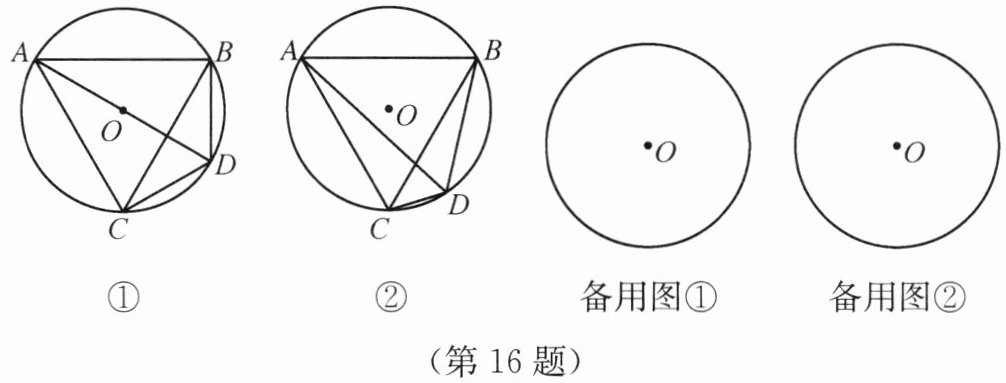
如图,已知$△ ABC$,$CA=CB$,$\odot O$是$△ ABC$的外接圆,点$D$在$\odot O$上$(AD>BD)$,连接$AD$,$BD$,$CD$.
【特殊感知】
(1)如图①,若$∠ ACB=60°$,点$D$在$AO$的延长线上,则$AD-BD$与$CD$的数量关系为
$AD-BD=CD$
.【一般探究】
(2)如图②,若$∠ ACB=60°$,点$C$,$D$在$AB$的同侧,判断$AD-BD$与$CD$的数量关系并说明理由.
【拓展延伸】
(3)若$∠ ACB=α$,直接写出$AD$,$BD$,$CD$满足的数量关系.(用含$α$的式子表示)
答案
16. (1) $AD-BD=CD$
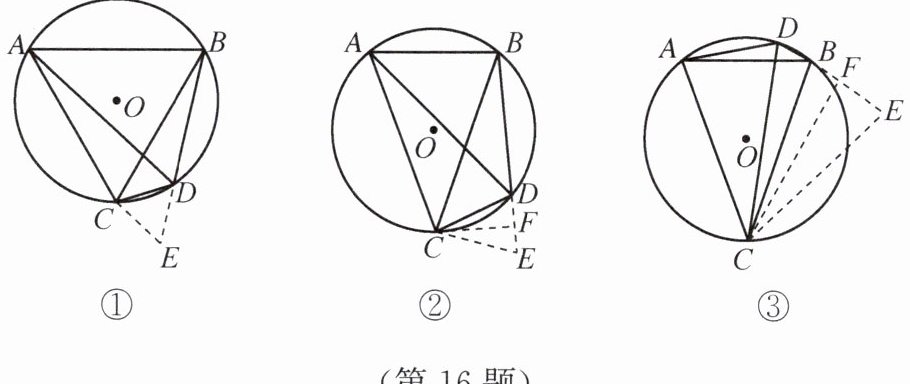
(2) 若$∠ ACB=60°$,点 C,D 在 AB 同侧,$AD-BD$ 与 CD 的数量关系为:$AD-BD=CD$,理由:如图①,延长 BD 至点 E 使 $DE=CD$,连接 CE,$\because CA=CB$,$∠ ACB=60°$,$\therefore △ ABC$ 为等边三角形 . $\therefore ∠ BAC=∠ ACB=∠ ABC=60°$,$\because$ 四边形 ABDC 为圆的内接四边形,$\therefore ∠ CDE=∠ BAC=60°$,$\because DE=CD$,$\therefore △ CDE$ 为等边三角形 . $\therefore CE=CD$,$∠ DCE=∠ E=60°$. $\therefore ∠ ACD=∠ ACB+∠ BCD=60°+∠ BCD$,$\because ∠ BCE=∠ BCD+∠ DCE=60°+∠ BCD$,$\therefore ∠ ACD=∠ BCE. \because ∠ ADC=∠ ABC=60°$,$\therefore ∠ ADC=∠ E=60°. \therefore △ ACD≌△ BCE(\mathrm{ASA})$,$\therefore AD=BE$,$\because BE=BD+DE=BD+CD$,$\therefore AD=BD+CD$,$\therefore AD-BD=CD$
(3) ① 当点 C,D 在 AB 同侧时,如图②,延长 BD 至点 E,连接 CE,使 $CE=CD$,过点 C 作 $CF⊥ DE$,垂足为 F,$\because CA=CB$,$∠ ACB=α$,$\therefore ∠ CAB=∠ CBA=90°-\frac{1}{2}α$,$\because$ 四边形 ABDC 为圆的内接四边形,$\therefore ∠ CDE=∠ BAC=90°-\frac{1}{2}α$,$\because CE=CD$,$\therefore ∠ CDE=∠ E=90°-\frac{1}{2}α$,$∠ DCE=α. \because CF⊥ DE$,$\therefore ∠ DCF=∠ ECF=\frac{1}{2}α$,$DF=EF=CD· \sin\frac{1}{2}α. \therefore DE=2DF=2CD· \sin\frac{1}{2}α. \because ∠ ACD=∠ ACB+∠ BCD=α+∠ BCD$,$∠ BCE=∠ BCD+∠ DCE=α+∠ BCD$,$\therefore ∠ ACD=∠ BCE$,$\because ∠ ADC=∠ ABC=90°-\frac{1}{2}α$,$\therefore ∠ ADC=∠ E. \therefore △ ACD≌△ BCE(\mathrm{ASA}). \therefore AD=BE. \because BE=BD+DE=BD+2CD· \sin\frac{1}{2}α$,$\therefore AD-BD=2CD· \sin\frac{1}{2}α$
② 当点 C,D 在 AB 两侧时,如图③,延长 DB 至点 E,使 $BE=AD$,连接 CE,过点 C 作 $CF⊥ DE$,垂足为 F,$\because CA=CB$,$∠ ACB=α$,$\therefore ∠ CAB=∠ CBA=90°-\frac{1}{2}α$,$\because$ 四边形 ADBC 为圆的内接四边形,$\therefore ∠ CBE=∠ DAC$,$\therefore △ CAD≌△ CBE(\mathrm{SAS}). \therefore CD=CE$,$∠ ADC=∠ E$,$\because ∠ ADC=∠ ABC=90°-\frac{1}{2}α$,$\therefore ∠ E=90°-\frac{1}{2}α. \because CF⊥ DE$,$\therefore ∠ DCF=∠ ECF=\frac{1}{2}α$,$DF=EF=CD· \sin\frac{1}{2}α$,$\therefore \frac{1}{2}DE=CD· \sin\frac{1}{2}α. \therefore DE=2CD· \sin\frac{1}{2}α$,$\because DE=BD+BE=AD+BD$,$\therefore AD+BD=2CD· \sin\frac{1}{2}α$. 综上,若$∠ ACB=α$,AD,BD,CD 满足的数量关系为:当点 C,D 在 AB 同侧时,$AD-BD=2CD· \sin\frac{1}{2}α$;当点 C,D 在 AB 两侧时,$AD+BD=2CD· \sin\frac{1}{2}α$
解析
【分析】
本题采用特殊到一般的思想逐步推导:
1. 特殊感知:已知$CA=CB$且$∠ ACB=60°$,可先判定$△ ABC$是等边三角形,结合AD为直径的特殊位置,利用圆和等边三角形的性质直接推导三条线段的关系;
2. 一般探究:沿用特殊情况的核心思路,用“补短法”构造全等三角形,延长BD到E使$DE=CD$,先证$△ CDE$为等边三角形,再证明$△ ACD≌△ BCE$,将AD转化为BE即可推导关系;
3. 拓展延伸:分类讨论点D的位置:①点C、D在AB同侧,类比(2)的构造方法,先作等腰$△ CDE$,证全等后结合三角函数表示DE的长度得到关系;②点C、D在AB异侧,同样构造全等三角形,结合三角函数推导线段关系即可。
【解析】
(1)$\because CA=CB$,$∠ ACB=60°$,$\therefore △ ABC$是等边三角形,$\because$点D在AO延长线上,即AD为$\odot O$直径,$\therefore ∠ ACD=∠ ABD=90°$,$∠ CAD=∠ BAD=30°$,$\therefore AD=2CD$,$BD=CD$,故$AD-BD=CD$。
(2)$AD-BD=CD$,理由如下:
如图①,延长BD至点E使$DE=CD$,连接CE,
$\because CA=CB$,$∠ ACB=60°$,$\therefore △ ABC$为等边三角形,$\therefore ∠ BAC=∠ ACB=∠ ABC=60°$,
$\because$四边形ABDC为圆的内接四边形,$\therefore ∠ CDE=∠ BAC=60°$,
$\because DE=CD$,$\therefore △ CDE$为等边三角形,$\therefore CE=CD$,$∠ DCE=∠ E=60°$,
$\therefore ∠ ACD=∠ ACB+∠ BCD=60°+∠ BCD$,$∠ BCE=∠ BCD+∠ DCE=60°+∠ BCD$,
$\therefore ∠ ACD=∠ BCE$,
又$\because ∠ ADC=∠ ABC=60°$,$\therefore ∠ ADC=∠ E=60°$,
$\therefore △ ACD≌△ BCE(\mathrm{ASA})$,$\therefore AD=BE$,
$\because BE=BD+DE=BD+CD$,$\therefore AD=BD+CD$,即$AD-BD=CD$。
(3)分两种情况讨论:
①当点C,D在AB同侧时:如图②,延长BD至点E,连接CE,使$CE=CD$,过点C作$CF⊥ DE$,垂足为F,
$\because CA=CB$,$∠ ACB=α$,$\therefore ∠ CAB=∠ CBA=90°-\frac{1}{2}α$,
$\because$四边形ABDC为圆的内接四边形,$\therefore ∠ CDE=∠ BAC=90°-\frac{1}{2}α$,
$\because CE=CD$,$\therefore ∠ CDE=∠ E=90°-\frac{1}{2}α$,$∠ DCE=α$,
$\because CF⊥ DE$,$\therefore ∠ DCF=∠ ECF=\frac{1}{2}α$,$DF=EF=CD· \sin\frac{1}{2}α$,
$\therefore DE=2DF=2CD· \sin\frac{1}{2}α$,
$\because ∠ ACD=∠ ACB+∠ BCD=α+∠ BCD$,$∠ BCE=∠ BCD+∠ DCE=α+∠ BCD$,
$\therefore ∠ ACD=∠ BCE$,
又$\because ∠ ADC=∠ ABC=90°-\frac{1}{2}α$,$\therefore ∠ ADC=∠ E$,
$\therefore △ ACD≌△ BCE(\mathrm{ASA})$,$\therefore AD=BE$,
$\because BE=BD+DE=BD+2CD· \sin\frac{1}{2}α$,$\therefore AD-BD=2CD· \sin\frac{1}{2}α$;
②当点C,D在AB两侧时:如图③,延长DB至点E,使$BE=AD$,连接CE,过点C作$CF⊥ DE$,垂足为F,
$\because CA=CB$,$∠ ACB=α$,$\therefore ∠ CAB=∠ CBA=90°-\frac{1}{2}α$,
$\because$四边形ADBC为圆的内接四边形,$\therefore ∠ CBE=∠ DAC$,
$\therefore △ CAD≌△ CBE(\mathrm{SAS})$,$\therefore CD=CE$,$∠ ADC=∠ E$,
$\because ∠ ADC=∠ ABC=90°-\frac{1}{2}α$,$\therefore ∠ E=90°-\frac{1}{2}α$,
$\because CF⊥ DE$,$\therefore ∠ DCF=∠ ECF=\frac{1}{2}α$,$DF=EF=CD· \sin\frac{1}{2}α$,
$\therefore DE=2CD· \sin\frac{1}{2}α$,
$\because DE=BD+BE=AD+BD$,$\therefore AD+BD=2CD· \sin\frac{1}{2}α$。
【答案】
(1) $AD-BD=CD$
(2) $AD-BD=CD$,理由见解析
(3) 当点C,D在AB同侧时,$AD-BD=2CD· \sin\frac{1}{2}α$;当点C,D在AB两侧时,$AD+BD=2CD· \sin\frac{1}{2}α$
【知识点】
圆内接四边形的性质、全等三角形的判定与性质、解直角三角形
【点评】
本题考查了特殊到一般、分类讨论的数学思想,核心解题方法是通过“截长补短”构造全等三角形实现线段的转化,需要学生熟练掌握圆的性质、三角形全等、三角函数等知识,对综合运用知识解决问题的能力要求较高。
【难度系数】
0.3
