

 登录
Ⅳ. 完形填空
“When I first started learning calligraphy, I just copied the teacher's strokes, and my work was ugly,” said Aryan from Afghanistan. He is a graduate student in Beijing,
During his six-year stay in China, he discovered the
To his surprise, the courses for foreign students in China
“At first, I didn't know much Chinese and thought calligraphy would be difficult,” Aryan said. “Later on, I found out that calligraphy can help me
He used to
Not only did Aryan gain a deeper
1. A. studying B. teaching
C. bringing D. introducing
2. A. problem B. pattern
C. richness D. feeling
3. A. local B. official
C. international D. formal
4. A. go against B. take up
C. take over D. go beyond
5. A. meetings B. activities
C. subjects D. competitions
6. A. food B. life
C. work D. joy
7. A. course B. past
C. experience D. hobby
8. A. improve B. know
C. enjoy D. find
9. A. hold B. create
C. break D. test
10. A. positive B. humorous
C. wrong D. clever
11. A. or B. but
C. and D. as
12. A. lead B. represent
C. sense D. recall
13. A. replies B. treasures
C. actions D. keys
14. A. hole B. ability
C. form D. knowledge
15. A. stressed B. relaxed
C. excellent D. busy
“When I first started learning calligraphy, I just copied the teacher's strokes, and my work was ugly,” said Aryan from Afghanistan. He is a graduate student in Beijing,
A
1 International Education of the Chinese Language.During his six-year stay in China, he discovered the
C
2 of Chinese culture. He also realized that Chinese is becoming a(n) C
3 language, and more people around the world want to communicate smoothly in Chinese.To his surprise, the courses for foreign students in China
D
4 the classroom. The school also organises extracurricular(课外的) B
5 to help them learn about and experience B
6 and culture. So Aryan was able to learn calligraphy at school from teachers. After closer and deeper contact with Chinese culture, Aryan found his D
7: calligraphy.“At first, I didn't know much Chinese and thought calligraphy would be difficult,” Aryan said. “Later on, I found out that calligraphy can help me
A
8 my Chinese language skills and my understanding of Chinese culture.”He used to
A
9 the idea that writing Chinese characters was all about writing them neatly. But he later found out that this view is C
10. Calligraphy helps him understand each stroke C
11 the Chinese attitude toward life. The horizontal, vertical(垂直的) and left and right falling strokes on the paper B
12 Chinese people's special symbols and memories. They are also the hidden D
13 to better understanding Chinese culture.Not only did Aryan gain a deeper
D
14 of Chinese characters, but he also developed a more mature personality along the way. Calligraphy gives him strength when he feels A
15 and lost, finding his inner peace.1. A. studying B. teaching
C. bringing D. introducing
2. A. problem B. pattern
C. richness D. feeling
3. A. local B. official
C. international D. formal
4. A. go against B. take up
C. take over D. go beyond
5. A. meetings B. activities
C. subjects D. competitions
6. A. food B. life
C. work D. joy
7. A. course B. past
C. experience D. hobby
8. A. improve B. know
C. enjoy D. find
9. A. hold B. create
C. break D. test
10. A. positive B. humorous
C. wrong D. clever
11. A. or B. but
C. and D. as
12. A. lead B. represent
C. sense D. recall
13. A. replies B. treasures
C. actions D. keys
14. A. hole B. ability
C. form D. knowledge
15. A. stressed B. relaxed
C. excellent D. busy
答案
1. A 2. C 3. C 4. D 5. B 6. B 7. D 8. A 9. A 10. C 11. C 12. B 13. D 14. D 15. A
【文章大意】本文是一篇记叙文,主要讲述了北京的一名研究生雅利安学习中文书法的过程以及在学习书法过程中得到一些关于汉字和中国文化的感悟。
1. A 根据“He is a graduate student”提到了他是一名学生,所以后文是他学习的课程是汉语国际教育。故选A。
2. C 根据“of Chinese culture”以及下文他对于书法的感悟可知,在中国的六年里,他发现了中国文化的丰富多彩。故选C。
3. C 根据“more people around the world want to communicate smoothly in Chinese”可知,世界上越来越多的人希望用汉语进行顺畅的交流,说明汉语正在成为一门国际语言。故选C。
4. D go against违背;take up从事;take over接管;go beyond超越。下文“The school also organises extracurricular”提到学校组织课外课程,说明课程不仅仅局限于课堂,而是超越了课堂。故选D。
5. B 根据“So Aryan was able to learn calligraphy at school from teachers.”可知,雅利安有机会参与学校组织的课外活动,学习书法。故选B。
6. B 根据“and culture”以及上文提到组织的是课外活动可知,此处是体验生活和文化。故选B。
7. D 根据上下文可知,雅利安非常喜爱书法,说明书法成了他的爱好。故选D。
8. A 根据“my Chinese language skills and my understanding of Chinese culture”可知,书法可以帮助他提高汉语水平并加深对中国文化的了解。故选A。
9. A 根据下文“the idea that writing Chinese characters was all about writing them neatly”可知,此处为短语hold the idea that,表示“认为”。故选A。
10. C 上文提到他曾经认为写汉字只要写得整齐就行,下文则说书法可以有助于了解中国人对生活的态度,可知之前的观点是错误的。故选C。
11. C 根据“The horizontal, vertical and left and right falling strokes on the paper ... Chinese people's special symbols and memories.”可知,书法帮助他理解了每个笔画和中国人对生活的态度,此处表示并列。故选C。
12. B 根据“the Chinese attitude toward life”以及“Chinese people's special symbols and memories”可知,笔画展现了中国人的生活态度,代表了中国人独特的符号和记忆。故选B。
13. D 根据“to better understanding Chinese culture”可知,汉字的笔画也是更好地理解中国文化的隐藏关键。故选D。
14. D 根据常识可知,学习书法能认识汉字,所以此处表示对汉字知识有了更深入的了解。故选D。
15. A 根据后文“and lost”可知,指感到有压力和失落。故选A。
中考趋势 V. 信息还原
从方框中选出能填入空白处的最佳选项。选项中有两项多余。
During my visit to Xi'an, I saw a strange instrument. It has a loud and high-pitched(声调
高的)sound, especially when it is played outdoors.
1 He told me that it is a Chinese instrument called suona. To find more information, I visited some Chinese online lesson websites.
Actually, the suona is a Chinese instrument. Its loud and high-pitched sound is perfect for outdoor performances.
2 It is widely used at traditional festival events, weddings and funerals(葬礼)in the countryside of north China.
3 It was developed from Central Asian instruments such as the “surnay” or “zurna”, from which its Chinese name comes. A musician playing an instrument very similar to a suona is shown in a drawing at a historic place on the Silk Road in what is now the western Xinjiang Uygur Autonomous Region.
The suona only has eight holes, and breathing and fingers are all that a performer depends on to control the pitch and tone.
4 The instrument looks simple, but it can vividly imitate the voice or singing of a human being or even the sounds of Chinese opera.
5 The eight-hole instrument has been called the “eight-eyed monkey” because it is difficult to control like a monkey.
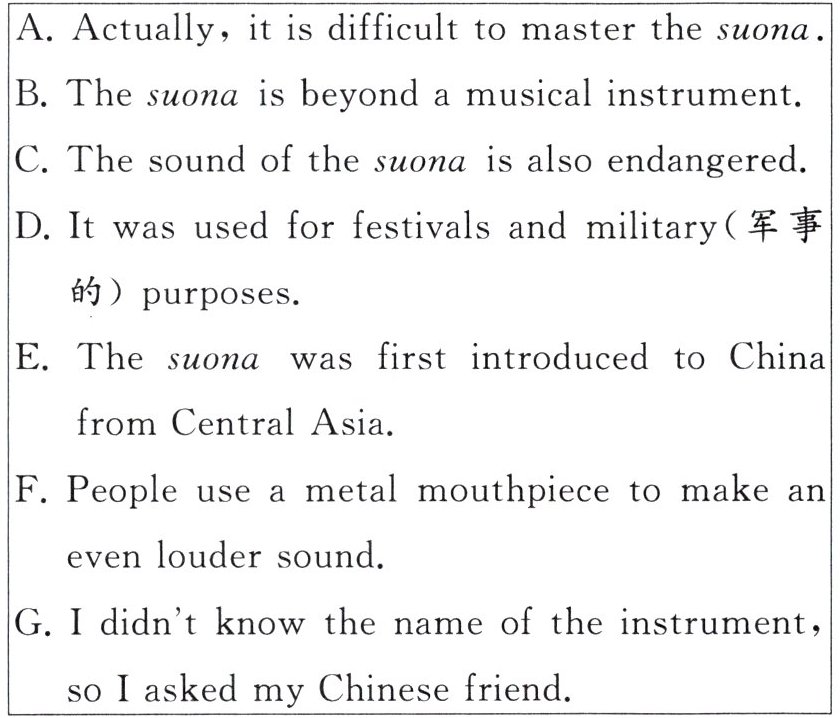
A. Actually, it is difficult to master the suona.
B. The suona is beyond a musical instrument.
C. The sound of the suona is also endangered.
D. It was used for festivals and military(军事的) purposes.
E. The suona was first introduced to China from Central Asia.
F. People use a metal mouthpiece to make an even louder sound.
G. I didn't know the name of the instrument, so I asked my Chinese friend.
1.
4.
从方框中选出能填入空白处的最佳选项。选项中有两项多余。
During my visit to Xi'an, I saw a strange instrument. It has a loud and high-pitched(声调
高的)sound, especially when it is played outdoors.
1 He told me that it is a Chinese instrument called suona. To find more information, I visited some Chinese online lesson websites.
Actually, the suona is a Chinese instrument. Its loud and high-pitched sound is perfect for outdoor performances.
2 It is widely used at traditional festival events, weddings and funerals(葬礼)in the countryside of north China.
3 It was developed from Central Asian instruments such as the “surnay” or “zurna”, from which its Chinese name comes. A musician playing an instrument very similar to a suona is shown in a drawing at a historic place on the Silk Road in what is now the western Xinjiang Uygur Autonomous Region.
The suona only has eight holes, and breathing and fingers are all that a performer depends on to control the pitch and tone.
4 The instrument looks simple, but it can vividly imitate the voice or singing of a human being or even the sounds of Chinese opera.
5 The eight-hole instrument has been called the “eight-eyed monkey” because it is difficult to control like a monkey.
A. Actually, it is difficult to master the suona.
B. The suona is beyond a musical instrument.
C. The sound of the suona is also endangered.
D. It was used for festivals and military(军事的) purposes.
E. The suona was first introduced to China from Central Asia.
F. People use a metal mouthpiece to make an even louder sound.
G. I didn't know the name of the instrument, so I asked my Chinese friend.
1.
G
2. D
3. E
4.
F
5. A
答案
1. G 2. D 3. E 4. F 5. A
【文章大意】本文是一篇说明文,主要介绍了作者在西安旅行时见到一种奇特的乐器——唢呐。
1. G 前文提到作者在西安遇到一种奇特的乐器,后文说“He told me that it is a Chinese instrument called suona.”(他告诉我这是一种叫唢呐的中国乐器)。G选项“I didn't know the name of the instrument, so I asked my Chinese friend.”(我不知道这种乐器的名字,所以问了我的中国朋友)承上启下,逻辑连贯。
2. D 前文讲唢呐声音响亮高亢,适合户外演出。D选项“It was used for festivals and military purposes.”(它曾被用于节日和军事用途)进一步说明唢呐的历史用途,与后文“现在广泛用于传统节日、婚礼和葬礼”形成时间上的递进关系。
3. E 后文紧接着说“It was developed from Central Asian instruments such as the 'surnay' or 'zurna' ...”(它由中亚乐器发展而来),E选项“The suona was first introduced to China from Central Asia.”(唢呐最早从中亚传入中国)作为段首主题句,引出下文对唢呐起源的详细介绍。
4. F 前文讲唢呐只有八个孔,演奏者完全依靠气息和手指来控制音高和音色。F选项“People use a metal mouthpiece to make an even louder sound.”(人们使用金属吹嘴来发出更大的声音)补充说明唢呐的构造特点,与前后文衔接自然。
5. A 后文说“The eight-hole instrument has been called the 'eight-eyed monkey' because it is difficult to control like a monkey.”(这个八孔乐器被称为“八眼猴”,因为它像猴子一样难以控制)。A选项“Actually, it is difficult to master the suona.”(实际上,唢呐很难掌握)与后文形成因果关系,解释了为什么唢呐会被比作难以驯服的猴子。
