

 登录
登录
5. Thanks to safety classes, he knew water
A.could
B.can't
C.should
D.must
A
make oil fires worse.A.could
B.can't
C.should
D.must
答案
5.A
解析
【分析】首先明确句子含义:多亏了安全课,他知道水________让油火更糟。该句是主从复合句,主句谓语为过去式knew,宾语从句需使用过去相关时态,需结合常识和情态动词的含义、时态辨析选项。
【解析】1. 分析句子结构:本句是包含宾语从句的主从复合句,主句谓语动词是过去式knew,因此宾语从句需使用过去时态。2. 结合语境与常识:安全课会教授消防知识,水会让油火更糟,此处需表达“会、能够”的含义。3. 辨析选项:A选项could是can的过去式,意为“能够、会”,符合语境和时态要求;B选项can't意为“不能”,不符合消防常识;C选项should意为“应该”,语气与句意不符;D选项must意为“必须”,不符合语境。因此选A。
【答案】A
【知识点】情态动词、宾语从句时态
【点评】本题考查情态动词在宾语从句中的运用,需结合句意、时态及常识判断,属于基础题型。
【难度系数】0.6
【解析】1. 分析句子结构:本句是包含宾语从句的主从复合句,主句谓语动词是过去式knew,因此宾语从句需使用过去时态。2. 结合语境与常识:安全课会教授消防知识,水会让油火更糟,此处需表达“会、能够”的含义。3. 辨析选项:A选项could是can的过去式,意为“能够、会”,符合语境和时态要求;B选项can't意为“不能”,不符合消防常识;C选项should意为“应该”,语气与句意不符;D选项must意为“必须”,不符合语境。因此选A。
【答案】A
【知识点】情态动词、宾语从句时态
【点评】本题考查情态动词在宾语从句中的运用,需结合句意、时态及常识判断,属于基础题型。
【难度系数】0.6
Ⅴ.完成句子。
1. James heated oil on the stove.(改为否定句)
James
2. Allen ran to the living-room to get the fire extinguisher.(对画线部分提问)
3. James put out the fire by rolling on the ground.(改为同义句)
James rolled on the ground
4. Allen could put out the fire.(改为一般疑问句)
5. James, the, fire, put, out, ground, on, the(.)(连词成句)
1. James heated oil on the stove.(改为否定句)
James
didn't
heat
oil on the stove.2. Allen ran to the living-room to get the fire extinguisher.(对画线部分提问)
Why
did
Allen run to the living-room?3. James put out the fire by rolling on the ground.(改为同义句)
James rolled on the ground
to
put
out the fire.4. Allen could put out the fire.(改为一般疑问句)
Could
Allen put
out the fire?5. James, the, fire, put, out, ground, on, the(.)(连词成句)
James put out the fire on the ground.
答案
Ⅴ.1.didn't heat 2.Why did 3.to put
4.Could;put 5.James put out the fire on
the ground.
4.Could;put 5.James put out the fire on
the ground.
解析
【分析】
本题为英语句型转换与连词成句题,共5小题,需结合不同语法规则逐一解答:
1. 第1题是一般过去时的肯定句改否定句,需先判断时态(一般过去时,实义动词作谓语),否定句需借助助动词,后面动词还原;
2. 第2题是对表目的的不定式提问,需确定对应疑问词,再结合原句时态添加助动词;
3. 第3题是同义句转换,原句表方式的结构需转换为表目的的不定式结构;
4. 第4题是含情态动词的句子改一般疑问句,需将情态动词提前,后面动词用原形;
5. 第5题是连词成句,需先确定句子主干(主语+谓语+宾语),再补充状语保证通顺。
【解析】
1. 原句是一般过去时,谓语heated为实义动词,改否定句时借助助动词didn't,heated还原为原形heat,故填didn't heat;
2. 画线部分表目的,用疑问词Why提问,原句为一般过去时,疑问句加助动词did,故填Why did;
3. 原句by rolling on the ground表灭火方式,同义句用不定式表目的,即to put out,故填to put;
4. 含情态动词could的句子改一般疑问句,将could提至句首,后面动词用原形put,故填Could; put;
5. 连词成句时,主语为James,谓语为put out,宾语为the fire,地点状语为on the ground,组合为James put out the fire on the ground.
【答案】
Ⅴ.1.didn't heat 2.Why did 3.to put 4.Could;put 5.James put out the fire on the ground.
【知识点】
一般过去时句型转换、同义句转换、连词成句
【点评】
本题考查初中英语基础语法与句型运用,涵盖一般过去时、情态动词等核心知识点,题型为常见的句型转换与连词成句,侧重基础能力考查。
【难度系数】
0.6
本题为英语句型转换与连词成句题,共5小题,需结合不同语法规则逐一解答:
1. 第1题是一般过去时的肯定句改否定句,需先判断时态(一般过去时,实义动词作谓语),否定句需借助助动词,后面动词还原;
2. 第2题是对表目的的不定式提问,需确定对应疑问词,再结合原句时态添加助动词;
3. 第3题是同义句转换,原句表方式的结构需转换为表目的的不定式结构;
4. 第4题是含情态动词的句子改一般疑问句,需将情态动词提前,后面动词用原形;
5. 第5题是连词成句,需先确定句子主干(主语+谓语+宾语),再补充状语保证通顺。
【解析】
1. 原句是一般过去时,谓语heated为实义动词,改否定句时借助助动词didn't,heated还原为原形heat,故填didn't heat;
2. 画线部分表目的,用疑问词Why提问,原句为一般过去时,疑问句加助动词did,故填Why did;
3. 原句by rolling on the ground表灭火方式,同义句用不定式表目的,即to put out,故填to put;
4. 含情态动词could的句子改一般疑问句,将could提至句首,后面动词用原形put,故填Could; put;
5. 连词成句时,主语为James,谓语为put out,宾语为the fire,地点状语为on the ground,组合为James put out the fire on the ground.
【答案】
Ⅴ.1.didn't heat 2.Why did 3.to put 4.Could;put 5.James put out the fire on the ground.
【知识点】
一般过去时句型转换、同义句转换、连词成句
【点评】
本题考查初中英语基础语法与句型运用,涵盖一般过去时、情态动词等核心知识点,题型为常见的句型转换与连词成句,侧重基础能力考查。
【难度系数】
0.6
Ⅵ.七选五·补对话。
James:Hi, Allen! 1.
Allen:Of course! That was really an awful accident.
James:2.
Allen:Well, when the pan was on fire, 3.
James:4.
Allen:I rolled on the ground to put it out. It was a way from the first-aid class.
James:Smart move! 5.
Allen: I used the fire extinguisher. And it worked!
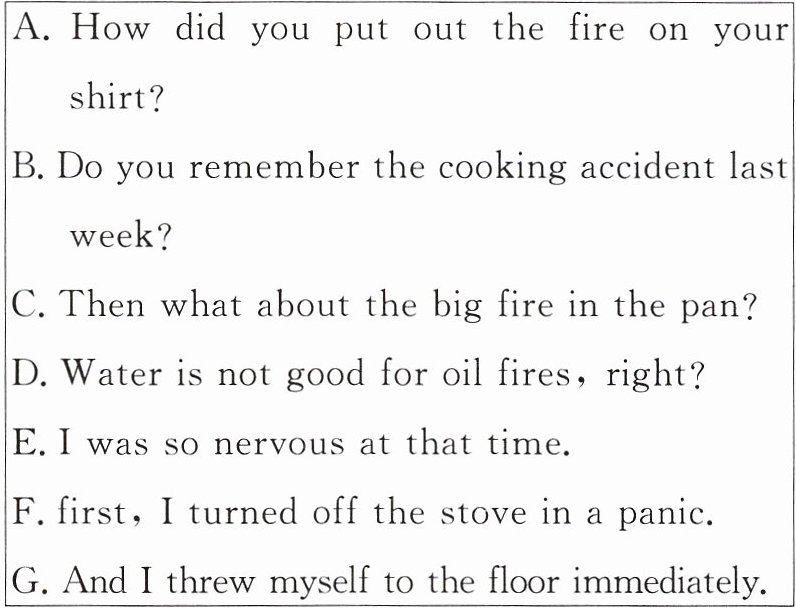
James:Hi, Allen! 1.
B
Allen:Of course! That was really an awful accident.
James:2.
E
Allen:Well, when the pan was on fire, 3.
F
James:4.
A
Allen:I rolled on the ground to put it out. It was a way from the first-aid class.
James:Smart move! 5.
C
Allen: I used the fire extinguisher. And it worked!
答案
Ⅵ.1.B 2.E 3.F 4.A 5.C
解析
【分析】
本题为补全对话题型,需结合对话上下文的问答逻辑与语境连贯性解题。首先通读对话和选项,明确对话围绕“上周的烹饪事故”展开:第一步,James开头询问Allen是否记得上周的烹饪事故,对应Allen的答语“Of course! That was really an awful accident.”;第二步,Allen提及事故可怕后,James衔接当时的状态描述;第三步,Allen说明事故发生时的初始动作;第四步,James询问衬衫上火的扑灭方式;第五步,James最后询问锅里大火的处理方式,以此完成对话补全。
【解析】
1. 空格1:James的问句需匹配Allen的答语“Of course! That was really an awful accident.”,选项B“Do you remember the cooking accident last week?”符合语境,故1选B;
2. 空格2:Allen说事故很可怕后,James衔接当时的状态描述,选项E“I was so nervous at that time.”符合逻辑,故2选E;
3. 空格3:Allen描述事故发生时的初始动作,选项F“first, I turned off the stove in a panic.”符合语境,故3选F;
4. 空格4:Allen回答“滚在地上灭火”,对应James的问题是关于衬衫上火的扑灭,选项A“How did you put out the fire on your shirt?”符合,故4选A;
5. 空格5:Allen回答用灭火器,对应James最后询问锅里大火的处理,选项C“Then what about the big fire in the pan?”符合,故5选C。
【答案】
1.B 2.E 3.F 4.A 5.C
【知识点】
补全对话,情景交际,日常用语
【点评】
本题考查日常情景对话的补全,重点考查学生对上下文问答逻辑的理解,需结合语境匹配合适语句,属于基础题型。
【难度系数】
0.5
本题为补全对话题型,需结合对话上下文的问答逻辑与语境连贯性解题。首先通读对话和选项,明确对话围绕“上周的烹饪事故”展开:第一步,James开头询问Allen是否记得上周的烹饪事故,对应Allen的答语“Of course! That was really an awful accident.”;第二步,Allen提及事故可怕后,James衔接当时的状态描述;第三步,Allen说明事故发生时的初始动作;第四步,James询问衬衫上火的扑灭方式;第五步,James最后询问锅里大火的处理方式,以此完成对话补全。
【解析】
1. 空格1:James的问句需匹配Allen的答语“Of course! That was really an awful accident.”,选项B“Do you remember the cooking accident last week?”符合语境,故1选B;
2. 空格2:Allen说事故很可怕后,James衔接当时的状态描述,选项E“I was so nervous at that time.”符合逻辑,故2选E;
3. 空格3:Allen描述事故发生时的初始动作,选项F“first, I turned off the stove in a panic.”符合语境,故3选F;
4. 空格4:Allen回答“滚在地上灭火”,对应James的问题是关于衬衫上火的扑灭,选项A“How did you put out the fire on your shirt?”符合,故4选A;
5. 空格5:Allen回答用灭火器,对应James最后询问锅里大火的处理,选项C“Then what about the big fire in the pan?”符合,故5选C。
【答案】
1.B 2.E 3.F 4.A 5.C
【知识点】
补全对话,情景交际,日常用语
【点评】
本题考查日常情景对话的补全,重点考查学生对上下文问答逻辑的理解,需结合语境匹配合适语句,属于基础题型。
【难度系数】
0.5
Ⅶ.还原阅读。
Last week, our school had a Sports Day. I joined the 100-meter race. At first, everything went well. 1.
2.
Just then, 3.
The doctor checked my leg and said it was only a bruise. 4.
5.
A. I was running as fast as I could.
B. But then I tripped over a stone.
C. The teacher ran over to help me.
D. Luckily, it wasn't too serious.
E. I learned a good lesson from this.
Last week, our school had a Sports Day. I joined the 100-meter race. At first, everything went well. 1.
A
I was even ahead of the others.2.
B
I fell down and felt a pain in my leg. I thought I might have broken it.Just then, 3.
C
He helped me stand up and took me to the doctor's office.The doctor checked my leg and said it was only a bruise. 4.
D
5.
E
I know now that I should be more careful in races and not rush too much.A. I was running as fast as I could.
B. But then I tripped over a stone.
C. The teacher ran over to help me.
D. Luckily, it wasn't too serious.
E. I learned a good lesson from this.
答案
Ⅶ.1.A 2.B 3.C 4.D 5.E
解析
【分析】
做英语还原阅读题时,需先通读全文把握故事脉络,再结合上下文的情节、动作、逻辑衔接来匹配选项。本文讲述了作者参加学校运动会100米赛跑的经历:从比赛顺利到意外摔倒,得到帮助后就医,最后收获教训,需根据每空前后的语境匹配对应选项。
1. 第1空后提到“我甚至超过其他人”,说明此时作者在全力奔跑,对应选项A;
2. 第2空后提到“我摔倒了,腿疼”,说明此处是摔倒的原因,对应选项B;
3. 第3空后提到“他扶我站起来带我去医务室”,说明此处是帮忙的人出现,对应选项C;
4. 第4空前医生说只是擦伤,对应选项D“幸运的是不严重”;
5. 第5空后提到“我知道应该更小心”,对应选项E“从这件事学到好教训”。
【解析】
1. 前文说比赛初期一切顺利,后文说“我甚至超过其他人”,说明作者在全力奔跑,故选A;
2. 后文说摔倒腿疼,此处需填摔倒的原因,“被石头绊倒”符合语境,故选B;
3. 后文提到有人扶作者去医务室,此处需填帮忙的人,“老师跑过来帮忙”符合,故选C;
4. 医生诊断只是擦伤,对应“幸运的是不严重”,故选D;
5. 后文说学到教训,对应“从这件事学到好教训”,故选E。
【答案】
1.A 2.B 3.C 4.D 5.E
【知识点】
英语还原阅读;故事类阅读理解
【点评】
本文是贴近学生生活的运动会经历,情节逻辑清晰,每空都有明确的上下文线索,通过梳理故事发展脉络即可轻松匹配选项,是基础型还原阅读题。
【难度系数】
0.8
做英语还原阅读题时,需先通读全文把握故事脉络,再结合上下文的情节、动作、逻辑衔接来匹配选项。本文讲述了作者参加学校运动会100米赛跑的经历:从比赛顺利到意外摔倒,得到帮助后就医,最后收获教训,需根据每空前后的语境匹配对应选项。
1. 第1空后提到“我甚至超过其他人”,说明此时作者在全力奔跑,对应选项A;
2. 第2空后提到“我摔倒了,腿疼”,说明此处是摔倒的原因,对应选项B;
3. 第3空后提到“他扶我站起来带我去医务室”,说明此处是帮忙的人出现,对应选项C;
4. 第4空前医生说只是擦伤,对应选项D“幸运的是不严重”;
5. 第5空后提到“我知道应该更小心”,对应选项E“从这件事学到好教训”。
【解析】
1. 前文说比赛初期一切顺利,后文说“我甚至超过其他人”,说明作者在全力奔跑,故选A;
2. 后文说摔倒腿疼,此处需填摔倒的原因,“被石头绊倒”符合语境,故选B;
3. 后文提到有人扶作者去医务室,此处需填帮忙的人,“老师跑过来帮忙”符合,故选C;
4. 医生诊断只是擦伤,对应“幸运的是不严重”,故选D;
5. 后文说学到教训,对应“从这件事学到好教训”,故选E。
【答案】
1.A 2.B 3.C 4.D 5.E
【知识点】
英语还原阅读;故事类阅读理解
【点评】
本文是贴近学生生活的运动会经历,情节逻辑清晰,每空都有明确的上下文线索,通过梳理故事发展脉络即可轻松匹配选项,是基础型还原阅读题。
【难度系数】
0.8
