

 登录
登录
一、完形填空
KEY→P28
范畴:人与自我 主题:学习方法 体裁:说明文 难度:★★★★ 建议用时:8分钟 评价:/10
Sure, reading textbooks and using cards help, but the best way to learn a new language is to practise speaking. We've listed plenty of great ways to practise 1 a new language in this article.
Repeat 2 you hear in movies. Find videos in the 3 you're trying to learn. Stop the playback often so you can do your best to repeat what you have just heard.
Use music to 4 words and pick up speechpatterns . Listen to a song in the language you're trying to learn, and then play it again and try to 5 along with it. At this point, pay less attention to understanding what's being said and pay more attention to repeating the sounds and the speech patterns you hear.
Build up your speaking skills by describing daily 6. This is a great way to make full use of the day without disrupting your daily life. For the best results, describe what you're doing out loud in the language you're learning. For example, if you're learning to speak French, 7 the following while washing the dishes—Je fais la vaisselle.
Practise with another learner. Getting immediate feedback by talking with another person is really 8 when learning to speak a language. Talking with a teacher is great, of course, but 9 a fellow learner is nice too. Since you're in the same boat, you'll want to encourage each other. You'll also be 10 inkeeping up with each other's progress.
Practise speaking while also learning to read and write. Even if your attention is focused on speaking the new language, it's helpful to spend some time in reading and writing the language as well.
()1. A. speaking B. reading C. hearing D. writing
()2. A. when B. how C. why D. what
()3. A. book B. movie C. language D. word
()4. A. find B. lose C. forget D. remember
()5. A. see B. sing C. dance D. work
()6. A. food B. drink C. activities D. clothes
()7. A. control B. count C. feel D. say
()8. A. thankful B. helpful C. useless D. careful
()9. A. doing with B. looking for C. caring for D. talking with
()10. A. weak B. honest C. active D. lazy
KEY→P28
范畴:人与自我 主题:学习方法 体裁:说明文 难度:★★★★ 建议用时:8分钟 评价:/10
Sure, reading textbooks and using cards help, but the best way to learn a new language is to practise speaking. We've listed plenty of great ways to practise 1 a new language in this article.
Repeat 2 you hear in movies. Find videos in the 3 you're trying to learn. Stop the playback often so you can do your best to repeat what you have just heard.
Use music to 4 words and pick up speech
Build up your speaking skills by describing daily 6. This is a great way to make full use of the day without disrupting your daily life. For the best results, describe what you're doing out loud in the language you're learning. For example, if you're learning to speak French, 7 the following while washing the dishes—Je fais la vaisselle.
Practise with another learner. Getting immediate feedback by talking with another person is really 8 when learning to speak a language. Talking with a teacher is great, of course, but 9 a fellow learner is nice too. Since you're in the same boat, you'll want to encourage each other. You'll also be 10 in
Practise speaking while also learning to read and write. Even if your attention is focused on speaking the new language, it's helpful to spend some time in reading and writing the language as well.
()1. A. speaking B. reading C. hearing D. writing
()2. A. when B. how C. why D. what
()3. A. book B. movie C. language D. word
()4. A. find B. lose C. forget D. remember
()5. A. see B. sing C. dance D. work
()6. A. food B. drink C. activities D. clothes
()7. A. control B. count C. feel D. say
()8. A. thankful B. helpful C. useless D. careful
()9. A. doing with B. looking for C. caring for D. talking with
()10. A. weak B. honest C. active D. lazy
答案
1~5 A D C D B 6~10 C D B D C
学习一门新语言的最好方法是练习口语。本文列出了很多练习说一门新语言的好方法。
1. A 由下文的描述可判断,这里指的是练习说一种新语言。
2. D 空处引导宾语从句,从句中缺少 hear 的宾语,故用what。
3. C 由全文内容可判断,作者讲述的是如何学习一门新的语言。
4. D 使用音乐记忆单词并学会语言模式。remember意为“记住”,符合语境。
5. B 再播放一次歌曲并尝试跟着它一起唱。“sing along with ...”意为“跟着……一起唱”。
6. C 由下文中的“describe what you're doing out loud ...”可知,这里指的是“活动”。
7. D 句中Je fais la vaisselle是说的内容,故用say。
8. B 学习一门新的语言时,和别人交谈来获得即时反馈很有帮助。
9. D 由上下文可知,这里指的是与学习同伴交谈也很好。
10. C 句意:你们也会积极地跟上彼此的进步。“be active in ...”意为“在……方面积极”,符合句意。
学习一门新语言的最好方法是练习口语。本文列出了很多练习说一门新语言的好方法。
1. A 由下文的描述可判断,这里指的是练习说一种新语言。
2. D 空处引导宾语从句,从句中缺少 hear 的宾语,故用what。
3. C 由全文内容可判断,作者讲述的是如何学习一门新的语言。
4. D 使用音乐记忆单词并学会语言模式。remember意为“记住”,符合语境。
5. B 再播放一次歌曲并尝试跟着它一起唱。“sing along with ...”意为“跟着……一起唱”。
6. C 由下文中的“describe what you're doing out loud ...”可知,这里指的是“活动”。
7. D 句中Je fais la vaisselle是说的内容,故用say。
8. B 学习一门新的语言时,和别人交谈来获得即时反馈很有帮助。
9. D 由上下文可知,这里指的是与学习同伴交谈也很好。
10. C 句意:你们也会积极地跟上彼此的进步。“be active in ...”意为“在……方面积极”,符合句意。
二、阅读理解
A 热考内容 传统文化 KEY→P28
范畴:人与社会 主题:历史与文化 体裁:应用文 难度:★★★ 建议用时:7分钟 评价:/3
Civilization(文明) in ancient China began over 11,000 years ago. The study of ancient China is broken up into big blocks of time to help make the study of ancient China a lot easier. The sheet below provides a quick glance. I think you'll enjoy learning about ancient China!
| Time period | Dynasty | Have a quick look |
| --- | --- | --- |
| Early (10000-1500 BC) | Xia | • Lungshan people, the great engineers
• Silk, potter's wheels, baked brick houses, flood control, irrigation(灌溉) |
| Bronze(青铜) Age (1500-600 BC) | Shang and Zhou | • Rich Nobles(贵族) & Poor Farmers
• Oracle Bones(甲骨文) & Ancestor Worship(祖先崇拜)
• Chariots(战车), bowmen, great royal hunts, bronze candlesticks(蜡烛台), jade carvings(玉雕), Chinese writing (pictographs), calligraphy |
| Classical Age (600 BC-200 AD) | Late Zhou, Qin and Han |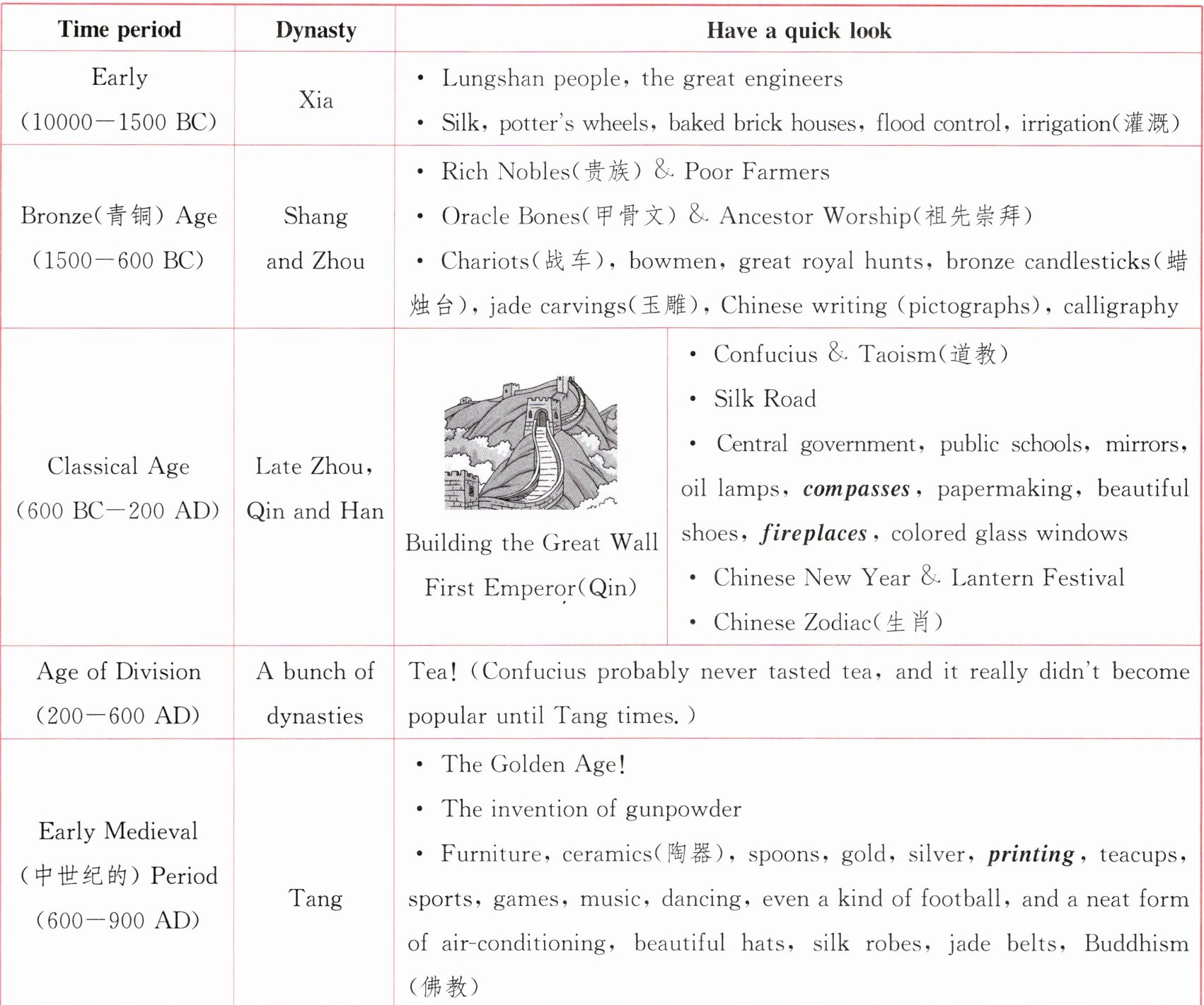 Building the Great Wall First Emperor(Qin)
• Confucius & Taoism(道教)
• Silk Road
• Central government, public schools, mirrors, oil lamps,compasses , papermaking, beautiful shoes, fireplaces , colored glass windows
• Chinese New Year & Lantern Festival
• Chinese Zodiac(生肖) |
| Age of Division (200-600 AD) | A bunch of dynasties | Tea! (Confucius probably never tasted tea, and it really didn't become popular until Tang times.) |
| Early Medieval (中世纪的) Period (600-900 AD) | Tang | • The Golden Age!
• The invention of gunpowder
• Furniture, ceramics(陶器), spoons, gold, silver,printing , teacups, sports, games, music, dancing, even a kind of football, and a neat form of air-conditioning, beautiful hats, silk robes, jade belts, Buddhism(佛教) |
素材来源: China Mrdonn
()1. 新考法·图片理解 Which of the following was invented in the Early Medieval Period?
A. B. C. D.
()2. What can we learn about the Early Medieval Period?
A. It was a period with little cultural development.
B. People there didn't like sports.
C. Buddhism was popular during this period.
D. There were no advanced tools.
()3. Which of the following is the best title for the passage?
A. Ancient Chinese Inventions
B. Dynasties in Ancient China
C. Time Periods and Features of Ancient China
D. Religious Development in Ancient China
A 热考内容 传统文化 KEY→P28
范畴:人与社会 主题:历史与文化 体裁:应用文 难度:★★★ 建议用时:7分钟 评价:/3
Civilization(文明) in ancient China began over 11,000 years ago. The study of ancient China is broken up into big blocks of time to help make the study of ancient China a lot easier. The sheet below provides a quick glance. I think you'll enjoy learning about ancient China!
| Time period | Dynasty | Have a quick look |
| --- | --- | --- |
| Early (10000-1500 BC) | Xia | • Lungshan people, the great engineers
• Silk, potter's wheels, baked brick houses, flood control, irrigation(灌溉) |
| Bronze(青铜) Age (1500-600 BC) | Shang and Zhou | • Rich Nobles(贵族) & Poor Farmers
• Oracle Bones(甲骨文) & Ancestor Worship(祖先崇拜)
• Chariots(战车), bowmen, great royal hunts, bronze candlesticks(蜡烛台), jade carvings(玉雕), Chinese writing (pictographs), calligraphy |
| Classical Age (600 BC-200 AD) | Late Zhou, Qin and Han |
Building the Great Wall First Emperor(Qin)• Confucius & Taoism(道教)
• Silk Road
• Central government, public schools, mirrors, oil lamps,
• Chinese New Year & Lantern Festival
• Chinese Zodiac(生肖) |
| Age of Division (200-600 AD) | A bunch of dynasties | Tea! (Confucius probably never tasted tea, and it really didn't become popular until Tang times.) |
| Early Medieval (中世纪的) Period (600-900 AD) | Tang | • The Golden Age!
• The invention of gunpowder
• Furniture, ceramics(陶器), spoons, gold, silver,
素材来源: China Mrdonn
()1. 新考法·图片理解 Which of the following was invented in the Early Medieval Period?
A.
B. C. D.()2. What can we learn about the Early Medieval Period?
A. It was a period with little cultural development.
B. People there didn't like sports.
C. Buddhism was popular during this period.
D. There were no advanced tools.
()3. Which of the following is the best title for the passage?
A. Ancient Chinese Inventions
B. Dynasties in Ancient China
C. Time Periods and Features of Ancient China
D. Religious Development in Ancient China
答案
BCC
