

 登录
登录
六、按要求完成下列各题。
1. My weekend was fun.(对画线部分提问)
2. Binbin watched a football match last Sunday.(对画线部分提问)
3. We climbed a hill in the park. We rowed a boat in the park.(合并为一句话)
4. They saw a big elephant.(改为一般疑问句)
5. What did you do last Saturday afternoon?(根据实际情况回答)
1. My weekend was fun.(对画线部分提问)
2. Binbin watched a football match last Sunday.(对画线部分提问)
3. We climbed a hill in the park. We rowed a boat in the park.(合并为一句话)
4. They saw a big elephant.(改为一般疑问句)
5. What did you do last Saturday afternoon?(根据实际情况回答)
答案
1. How was your weekend?
2. What did Binbin do last Sunday?
3. We climbed a hill and rowed a boat in the park.
4. Did they see a big elephant?
5. 示例:I played badminton with my father last Saturday afternoon.(答案不唯一,符合一般过去时、逻辑通顺即可)
2. What did Binbin do last Sunday?
3. We climbed a hill and rowed a boat in the park.
4. Did they see a big elephant?
5. 示例:I played badminton with my father last Saturday afternoon.(答案不唯一,符合一般过去时、逻辑通顺即可)
解析
1. 画线部分fun是描述周末的感受,对感受提问用特殊疑问词How,原句为一般过去时,be动词用was,同时将第一人称的my改为第二人称的your,即可得到正确问句。
2. 画线部分是过去发生的动作内容,对动作提问用特殊疑问词What,一般过去时的疑问句需要借助助动词did,后面的谓语动词要还原为原形do。
3. 两个原句主语、地点状语都一致,仅谓语动作不同,可以用并列连词and连接两个谓语动作,删去重复的部分,合并为简洁的单句。
4. 原句是一般过去时,谓语是实义动词see的过去式saw,改为一般疑问句时,需要把助动词Did放在句首,同时将谓语动词还原为原形see。
5. 本题为开放性题目,回答需要使用一般过去时,描述自己上周六下午实际做的合理活动即可,给出符合要求的示例。
2. 画线部分是过去发生的动作内容,对动作提问用特殊疑问词What,一般过去时的疑问句需要借助助动词did,后面的谓语动词要还原为原形do。
3. 两个原句主语、地点状语都一致,仅谓语动作不同,可以用并列连词and连接两个谓语动作,删去重复的部分,合并为简洁的单句。
4. 原句是一般过去时,谓语是实义动词see的过去式saw,改为一般疑问句时,需要把助动词Did放在句首,同时将谓语动词还原为原形see。
5. 本题为开放性题目,回答需要使用一般过去时,描述自己上周六下午实际做的合理活动即可,给出符合要求的示例。
七、问答匹配。
A. Did you do your homework last night?
B. Let's climb the hill in the park.
C. What did your father d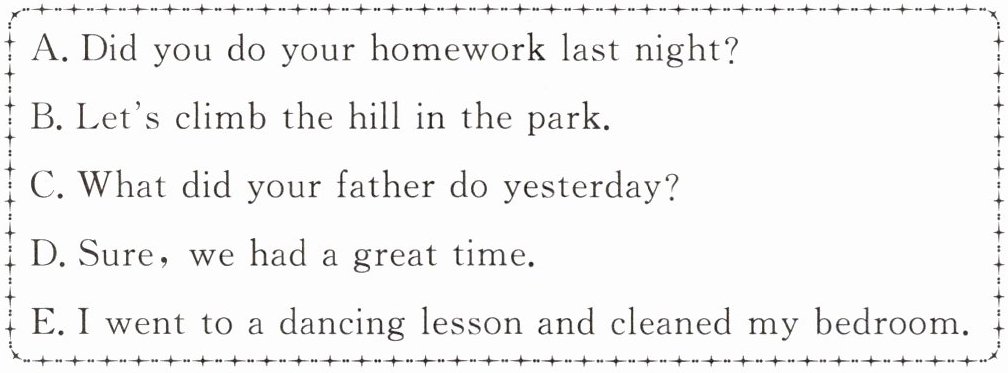 esterday?
D. Sure, we had a great time.
E. I went to a dancing lesson and cleaned my bedroom.
()1. —What did you do last weekend?
—
()2. —Did you have a good time on Saturday afternoon?
—
()3. —
—No, I didn't.
()4. —
—Good idea.
()5. —
—He visited my grandparents with my mom.
A. Did you do your homework last night?
B. Let's climb the hill in the park.
C. What did your father d
esterday?D. Sure, we had a great time.
E. I went to a dancing lesson and cleaned my bedroom.
()1. —What did you do last weekend?
—
()2. —Did you have a good time on Saturday afternoon?
—
()3. —
—No, I didn't.
()4. —
—Good idea.
()5. —
—He visited my grandparents with my mom.
答案
1. E
2. D
3. A
4. B
5. C
2. D
3. A
4. B
5. C
解析
我们逐一匹配问答:
1. 第一题问句询问对方上周末做了什么,E选项“我去上了一节舞蹈课,还打扫了我的卧室”是对应动作的回答,符合语境。
2. 第二题问句询问对方周六下午是否玩得开心,D选项“当然,我们玩得很愉快”是对应问题的肯定回应,二者匹配。
3. 第三题答句是一般过去时一般疑问句的否定回答"No, I didn't.",A选项“你昨晚做作业了吗?”是对应的一般疑问句,符合答句要求。
4. 第四题答句"Good idea.(好主意)"是对他人提议的赞同,B选项“我们去公园爬山吧”是提出建议的祈使句,二者匹配。
5. 第五题答句描述了男性长辈的活动,C选项“你爸爸昨天做了什么?”是对应人物的特殊疑问句,完全匹配。
1. 第一题问句询问对方上周末做了什么,E选项“我去上了一节舞蹈课,还打扫了我的卧室”是对应动作的回答,符合语境。
2. 第二题问句询问对方周六下午是否玩得开心,D选项“当然,我们玩得很愉快”是对应问题的肯定回应,二者匹配。
3. 第三题答句是一般过去时一般疑问句的否定回答"No, I didn't.",A选项“你昨晚做作业了吗?”是对应的一般疑问句,符合答句要求。
4. 第四题答句"Good idea.(好主意)"是对他人提议的赞同,B选项“我们去公园爬山吧”是提出建议的祈使句,二者匹配。
5. 第五题答句描述了男性长辈的活动,C选项“你爸爸昨天做了什么?”是对应人物的特殊疑问句,完全匹配。
