

 登录
登录
(
—I'm sorry. I won't do it again.
A.drives
B.drive
C.are driving
D.drove
C
)1. (2026·宿迁泗洪期末)—Dad, please don't make a phone call. You a car.—I'm sorry. I won't do it again.
A.drives
B.drive
C.are driving
D.drove
答案
1.C [解析]考查现在进行时。句意:——爸爸,请不要打电话。你正在开车。——对不起。我不会再这样做了。drive意为“驾驶,开车”,是动词。根据“Dad, please don't make a phone call.”可知,爸爸正在开车,应用现在进行时,其谓语结构是“be+doing”。故选 C。
(
A.$\underline{\mathrm{Ch}}$ina
B.$\underline{\mathrm{ch}}$icken
C.$\underline{\mathrm{Ch}}$ristmas
D.tea$\underline{\mathrm{ch}}$
C
)2.(2026·连云港期末)Which underlined part of the four words has a different sound?A.$\underline{\mathrm{Ch}}$ina
B.$\underline{\mathrm{ch}}$icken
C.$\underline{\mathrm{Ch}}$ristmas
D.tea$\underline{\mathrm{ch}}$
答案
2.C [解析]考查语音知识。句意:这四个单词中哪个画线部分的发音不同? China /'tʃaɪnə/;chicken /'tʃɪkɪn/;Christmas /'krɪsməs/;teach /tiːtʃ/。根据音标可知,A、B、D 三项画线部分的发音均为 /tʃ/,C 项的画线部分发音为 /k/,与其他三项的画线部分发音不同。故选 C。
(
—Yes. We should say thanks to after school today.
A.them; they
B.them; them
C.they; them
D.they; they
C
)3.(2026·常州外国语学校期中)—I think are kind enough to help with our problems.—Yes. We should say thanks to after school today.
A.them; they
B.them; them
C.they; them
D.they; they
答案
3.C [解析]考查代词辨析。句意:——我认为他们足够友善,愿意帮助我们解决问题。——是的。今天放学后我们应该感谢他们。them 他/她/它们,人称代词的宾格;they 他/她/它们,人称代词的主格。第一空在动词“think”后的宾语从句中作主语,应用主格 they;第二空在介词“to”后作宾语,应用宾格 them。故选 C。
(
—I was not in the mood(没有心情) for it. I just made a at the answers.
A.plan
B.guess
C.wish
D.note
B
)4. —You got a low score in the test.—I was not in the mood(没有心情) for it. I just made a at the answers.
A.plan
B.guess
C.wish
D.note
答案
4.B [解析]考查名词辨析。句意:——你这次考试分数很低。——我当时没有心情考试。答案都是猜的。plan 计划;guess 猜测;wish 希望;note 笔记。make a guess at...意为“对……作猜测”,为固定搭配。故选 B。
(
A.the Double Ninth Festival
B.the Lantern Festival
C.the Mid-Autumn Festival
D.the Dragon Boat Festival
B
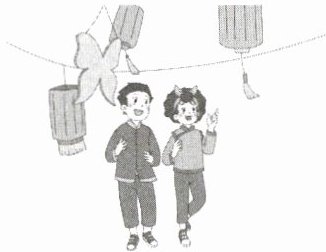
)5. 新考法 图片理解 Look at the picture on the right. The people are celebrating .A.the Double Ninth Festival
B.the Lantern Festival
C.the Mid-Autumn Festival
D.the Dragon Boat Festival
答案
5.B [解析]考查图片理解与常识。句意:看右边的图片。人们正在庆祝元宵节。the Double Ninth Festival 重阳节;the Lantern Festival 元宵节;the Mid-Autumn Festival 中秋节;the Dragon Boat Festival 端午节。根据图片可知,图片中有灯笼,人们在赏花灯,因此人们在庆祝元宵节。故选 B。
(
—Yes. of them are interesting.
A.Every
B.Both
C.All
D.Each
B
)6. (2026·淮安开明中学期中)—Do you like Chinese and English classes?—Yes. of them are interesting.
A.Every
B.Both
C.All
D.Each
答案
6.B [解析]考查词语辨析。句意:——你喜欢语文课和英语课吗? ——是的。这两门课都很有趣。every 每个;both 两个都;all 全部;each 每个。根据“Chinese and English classes”和“... of them are”可知,谈论的是两门学科,用both 表示“两个都”。故选 B。
(
—Oh, it's the door.
A.under
B.behind
C.in
D.above
B
)7. —Where is my dog? I can't find it.—Oh, it's the door.
A.under
B.behind
C.in
D.above
答案
7.B [解析]考查介词辨析。句意:——我的狗在哪里? 我找不到它了。——哦,它在门后面。under 在……下面;behind 在……后面;in 在……里面;above 在……上面。根据“I can't find it.”及常识可知,狗通常会躲在门后面。故选 B。
(
— eight o'clock this morning.
A.At; in
B.At; on
C.At; /
D.In; in
C
)8. —What time did you find the bird fly into your bedroom?— eight o'clock this morning.
A.At; in
B.At; on
C.At; /
D.In; in
答案
8.C [解析]考查介词辨析。句意:——你几点发现那只鸟飞进你的卧室的? ——今天早上八点。at 后接具体的时间点;on 后接具体某一天或具体某一天的上午、下午或晚上;in 后接年、月、季节。“eight o'clock”是具体的时间点,前面应用 at,且位于句首,首字母应大写,第一空应用 At;当morning 前有 this、that 等修饰词时,其前不用加介词,第二空不填介词。故选 C。
(
Mum?
—Why not? Let's go.
A.some; some
B.any; any
C.some; any
D.any; some
D
)9. —We don't have drinks. Can we buy ,Mum?
—Why not? Let's go.
A.some; some
B.any; any
C.some; any
D.any; some
答案
9.D [解析]考查 some 和 any 的用法。句意:——我们没有饮料了。妈妈,我们可以买一些吗? ——为什么不呢? 咱们走吧。some 一些;any 任一的,任何的。根据“We don't →some 用于肯定句或希望得到对方肯定回答的疑问句中; any 用于否定句或疑问句中。have...drinks.”可知,句子为否定句,所以第一空应用any;根据“Can we buy..., Mum?”可知,此处提出请求并希望得到对方的肯定回答,第二空应用 some。故选 D。
