

 登录
登录
During ancient times, children didn't have smartphones, iPads or computers.
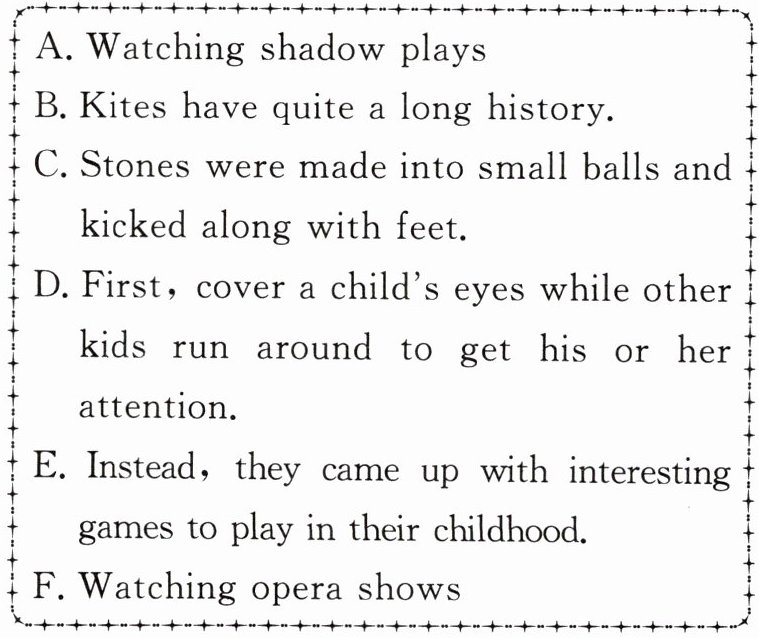
6. Let’s take a look.
Flying kites
7. The earliest kites were made of wood, instead of paper. Nowadays, the three most famous kites are the Beijing kite, Tianjin kite and Weifang kite, which each has distinctive features. The swallow-shaped kite is a well-known Beijing style.
8.
The closest thing to watching a film or television for fun during ancient times was going to see a shadow play. Folk artists control puppets behind the screen, telling stories. During the Qing Dynasty, shadow play art reached its peak, and was staged for each major occasion.
Stone balls
During the Qing Dynasty, kicking a stone ball around was a popular sport in the northern part of China, and it was often played in winter to keep warm. 9. And this game is still popular till today in Beijing.
Hide-and-seek
Hide-and-seek is a traditional game for children, popular around the nation. There are two ways to play. 10. Second, more commonly, other children hide and one child must try to find them.
C
day, they, age, science, language, colour, ever, only, choice, interest, other
Building blocks(积木) are still one of the most popular toys today. Children of all 11. like them because of their interesting design. They are always the best 12. as gifts. Most traditional toys, like building blocks, were first made of wood. Today, wooden building blocks are still used, but now there are several other types of building blocks to choose from, like plastic building blocks.
Children build all kinds of things that they see in 13. life with building blocks. This gives 14. the chance to learn the latest things and life skills.
Building blocks can help children practise their 15. skills. Most children talk to each other as they build
things with these traditional toys. This type of toy also helps develop the skills that children need in life. As they begin to join groups playing with building blocks, they learn to take turns, share, and solve problems with 16. ______ . However, these are not the 17. ______ advantages of playing with building blocks.
Building blocks can also help develop children’s skills in math and 18. . They allow children to work according to the steps of scientific discovery, which are first to watch and think, and then to test. Building blocks also come in different shapes, 19. and sizes. These types of building blocks encourage children to develop skills in dividing things.
Playing with building blocks is both fun and very 20. . Maybe that is the reason why building blocks are still popular today.
6. Let’s take a look.
Flying kites
7. The earliest kites were made of wood, instead of paper. Nowadays, the three most famous kites are the Beijing kite, Tianjin kite and Weifang kite, which each has distinctive features. The swallow-shaped kite is a well-known Beijing style.
8.
The closest thing to watching a film or television for fun during ancient times was going to see a shadow play. Folk artists control puppets behind the screen, telling stories. During the Qing Dynasty, shadow play art reached its peak, and was staged for each major occasion.
Stone balls
During the Qing Dynasty, kicking a stone ball around was a popular sport in the northern part of China, and it was often played in winter to keep warm. 9. And this game is still popular till today in Beijing.
Hide-and-seek
Hide-and-seek is a traditional game for children, popular around the nation. There are two ways to play. 10. Second, more commonly, other children hide and one child must try to find them.
C
day, they, age, science, language, colour, ever, only, choice, interest, other
Building blocks(积木) are still one of the most popular toys today. Children of all 11. like them because of their interesting design. They are always the best 12. as gifts. Most traditional toys, like building blocks, were first made of wood. Today, wooden building blocks are still used, but now there are several other types of building blocks to choose from, like plastic building blocks.
Children build all kinds of things that they see in 13. life with building blocks. This gives 14. the chance to learn the latest things and life skills.
Building blocks can help children practise their 15. skills. Most children talk to each other as they build
things with these traditional toys. This type of toy also helps develop the skills that children need in life. As they begin to join groups playing with building blocks, they learn to take turns, share, and solve problems with 16. ______ . However, these are not the 17. ______ advantages of playing with building blocks.
Building blocks can also help develop children’s skills in math and 18. . They allow children to work according to the steps of scientific discovery, which are first to watch and think, and then to test. Building blocks also come in different shapes, 19. and sizes. These types of building blocks encourage children to develop skills in dividing things.
Playing with building blocks is both fun and very 20. . Maybe that is the reason why building blocks are still popular today.
答案
B篇 本文主要介绍了中国古代儿童玩的游戏。
6.E 7.B 8.A 9.C 10.D
C篇 本文介绍了积木。
11.ages 12.choices 13.daily 14.them 15.language
16.others 17.only 18.science 19.colours 20.interesting
6.E 7.B 8.A 9.C 10.D
C篇 本文介绍了积木。
11.ages 12.choices 13.daily 14.them 15.language
16.others 17.only 18.science 19.colours 20.interesting
解析
【分析】
1. B篇(七选五):需结合上下文逻辑衔接解题。第6题承接“古代儿童无现代设备”,引出古代游戏;第7题围绕“风筝”主题,引出风筝历史;第8题对应下文“皮影戏”;第9题承接“石球”的玩法;第10题结合后文“second”,对应捉迷藏的第一种玩法。
2. C篇(完形填空):需结合固定搭配、语境及词性解题。如“children of all ages”是固定搭配,“daily life”为固定短语,结合上下文语义确定词汇。
【解析】
B篇(七选五):
6. 选E:前文说古代儿童无现代电子产品,E句“他们想出了有趣的童年游戏”承上启下,引出下文介绍的游戏,符合逻辑。
7. 选B:本段主题为风筝,B句“风筝有很长的历史”引出后文对风筝起源(木头制)的描述,契合主题。
8. 选A:后文介绍皮影戏,A句“看皮影戏”作为本段主题句,衔接下文内容。
9. 选C:本段主题为石球,C句“石头被做成小球用脚踢”承接前文“踢石球”的活动,对应石球的玩法。
10. 选D:本段讲捉迷藏,后文有“second”,D句“第一个玩法”符合顺序逻辑,对应捉迷藏的两种玩法。
C篇(完形填空):
11. ages:固定搭配“children of all ages”(各年龄段的孩子),填ages。
12. choices:“best”后接名词复数,意为“作为礼物的最佳选择”,填choices。
13. daily:固定搭配“daily life”(日常生活),填daily。
14. them:give后接宾格,指代children,填them。
15. language:后文提到“talk to each other”,对应“语言技能”,填language。
16. others:意为“和其他人解决问题”,填others。
17. only:意为“不是唯一的好处”,填only。
18. science:与math并列,意为“数学和科学”,填science。
19. colours:与shapes、sizes并列,意为“形状、颜色和大小”,复数形式,填colours。
20. interesting:与fun并列,意为“有趣的”,填interesting。
【答案】
B篇:6.E 7.B 8.A 9.C 10.D
C篇:11.ages 12.choices 13.daily 14.them 15.language 16.others 17.only 18.science 19.colours 20.interesting
【知识点】
七选五语境衔接、完形填空词汇运用、固定搭配
【点评】
本题分为七选五和完形填空两部分,七选五考查上下文逻辑衔接能力,完形填空考查词汇、固定搭配及语境理解能力,整体难度适中,学生需结合语境和词汇知识作答。
【难度系数】
0.6
1. B篇(七选五):需结合上下文逻辑衔接解题。第6题承接“古代儿童无现代设备”,引出古代游戏;第7题围绕“风筝”主题,引出风筝历史;第8题对应下文“皮影戏”;第9题承接“石球”的玩法;第10题结合后文“second”,对应捉迷藏的第一种玩法。
2. C篇(完形填空):需结合固定搭配、语境及词性解题。如“children of all ages”是固定搭配,“daily life”为固定短语,结合上下文语义确定词汇。
【解析】
B篇(七选五):
6. 选E:前文说古代儿童无现代电子产品,E句“他们想出了有趣的童年游戏”承上启下,引出下文介绍的游戏,符合逻辑。
7. 选B:本段主题为风筝,B句“风筝有很长的历史”引出后文对风筝起源(木头制)的描述,契合主题。
8. 选A:后文介绍皮影戏,A句“看皮影戏”作为本段主题句,衔接下文内容。
9. 选C:本段主题为石球,C句“石头被做成小球用脚踢”承接前文“踢石球”的活动,对应石球的玩法。
10. 选D:本段讲捉迷藏,后文有“second”,D句“第一个玩法”符合顺序逻辑,对应捉迷藏的两种玩法。
C篇(完形填空):
11. ages:固定搭配“children of all ages”(各年龄段的孩子),填ages。
12. choices:“best”后接名词复数,意为“作为礼物的最佳选择”,填choices。
13. daily:固定搭配“daily life”(日常生活),填daily。
14. them:give后接宾格,指代children,填them。
15. language:后文提到“talk to each other”,对应“语言技能”,填language。
16. others:意为“和其他人解决问题”,填others。
17. only:意为“不是唯一的好处”,填only。
18. science:与math并列,意为“数学和科学”,填science。
19. colours:与shapes、sizes并列,意为“形状、颜色和大小”,复数形式,填colours。
20. interesting:与fun并列,意为“有趣的”,填interesting。
【答案】
B篇:6.E 7.B 8.A 9.C 10.D
C篇:11.ages 12.choices 13.daily 14.them 15.language 16.others 17.only 18.science 19.colours 20.interesting
【知识点】
七选五语境衔接、完形填空词汇运用、固定搭配
【点评】
本题分为七选五和完形填空两部分,七选五考查上下文逻辑衔接能力,完形填空考查词汇、固定搭配及语境理解能力,整体难度适中,学生需结合语境和词汇知识作答。
【难度系数】
0.6
