

 登录
登录
Ⅳ.补全对话(本题共6小题,每小题2分,满分12分)
从下面方框中选择合适的句子,填到横线上,使对话意思完整。
A:Hi,I got a call from my cousin yesterday. It was so funny!
B:
A:He's studying in New York now. We talked about our weekends,but something strange happened.
B:Really? That sounds fun!
A:When I called him,it was 8 p. m. on Saturday here. But it was only 7 a. m. the same day there!
B:Wow! What about his daily life?
A:You're right! He eats breakfast when we eat dinner.
B:
A:A little at first.
B:Me too!
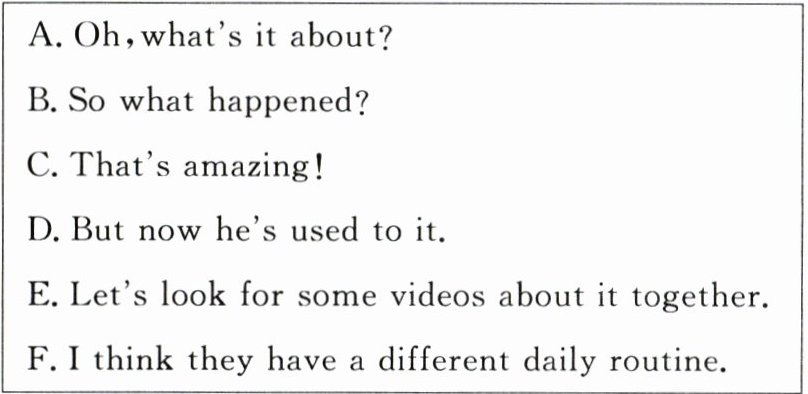
59.
63.
从下面方框中选择合适的句子,填到横线上,使对话意思完整。
A:Hi,I got a call from my cousin yesterday. It was so funny!
B:
A
59 I love hearing interesting stories.A:He's studying in New York now. We talked about our weekends,but something strange happened.
B:Really? That sounds fun!
B
60A:When I called him,it was 8 p. m. on Saturday here. But it was only 7 a. m. the same day there!
B:Wow! What about his daily life?
F
61A:You're right! He eats breakfast when we eat dinner.
B:
C
62 Does he feel tired because of the time difference?A:A little at first.
D
63 Well,I want to learn more about time zones.B:Me too!
E
6459.
A
60. B
61. F
62. C
63.
D
64. E
答案
59.A 60.B 61.F 62.C 63.D 64.E
解析
【分析】
补全对话需结合上下文语境分析逻辑衔接:59空A提及接到表弟电话很有趣,B应询问具体内容;60空A说有奇怪的事,B需问发生了什么;61空B问表弟的日常生活,需对应日常不同的表述;62空听到时差的事,B应表达感叹;63空A说一开始累,需转折说明现在的状态;64空双方想了解时区,需提议找相关资料。
【解析】
59. 上文A提到接到表弟的电话很有趣,B需询问具体内容,选A(Oh, what's it about?);
60. 上文A说聊周末时有奇怪的事,B需询问发生了什么,选B(So what happened?);
61. 上文B问表弟的日常生活,下文A回应“他吃早餐时我们吃晚餐”,说明日常不同,选F(I think they have a different daily routine.);
62. 上文A说时差的情况,B应表达感叹,选C(That's amazing!);
63. 上文A说一开始有点累,需转折说明现在的状态,选D(But now he's used to it.);
64. 上文双方都想了解时区,B应提议一起找相关资料,选E(Let's look for some videos about it together.)。
【答案】
59.A 60.B 61.F 62.C 63.D 64.E
【知识点】
补全对话、日常交际用语
【点评】
本题考查日常交际用语在补全对话中的运用,需结合上下文语境判断句子逻辑,难度适中,侧重语境理解能力。
【难度系数】
0.5
补全对话需结合上下文语境分析逻辑衔接:59空A提及接到表弟电话很有趣,B应询问具体内容;60空A说有奇怪的事,B需问发生了什么;61空B问表弟的日常生活,需对应日常不同的表述;62空听到时差的事,B应表达感叹;63空A说一开始累,需转折说明现在的状态;64空双方想了解时区,需提议找相关资料。
【解析】
59. 上文A提到接到表弟的电话很有趣,B需询问具体内容,选A(Oh, what's it about?);
60. 上文A说聊周末时有奇怪的事,B需询问发生了什么,选B(So what happened?);
61. 上文B问表弟的日常生活,下文A回应“他吃早餐时我们吃晚餐”,说明日常不同,选F(I think they have a different daily routine.);
62. 上文A说时差的情况,B应表达感叹,选C(That's amazing!);
63. 上文A说一开始有点累,需转折说明现在的状态,选D(But now he's used to it.);
64. 上文双方都想了解时区,B应提议一起找相关资料,选E(Let's look for some videos about it together.)。
【答案】
59.A 60.B 61.F 62.C 63.D 64.E
【知识点】
补全对话、日常交际用语
【点评】
本题考查日常交际用语在补全对话中的运用,需结合上下文语境判断句子逻辑,难度适中,侧重语境理解能力。
【难度系数】
0.5
Ⅴ.读写题(本题共分两节,满分15分)
第一节 阅读短文,根据语篇内容,在方框内的缩写文章中,填入与短文意思最符合的单词,每空一词。(共6小题,每小题1分,满分6分)
In China,it's common to have breakfast,lunch and dinner every day.
People usually have baozi, youtiao and soya milk for breakfast. The breakfast time in China is usually from 7:00 a. m. to 9:00 a. m. Most Chinese students have classes at 8:00 a. m. , so they have breakfast at around 7:00 a. m.
Lunchtime is usually at about 12:00. Most Chinese have a quick lunch, so they can have time for a rest. Their lunch is usually noodles or rice with some vegetables and meat. Most people usually eat at school or their workplace. And some take their lunch box from home.
Dinner is a time to relax for many Chinese, because they have it with their family. The food is usually soup, meat, vegetables and rice. Dinner time is usually from 6:00 p. m. to 8:00 p. m. For restaurants,the busy time is from 7:00 p. m. to 10:00 p. m. There is one interesting thing in China. People don't leave the restaurant right away. After dinner,they usually talk and play games with their family or friends.
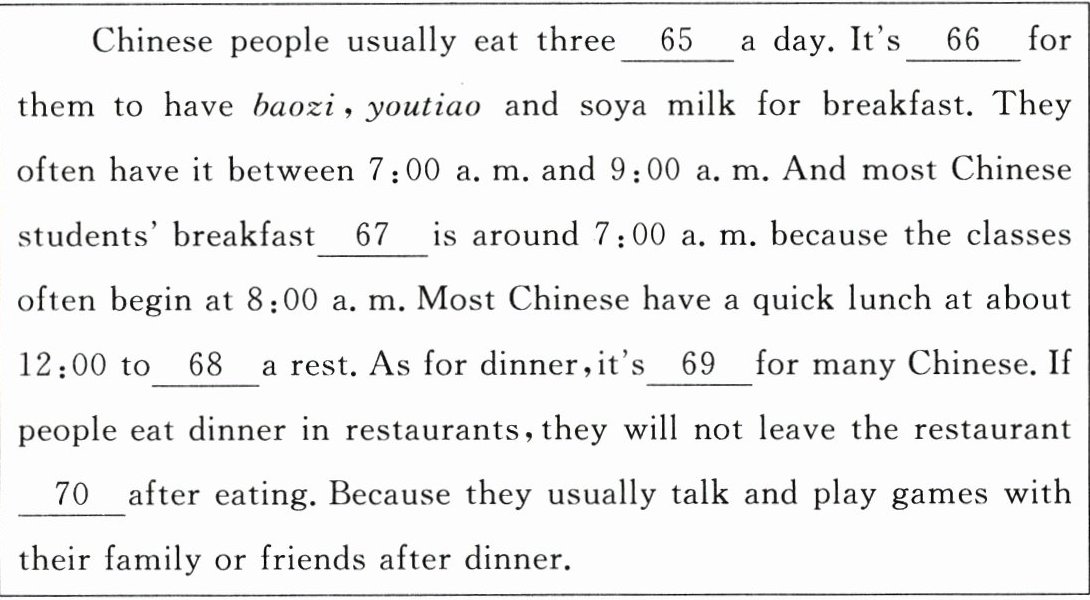
65. 66. 67. 68.
69. 70.
第二节 阅读短文,根据语篇内容,回答3个问题。(共3小题,每小题3分,满分9分)
71. Do Chinese people usually have dinner with their family?
72. Where do most Chinese people usually eat lunch?
73. What do you find interesting about Chinese dining habits?
Why?
第一节 阅读短文,根据语篇内容,在方框内的缩写文章中,填入与短文意思最符合的单词,每空一词。(共6小题,每小题1分,满分6分)
In China,it's common to have breakfast,lunch and dinner every day.
People usually have baozi, youtiao and soya milk for breakfast. The breakfast time in China is usually from 7:00 a. m. to 9:00 a. m. Most Chinese students have classes at 8:00 a. m. , so they have breakfast at around 7:00 a. m.
Lunchtime is usually at about 12:00. Most Chinese have a quick lunch, so they can have time for a rest. Their lunch is usually noodles or rice with some vegetables and meat. Most people usually eat at school or their workplace. And some take their lunch box from home.
Dinner is a time to relax for many Chinese, because they have it with their family. The food is usually soup, meat, vegetables and rice. Dinner time is usually from 6:00 p. m. to 8:00 p. m. For restaurants,the busy time is from 7:00 p. m. to 10:00 p. m. There is one interesting thing in China. People don't leave the restaurant right away. After dinner,they usually talk and play games with their family or friends.
65. 66. 67. 68.
69. 70.
第二节 阅读短文,根据语篇内容,回答3个问题。(共3小题,每小题3分,满分9分)
71. Do Chinese people usually have dinner with their family?
72. Where do most Chinese people usually eat lunch?
73. What do you find interesting about Chinese dining habits?
Why?
答案
65.meals 66.common 67.time 68.take/have 69.relaxing 70.soon
71. Yes,they do.
72. At school or their workplace.
73. Sharing food from big plates in the middle. Because it's fun and friendly.(开放性问题,回答合理即可)
71. Yes,they do.
72. At school or their workplace.
73. Sharing food from big plates in the middle. Because it's fun and friendly.(开放性问题,回答合理即可)
解析
【分析】
本题分为两节,第一节为英语语篇填空,需结合上下文语境、词汇含义及固定搭配填写合适的单词;第二节为阅读理解问答,需定位原文信息准确作答,开放性问题需结合短文内容合理表达。解题时先通读短文把握主旨,再逐空分析,问答部分对应原文细节即可。
【解析】
第一节填空:
65. 前文提到“eat three...a day”,结合常识及短文,中国人一天吃三餐,故填meals;
66. 后文列举早餐常见食物,说明这种早餐搭配很普遍,故填common;
67. 后文提到具体时间“around 7:00 a.m.”,此处指早餐时间,故填time;
68. 固定搭配“take/have a rest”表示休息,符合语境,故填take/have;
69. 后文提到晚餐时人们会和家人朋友聊天游戏,说明晚餐是放松的,故填relaxing;
70. 固定搭配“not...soon”表示不立刻,符合“不会马上离开餐厅”的语境,故填soon;
第二节问答:
71. 原文明确提到“they have it with their family”,故回答Yes,they do.;
72. 原文直接说明“Most people usually eat at school or their workplace.”,直接提取即可;
73. 开放性问题,结合短文提到的晚餐习惯,示例回答合理即可。
【答案】
65.meals 66.common 67.time 68.take/have 69.relaxing 70.soon
71. Yes,they do.
72. At school or their workplace.
73. Sharing food from big plates in the middle. Because it's fun and friendly.(开放性问题,回答合理即可)
【知识点】
英语语篇填空、阅读理解、固定搭配
【点评】
本题考查学生对英语短文的理解与运用能力,基础填空部分侧重词汇和语境理解,问答部分侧重信息定位,开放性问题能考查学生的表达能力,整体难度适中。
【难度系数】
0.5
本题分为两节,第一节为英语语篇填空,需结合上下文语境、词汇含义及固定搭配填写合适的单词;第二节为阅读理解问答,需定位原文信息准确作答,开放性问题需结合短文内容合理表达。解题时先通读短文把握主旨,再逐空分析,问答部分对应原文细节即可。
【解析】
第一节填空:
65. 前文提到“eat three...a day”,结合常识及短文,中国人一天吃三餐,故填meals;
66. 后文列举早餐常见食物,说明这种早餐搭配很普遍,故填common;
67. 后文提到具体时间“around 7:00 a.m.”,此处指早餐时间,故填time;
68. 固定搭配“take/have a rest”表示休息,符合语境,故填take/have;
69. 后文提到晚餐时人们会和家人朋友聊天游戏,说明晚餐是放松的,故填relaxing;
70. 固定搭配“not...soon”表示不立刻,符合“不会马上离开餐厅”的语境,故填soon;
第二节问答:
71. 原文明确提到“they have it with their family”,故回答Yes,they do.;
72. 原文直接说明“Most people usually eat at school or their workplace.”,直接提取即可;
73. 开放性问题,结合短文提到的晚餐习惯,示例回答合理即可。
【答案】
65.meals 66.common 67.time 68.take/have 69.relaxing 70.soon
71. Yes,they do.
72. At school or their workplace.
73. Sharing food from big plates in the middle. Because it's fun and friendly.(开放性问题,回答合理即可)
【知识点】
英语语篇填空、阅读理解、固定搭配
【点评】
本题考查学生对英语短文的理解与运用能力,基础填空部分侧重词汇和语境理解,问答部分侧重信息定位,开放性问题能考查学生的表达能力,整体难度适中。
【难度系数】
0.5
