

 登录
登录
(
A.send
B.trust
C.block
D.drive
D
)5.[2025·合肥四十五中期末]Sometimes, life's big challenges can finally us to discover our true power.A.send
B.trust
C.block
D.drive
答案
5.D
解析
【分析】首先理解句子语境:生活中的重大挑战能______我们发现自身真正的力量。解题思路是:先明确四个选项动词的含义,再结合语境和固定搭配判断最合适的选项。
【解析】句子意为:有时候,生活中的重大挑战最终能驱使我们发现自己真正的力量。逐一分析选项:A.send意为“发送”,不符合语境;B.trust意为“信任”,主语是“challenges(挑战)”,无法发出“信任”的动作,排除;C.block意为“阻塞”,不符合句意;D.drive意为“驱使”,固定搭配drive sb to do sth表示“驱使某人做某事”,符合语境和语法,故选D。
【答案】D
【知识点】动词词义辨析;固定搭配
【点评】本题考查动词词义辨析及固定搭配的运用,需结合语境理解动词含义,掌握常见动词的常用搭配。
【难度系数】0.5
【解析】句子意为:有时候,生活中的重大挑战最终能驱使我们发现自己真正的力量。逐一分析选项:A.send意为“发送”,不符合语境;B.trust意为“信任”,主语是“challenges(挑战)”,无法发出“信任”的动作,排除;C.block意为“阻塞”,不符合句意;D.drive意为“驱使”,固定搭配drive sb to do sth表示“驱使某人做某事”,符合语境和语法,故选D。
【答案】D
【知识点】动词词义辨析;固定搭配
【点评】本题考查动词词义辨析及固定搭配的运用,需结合语境理解动词含义,掌握常见动词的常用搭配。
【难度系数】0.5
Ⅰ. 阅读理解 时文阅读
Ma Junhe, a 14-year-old student from Henan Province, recently made a telescope (望远镜). The telescope only cost 70 yuan, but it works so well that he can even see things on the moon clearly.
After learning about Newtonian Reflector Telescopes (牛顿式反射望远镜) in class, he thought he could try to make one at home. So, he decided to have a try.
He didn't have a lot of money to put his idea into practice, so he felt a little sad. But he didn't give up and came up with lots of clever ideas. For example, the telescope pipe was made from a waste plastic pipe, and he used his drum set to hold the whole telescope.
Ma faced many challenges along the way. First, he used cardboard (硬纸板) to make a lens cone(镜筒), as taught in class, but it didn't work well. At that time, he was even disappointed with himself. With his teacher's advice and help, he used a plastic pipe instead. When he set up the eyepiece(目镜), which was much smaller than the pipe's opening, he had to try many times to make sure it fit and could be changed easily.
After failing over 10 times, Ma finally succeeded. His telescope can magnify 90 times, allowing him to clearly see the moon's surface. This is
more powerful than many common telescopes. Most of them usually have a magnification of 20 to 50 times.
" Seeing the moon's surface through my telescope made me feel so excited and proud," said Ma. " With enough effort, even with little money, anyone can create something amazing. "
(
A. By showing numbers.
B. By asking a question.
C. By giving an example.
D. By telling the differences.
(
A. The challenges Ma faced and how he fixed them.
B. How Ma got money for the telescope.
C. Why Ma's science teacher helped him.
D. Where Ma bought the telescope materials.
(
A. Make. . . look shorter.
B. Make. . . look stronger.
C. Make. . . look better.
D. Make. . . look bigger.
(
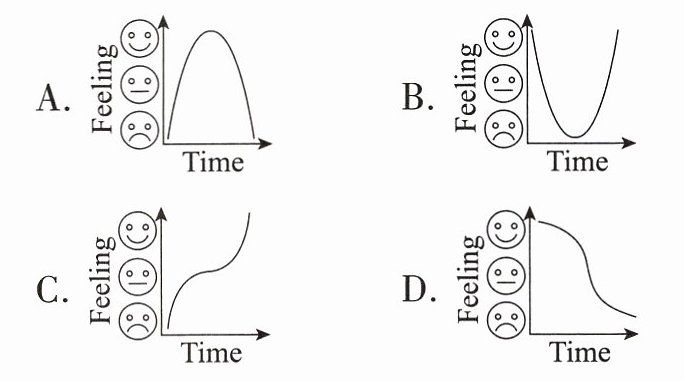
A. Feeling Time
B. Feeling Time
C. Feeling Time
D. Feeling Time
(
①Ma got advice on using a plastic pipe.
②Ma tried making a lens cone with cardboard.
③Ma succeeded with plastic pipes.
④Ma learnt about telescopes in class.
A. ②→①→④→③
B. ③→④→①→②
C. ①→③→②→④
D. ④→②→①→③
Ma Junhe, a 14-year-old student from Henan Province, recently made a telescope (望远镜). The telescope only cost 70 yuan, but it works so well that he can even see things on the moon clearly.
After learning about Newtonian Reflector Telescopes (牛顿式反射望远镜) in class, he thought he could try to make one at home. So, he decided to have a try.
He didn't have a lot of money to put his idea into practice, so he felt a little sad. But he didn't give up and came up with lots of clever ideas. For example, the telescope pipe was made from a waste plastic pipe, and he used his drum set to hold the whole telescope.
Ma faced many challenges along the way. First, he used cardboard (硬纸板) to make a lens cone(镜筒), as taught in class, but it didn't work well. At that time, he was even disappointed with himself. With his teacher's advice and help, he used a plastic pipe instead. When he set up the eyepiece(目镜), which was much smaller than the pipe's opening, he had to try many times to make sure it fit and could be changed easily.
After failing over 10 times, Ma finally succeeded. His telescope can magnify 90 times, allowing him to clearly see the moon's surface. This is
more powerful than many common telescopes. Most of them usually have a magnification of 20 to 50 times.
" Seeing the moon's surface through my telescope made me feel so excited and proud," said Ma. " With enough effort, even with little money, anyone can create something amazing. "
(
C
)1. [新考法·写作手法] How does the writer support his idea in Paragraph 3?A. By showing numbers.
B. By asking a question.
C. By giving an example.
D. By telling the differences.
(
A
)2. What is Paragraph 4 mainly about?A. The challenges Ma faced and how he fixed them.
B. How Ma got money for the telescope.
C. Why Ma's science teacher helped him.
D. Where Ma bought the telescope materials.
(
D
)3. What does the underlined word "magnify" in Paragraph 5 mean?A. Make. . . look shorter.
B. Make. . . look stronger.
C. Make. . . look better.
D. Make. . . look bigger.
(
C
)4. [新考法·推断人物情绪变化] Which of the following best shows the changes in Ma's feelings in the story above?A. Feeling Time
B. Feeling Time
C. Feeling Time
D. Feeling Time
(
D
)5. [新考法·事件发展顺序] What was the correct order of the following events?①Ma got advice on using a plastic pipe.
②Ma tried making a lens cone with cardboard.
③Ma succeeded with plastic pipes.
④Ma learnt about telescopes in class.
A. ②→①→④→③
B. ③→④→①→②
C. ①→③→②→④
D. ④→②→①→③
答案
1.C 2.A 3.D 4.C 5.D
解析
【分析】
这是一篇关于学生自制望远镜的时文阅读,共5道题,分别考察写作手法、段落主旨、词义猜测、人物情绪变化、事件顺序。解题时需先通读全文,定位每个问题对应的段落,结合选项逐一分析:1. 第1题定位第3段,该段通过举例说明解决资金不足的方法;2. 第2题定位第4段,内容围绕制作中的挑战及解决方法;3. 第3题结合望远镜功能及上下文推断词义;4. 第4题梳理马君赫的情绪变化过程;5. 第5题按原文事件发展顺序排列。
【解析】
1. 第1题:第3段通过列举“用废塑料管道做镜筒、用鼓组固定望远镜”的具体例子,说明解决资金不足的方法,属于举例论证,故选C;
2. 第2题:第4段首句“Ma faced many challenges along the way”点明主旨,后续内容围绕制作望远镜时遇到的挑战及解决方法展开,故选A;
3. 第3题:望远镜的核心功能是放大物体,结合后文“清晰看到月球表面”,可推断划线词magnify意为“使…变大”,故选D;
4. 第4题:梳理马君赫的情绪变化:因没钱制作而难过→不放弃尝试→硬纸板镜筒失效时失望→老师帮助后→成功时兴奋自豪,对应选项C;
5. 第5题:原文事件发展顺序为:课堂学习望远镜(④)→尝试用硬纸板做镜筒(②)→老师建议换塑料管道(①)→成功制作望远镜(③),故顺序为④→②→①→③,选D。
【答案】
1.C 2.A 3.D 4.C 5.D
【知识点】
阅读理解细节理解、写作手法辨析、词义猜测
【点评】
本题为记叙文时文阅读,围绕学生自制望远镜的励志故事,考察多种基础阅读题型,贴近学生生活,需学生精准定位原文信息,分析逻辑关系,整体难度适中。
【难度系数】
0.6
这是一篇关于学生自制望远镜的时文阅读,共5道题,分别考察写作手法、段落主旨、词义猜测、人物情绪变化、事件顺序。解题时需先通读全文,定位每个问题对应的段落,结合选项逐一分析:1. 第1题定位第3段,该段通过举例说明解决资金不足的方法;2. 第2题定位第4段,内容围绕制作中的挑战及解决方法;3. 第3题结合望远镜功能及上下文推断词义;4. 第4题梳理马君赫的情绪变化过程;5. 第5题按原文事件发展顺序排列。
【解析】
1. 第1题:第3段通过列举“用废塑料管道做镜筒、用鼓组固定望远镜”的具体例子,说明解决资金不足的方法,属于举例论证,故选C;
2. 第2题:第4段首句“Ma faced many challenges along the way”点明主旨,后续内容围绕制作望远镜时遇到的挑战及解决方法展开,故选A;
3. 第3题:望远镜的核心功能是放大物体,结合后文“清晰看到月球表面”,可推断划线词magnify意为“使…变大”,故选D;
4. 第4题:梳理马君赫的情绪变化:因没钱制作而难过→不放弃尝试→硬纸板镜筒失效时失望→老师帮助后→成功时兴奋自豪,对应选项C;
5. 第5题:原文事件发展顺序为:课堂学习望远镜(④)→尝试用硬纸板做镜筒(②)→老师建议换塑料管道(①)→成功制作望远镜(③),故顺序为④→②→①→③,选D。
【答案】
1.C 2.A 3.D 4.C 5.D
【知识点】
阅读理解细节理解、写作手法辨析、词义猜测
【点评】
本题为记叙文时文阅读,围绕学生自制望远镜的励志故事,考察多种基础阅读题型,贴近学生生活,需学生精准定位原文信息,分析逻辑关系,整体难度适中。
【难度系数】
0.6
