

 登录
I Reading comprehension.
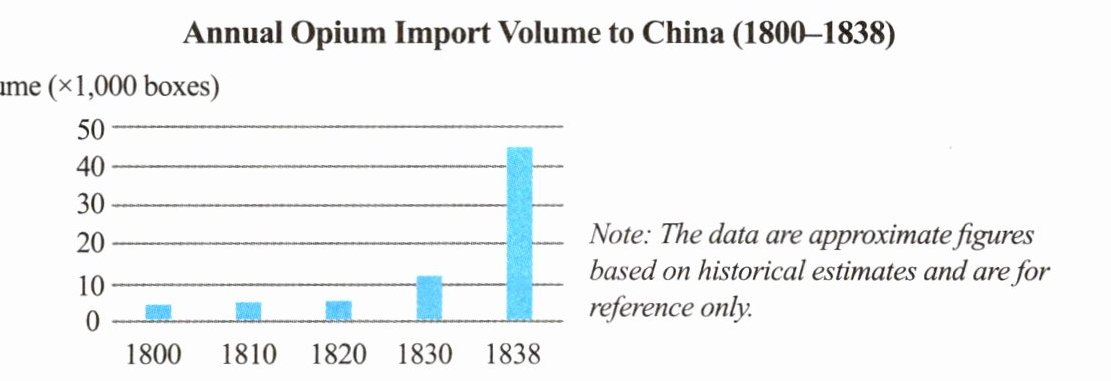
In the early 19th century, illegal opium smuggling(走私) caused a terrible crisis in the Qing Dynasty. As the bar chart below shows, the annual import volume of opium jumped sharply from about 4,000 boxes in the early 1800s to over 40,000 boxes by 1838. This trade drained massive silver reserves, ruined people’s health and weakened the whole country. As the crisis grew more serious, the Daoguang Emperor appointed Lin Zexu as Imperial Commissioner to stop the drug trade in Guangdong in 1838.
Lin Zexu was determined and responsible. He forced foreign drug dealers to hand in more than 21,000 boxes of opium. From June 3 to June 25, 1839, he supervised the public destruction of all opium at Humen Beach. Workers used seawater and quicklime to break down the drug and washed the waste into the sea. This historic event is called the Destruction of Opium at Humen, a powerful symbol of China’s fight against drugs.
Although the event triggered the First Opium War later, Lin Zexu is still respected as a national hero. His spirit reminds modern Chinese people to stay away from drugs forever, and June 3rd is regarded as a meaningful date for China’s anti-drug publicity.
(
A. Opium brought too much tax money to the government.
B. Opium damaged the economy and people’s health.
C. Foreign countries refused to sell other goods to China.
D. Lin Zexu asked the emperor to start a war.
(
A. 18 days B. 23 days C. 30 days D. 38 days
(
A. 1800–1810 B. 1810–1820
C. 1820–1830 D. 1830–1838
(
A. He started the First Opium War on purpose.
B. He destroyed the opium by burning it with fire.
C. He is remembered as a patriotic national hero.
D. He worked alone without any support from the government.
(
A. caused B. stopped C. avoided D. defeated
In the early 19th century, illegal opium smuggling(走私) caused a terrible crisis in the Qing Dynasty. As the bar chart below shows, the annual import volume of opium jumped sharply from about 4,000 boxes in the early 1800s to over 40,000 boxes by 1838. This trade drained massive silver reserves, ruined people’s health and weakened the whole country. As the crisis grew more serious, the Daoguang Emperor appointed Lin Zexu as Imperial Commissioner to stop the drug trade in Guangdong in 1838.
Lin Zexu was determined and responsible. He forced foreign drug dealers to hand in more than 21,000 boxes of opium. From June 3 to June 25, 1839, he supervised the public destruction of all opium at Humen Beach. Workers used seawater and quicklime to break down the drug and washed the waste into the sea. This historic event is called the Destruction of Opium at Humen, a powerful symbol of China’s fight against drugs.
Although the event triggered the First Opium War later, Lin Zexu is still respected as a national hero. His spirit reminds modern Chinese people to stay away from drugs forever, and June 3rd is regarded as a meaningful date for China’s anti-drug publicity.
(
B
)1. Why did the Qing government decide to ban opium?A. Opium brought too much tax money to the government.
B. Opium damaged the economy and people’s health.
C. Foreign countries refused to sell other goods to China.
D. Lin Zexu asked the emperor to start a war.
(
B
)2. How long did the Humen Opium Destruction last?A. 18 days B. 23 days C. 30 days D. 38 days
(
D
)3. According to the bar chart, which period saw the fastest increase in opium imports?A. 1800–1810 B. 1810–1820
C. 1820–1830 D. 1830–1838
(
C
)4. What can we learn about Lin Zexu from the passage?A. He started the First Opium War on purpose.
B. He destroyed the opium by burning it with fire.
C. He is remembered as a patriotic national hero.
D. He worked alone without any support from the government.
(
A
)5. The underlined word “triggered” in Paragraph 3 most probably means .A. caused B. stopped C. avoided D. defeated
答案
1—5 B B D C A
解析
【分析】
本题为结合历史背景的英语阅读理解题,需通过定位原文信息、分析图表数据、猜测词汇含义等方式解答各小题:
1. 第1题:定位原文第一段,提取清政府禁烟的原因;
2. 第2题:根据原文给出的虎门销烟起止日期,计算时间跨度;
3. 第3题:观察柱状图的变化幅度,判断鸦片进口增长最快的时期;
4. 第4题:定位原文关于林则徐的描述,匹配正确信息;
5. 第5题:结合上下文语境及历史背景,猜测划线词的词义。
【解析】
1. 第1题:原文第一段提到鸦片贸易“drained massive silver reserves(耗尽大量白银储备),ruined people’s health(损害民众健康)”,这是清政府禁烟的原因,对应选项B。
2. 第2题:原文明确虎门销烟从6月3日到6月25日,计算天数:25 - 3 + 1 = 23天,对应选项B。
3. 第3题:观察柱状图,1830-1838年的柱子增长幅度远大于其他时段,鸦片进口量从约12000箱增至约45000箱,增长最快,对应选项D。
4. 第4题:原文指出“Lin Zexu is still respected as a national hero”,说明他被铭记为爱国民族英雄,对应选项C。
5. 第5题:划线词所在句意为“这一事件引发了后来的第一次鸦片战争”,triggered意为“引发、导致”,对应选项A。
【答案】
1—5 B B D C A
【知识点】
英语阅读理解、词义猜测、历史常识
【点评】
本题结合虎门销烟的历史背景考查英语阅读能力,涵盖细节查找、时间计算、图表分析、词义猜测等题型,需学生准确提取信息并结合相关知识作答,难度适中。
【难度系数】
0.6
