

 登录
一、阅读理解。
阅读下面四篇语言材料,然后按文后要求做题。
A
Learn Spanish Fast — Speak Like a Local in 3 Months!
For: Children and adults
What You Get:
★Native teachers (all CELTA certified)
★Small classes (max 6 students)
★Daily 1-hour speaking + 30-minute grammar lesson
★Free e-textbooks + weekly progress tests
★Cultural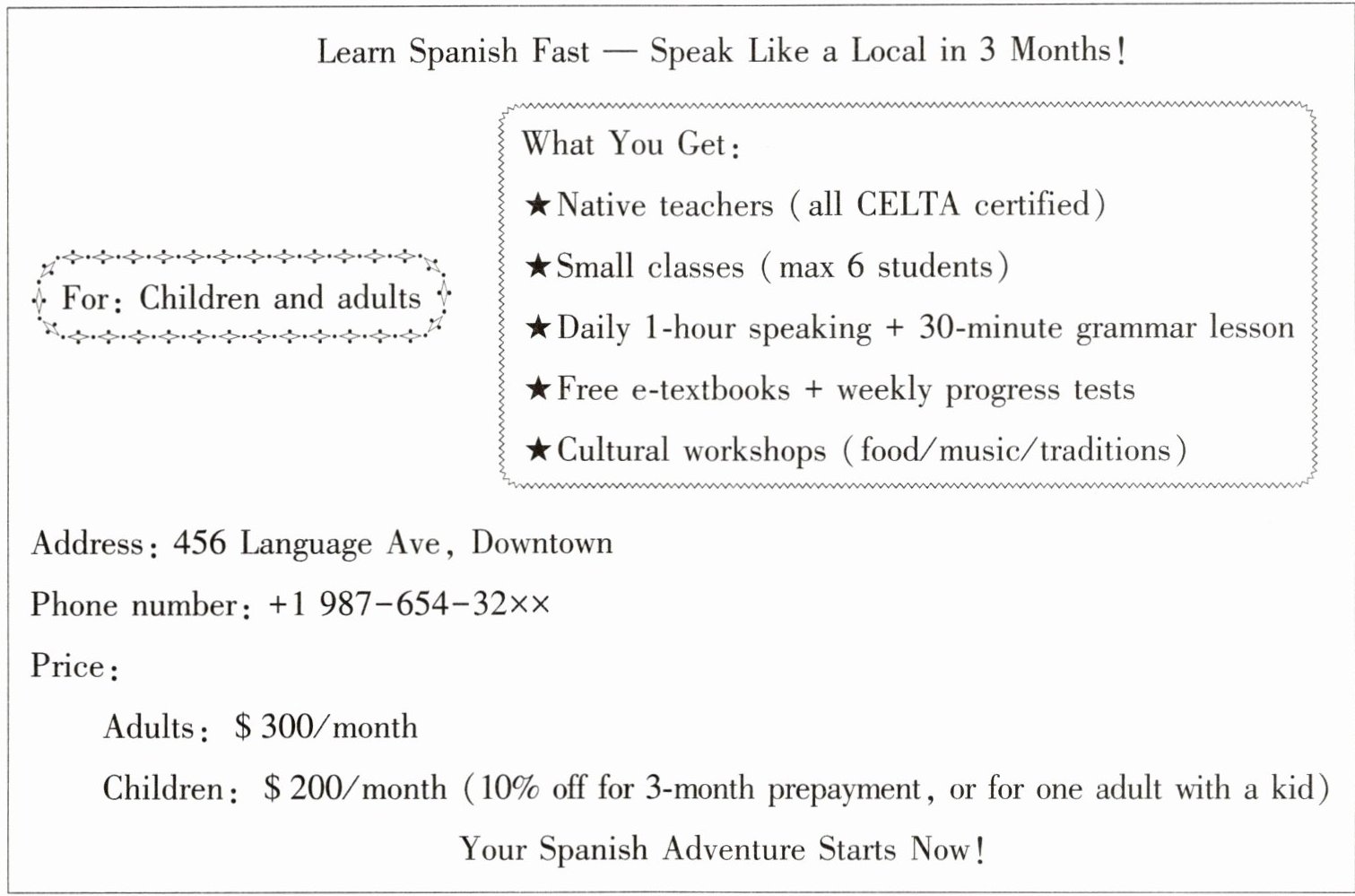 workshops (food/music/traditions)
Address: 456 Language Ave, Downtown
Phone number: +1 987-654-32××
Price:
Adults: $ 300/monthChildren: $ 200/month (10% off for 3-month prepayment, or for one adult with a kid)
Your Spanish Adventure Starts Now!
根据材料内容选择最佳选项。
(
A. Five. B. Seven.
C. Six. D. Twelve.
(
A. 30 minutes. B. An hour.
C. One and a half hours. D. Two hours.
(
A. Dance. B. Music.
C. Food. D. Traditions.
(
A. $ 300. B. $ 200.
C. $ 500. D. $ 450.
(
A. An ad. B. A diary.
C. A letter. D. A report.
阅读下面四篇语言材料,然后按文后要求做题。
A
Learn Spanish Fast — Speak Like a Local in 3 Months!
For: Children and adults
What You Get:
★Native teachers (all CELTA certified)
★Small classes (max 6 students)
★Daily 1-hour speaking + 30-minute grammar lesson
★Free e-textbooks + weekly progress tests
★Cultural
workshops (food/music/traditions)Address: 456 Language Ave, Downtown
Phone number: +1 987-654-32××
Price:
Adults: $ 300/monthChildren: $ 200/month (10% off for 3-month prepayment, or for one adult with a kid)
Your Spanish Adventure Starts Now!
根据材料内容选择最佳选项。
(
C
)1. How many students are there at most in one class?A. Five. B. Seven.
C. Six. D. Twelve.
(
B
)2. How long can a student spend speaking every day?A. 30 minutes. B. An hour.
C. One and a half hours. D. Two hours.
(
A
)3. What kind of cultural activities does the school not offer?A. Dance. B. Music.
C. Food. D. Traditions.
(
D
)4. How much will a mother need to pay every month if she wants to study in this school with her 8-year-old daughter?A. $ 300. B. $ 200.
C. $ 500. D. $ 450.
(
A
)5. What is the text?A. An ad. B. A diary.
C. A letter. D. A report.
答案
1. C 由 “Small classes ( max 6 students)” 可知,每班最多6名学生。
2. B 由 “Daily 1-hour speaking + 30-minute grammar lesson” 可知,学生每天将有一小时的口语活动时间。
3. A 由 “Cultural workshops ( food/music/traditions)” 可知,学校提供的文化活动中不包括dance。
4. D
5. A 综合内容可知,本文是一则招生广告。
解析
【分析】
这是一篇西班牙语培训课程的招生广告,属于应用文阅读。解题时需根据每道题的关键词快速定位原文对应信息,结合细节、计算、文本类型判断逐一匹配选项:第1题定位班级最大学生数;第2题定位每日口语时长;第3题定位文化活动内容;第4题结合价格规则计算总费用;第5题判断文本类型。
【解析】
1. 细节理解题:根据原文“Small classes (max 6 students)”可知,每班最多6名学生,对应选项C。
2. 细节理解题:根据原文“Daily 1-hour speaking + 30-minute grammar lesson”可知,学生每天有1小时的口语时间,对应选项B。
3. 细节理解题:根据原文“Cultural workshops (food/music/traditions)”可知,文化活动包含食物、音乐、传统,不包含舞蹈,对应选项A。
4. 计算题:妈妈是成人,每月费用300美元;女儿是儿童,因是一个成人带一个孩子,总费用享受10%折扣,总原价为300+200=500美元,折扣后为500×(1-10%)=450美元,对应选项D。
5. 推理判断题:文本包含课程内容、价格、联系方式等招生信息,属于广告,对应选项A。
【答案】
1. C 2. B 3. A 4. D 5. A
【知识点】
应用文阅读、细节理解、推理判断
【点评】
本题为应用文阅读理解题,考查学生快速定位原文信息、细节理解、简单计算及文本类型判断的能力,需仔细核对原文细节和规则,整体难度适中。
【难度系数】
0.6
B
People in different countries speak
different languages. But is there a language that can be understood by everyone in the world? If there is, the answer might be emojis(表情符号). They first appeared on the internet in 1982. Now they are widely used in our daily lives, such as in online communications.
Emojis are a kind of special language. Pictures are used to put meaning across. A group called the Unicode Consortium works on choosing emojis. It has added new emojis every year since 2014. They show what people think about and like.
Emojis can be used to stand for different groups of people. In 2015, emojis faces with different skin tones were added. In 2016, different jobs were added, such as doctor, police officer and painter. This year, emojis of disabled people were added, including emojis of blind people and people in wheelchairs.
But there is also more to emojis. ▲
In 2019, some emojis were added, including several animals, such as sloths (树懒) and flamingos (火烈鸟). These animals are not very common, but are known to many people. For example, sloths have become popular because of the 2016 film Zootopia (《疯狂动物城》). Many people seem to see themselves in real life through sloths: slow at work, slow at reply and slow at everything. Many fashion designers have included flamingos in their designs in recent years. This animal makes people feel like they're on vacation.
It seems that emojis are a mirror of the world we live in. It will be interesting to see how they change and grow in the years to come.
根据材料内容选择最佳选项。
(
A. Music. B. Sounds.
C. Words. D. Pictures.
(
A. For 12 years. B. For 11 years.
C. For 7 years. D. For 10 years.
(
A. They aren't popular like others.
B. They can also stand for some unknown animals.
C. They are created by many famous movie directors.
D. They can also refer to pop culture and new culture trends.
(
A. Because they became new emojis in 2019.
B. Because many fashion designers used them in their works.
C. Because many people seem to see themselves in real life through sloth in the film Zootopia.
D. Because they refer to pop culture and new culture trends.
(
A. Emojis are a common language like Chinese and English.
B. Emojis of disabled people were added in 2016.
C. Emojis were created by a group
named the Unicode Consortium.
D. Emojis about plants are not very common, but are known to many people.
People in different countries speak
different languages. But is there a language that can be understood by everyone in the world? If there is, the answer might be emojis(表情符号). They first appeared on the internet in 1982. Now they are widely used in our daily lives, such as in online communications.
Emojis are a kind of special language. Pictures are used to put meaning across. A group called the Unicode Consortium works on choosing emojis. It has added new emojis every year since 2014. They show what people think about and like.
Emojis can be used to stand for different groups of people. In 2015, emojis faces with different skin tones were added. In 2016, different jobs were added, such as doctor, police officer and painter. This year, emojis of disabled people were added, including emojis of blind people and people in wheelchairs.
But there is also more to emojis. ▲
In 2019, some emojis were added, including several animals, such as sloths (树懒) and flamingos (火烈鸟). These animals are not very common, but are known to many people. For example, sloths have become popular because of the 2016 film Zootopia (《疯狂动物城》). Many people seem to see themselves in real life through sloths: slow at work, slow at reply and slow at everything. Many fashion designers have included flamingos in their designs in recent years. This animal makes people feel like they're on vacation.
It seems that emojis are a mirror of the world we live in. It will be interesting to see how they change and grow in the years to come.
根据材料内容选择最佳选项。
(
D
)6. What do emojis use to express thoughts?A. Music. B. Sounds.
C. Words. D. Pictures.
(
D
)7. How long have emojis of different jobs been used according to the text?A. For 12 years. B. For 11 years.
C. For 7 years. D. For 10 years.
(
D
)8. Which of the following can be put in ▲?A. They aren't popular like others.
B. They can also stand for some unknown animals.
C. They are created by many famous movie directors.
D. They can also refer to pop culture and new culture trends.
(
C
)9. Why did sloths become popular according to the text?A. Because they became new emojis in 2019.
B. Because many fashion designers used them in their works.
C. Because many people seem to see themselves in real life through sloth in the film Zootopia.
D. Because they refer to pop culture and new culture trends.
(
B
)10. What can we learn from the text?A. Emojis are a common language like Chinese and English.
B. Emojis of disabled people were added in 2016.
C. Emojis were created by a group
named the Unicode Consortium.
D. Emojis about plants are not very common, but are known to many people.
答案
6. D 由第二段第二句可知,表情符号用图片来表达意义。
7. D 由第三段第三句可知,在2016年有关于不同职业的表情符号被添加进来,由此推断有关职业的表情符号已经使用10年了。
8. D 由下文内容可知,新的表情符号与流行文化和新的文化潮流密切相关。选项D能起到承接下文的作用。
9. C 10. B
解析
【分析】
本题为英语阅读理解题,需根据原文内容逐一分析选项,通过定位原文细节、推理时间、分析上下文逻辑等方式选出正确答案。具体解题思路为:先定位各题目对应的原文段落,再结合选项与原文信息的匹配度、逻辑衔接性等逐一判断。
【解析】
6. 由第二段第二句“Pictures are used to put meaning across.”可知,表情符号用图片来表达意义,故选D。
7. 由第三段“In 2016, different jobs were added...”,结合时间推断,从2016年到题目对应的时间,相关职业表情符号已使用10年,故选D。
8. 空格处需承接下文内容,下文提到树懒因《疯狂动物城》流行、火烈鸟与时尚潮流相关,对应D选项“它们也能指代流行文化和新文化潮流”,起到承上启下的作用,故选D。
9. 由第五段“sloths have become popular because of the 2016 film Zootopia... Many people seem to see themselves in real life through sloths”可知,树懒流行是因为《疯狂动物城》,人们在其中看到自己的状态,故选C。
10. A项错误,表情符号是特殊语言,并非像中英那样的通用语言;B项符合原文表述;C项错误,Unicode Consortium是选择表情符号的组织,并非创造;D项错误,文中介绍的是动物类表情符号,而非植物类,故选B。
【答案】
6.D 7.D 8.D 9.C 10.B
【知识点】
英语阅读理解、细节理解题、推理判断题
【点评】
本文是关于表情符号的说明文,题目考查学生对原文细节的查找、逻辑衔接的分析以及推理判断能力,需要学生仔细阅读原文,精准定位信息,结合上下文分析选项。
【难度系数】
0.6
