

 登录
登录
一 Mr Li 说明了这次班会的背景。用所给单词的适当形式填空。
1. Many
2. Please
3. Small
4. It's never too late to
1. Many
resources
(resource) are running out.2. Please
unplug
(plug) your computer after using it.3. Small
changes
(change) can make a difference
(different) to protect our Earth.4. It's never too late to
change
(change) our bad habits.答案
1. resources 2. unplug 3. changes;difference 4. change
解析
【分析】
本题为用所给单词适当形式填空的英语基础题,需结合语境和语法规则判断单词的正确形式:
1. 看到many(许多),其修饰可数名词复数,故将名词resource变为复数形式;
2. 句子为祈使句,结合句意“用完电脑后要拔掉插头”,需用plug的反义词;
3. 第一空small修饰可数名词,此处表泛指“小的改变”,用复数形式;第二空考查固定搭配make a difference,需将形容词different变为名词;
4. 考查固定结构too...to...,to为不定式符号,后接动词原形,故用动词原形。
【解析】
1. many修饰可数名词复数,resource的复数形式为resources,故填resources;
2. 根据语境“用完电脑后”,需表达“拔掉插头”的含义,plug的反义词为unplug,祈使句用动词原形,故填unplug;
3. 第一空small修饰可数名词,此处表多个小改变,用change的复数changes;第二空固定搭配make a difference意为“有影响”,需将形容词different变为名词difference,故填changes; difference;
4. too...to...结构中,to后接动词原形,故填change。
【答案】
1. resources 2. unplug 3. changes;difference 4. change
【知识点】
可数名词复数、固定搭配、动词形式变化
【点评】
本题聚焦英语词汇的基础变形,涵盖名词单复数、动词反义词、固定短语及不定式用法,是巩固英语基础的典型题目,需学生熟练掌握常见语法规则和词汇搭配。
【难度系数】
0.5
本题为用所给单词适当形式填空的英语基础题,需结合语境和语法规则判断单词的正确形式:
1. 看到many(许多),其修饰可数名词复数,故将名词resource变为复数形式;
2. 句子为祈使句,结合句意“用完电脑后要拔掉插头”,需用plug的反义词;
3. 第一空small修饰可数名词,此处表泛指“小的改变”,用复数形式;第二空考查固定搭配make a difference,需将形容词different变为名词;
4. 考查固定结构too...to...,to为不定式符号,后接动词原形,故用动词原形。
【解析】
1. many修饰可数名词复数,resource的复数形式为resources,故填resources;
2. 根据语境“用完电脑后”,需表达“拔掉插头”的含义,plug的反义词为unplug,祈使句用动词原形,故填unplug;
3. 第一空small修饰可数名词,此处表多个小改变,用change的复数changes;第二空固定搭配make a difference意为“有影响”,需将形容词different变为名词difference,故填changes; difference;
4. too...to...结构中,to后接动词原形,故填change。
【答案】
1. resources 2. unplug 3. changes;difference 4. change
【知识点】
可数名词复数、固定搭配、动词形式变化
【点评】
本题聚焦英语词汇的基础变形,涵盖名词单复数、动词反义词、固定短语及不定式用法,是巩固英语基础的典型题目,需学生熟练掌握常见语法规则和词汇搭配。
【难度系数】
0.5
二 情境题 Mr Li 和同学们一起讨论生活中的节能妙招。选择正确的选项,补全对话。
A. We should take quick showers to use less water and energy.
B. we should turn off the lights after school.
C. How can we save energy?
D. To save electricity, we can use LED lighting at home.
E. we should always unplug our computers when we don't use them.
Mr Li:Good morning,class! Today we talk about saving energy. Energy will run out. So we must save energy. 1.
 :I have an idea! 2.
 :That's right! 3.
 :Also,4.
 :When school is over,5.
A. We should take quick showers to use less water and energy.
B. we should turn off the lights after school.
C. How can we save energy?
D. To save electricity, we can use LED lighting at home.
E. we should always unplug our computers when we don't use them.
Mr Li:Good morning,class! Today we talk about saving energy. Energy will run out. So we must save energy. 1.
C
:I have an idea! 2. A
It uses less hot water and electricity.:That's right! 3. D
It uses less power than common bulbs(普通灯泡).:Also,4. E
Even when they're off,they still use a little electricity.:When school is over,5. B
It's an easy way to save power.答案
1.C 2.A 3.D 4.E 5.B
解析
【分析】
本题为英语对话补全题,围绕“节能”主题展开,需结合上下文语境匹配选项。先通读对话和各选项,明确每处语境:第1空是老师引出节能方法的问题,需选问句;第2空对应节水节能的做法;第3空对应电灯相关的节能方法;第4空对应不用电器时的节能做法;第5空对应放学后的节能做法,据此逐一匹配选项。
【解析】
1. 第1空:老师引出节能话题,询问节能的方法,对应选项C(How can we save energy?);
2. 第2空:后文提到“用更少热水和电”,选项A(We should take quick showers to use less water and energy.)符合节水节能的语境;
3. 第3空:后文提到“比普通灯泡耗电少”,选项D(To save electricity, we can use LED lighting at home.)对应电灯节能的内容;
4. 第4空:后文提到“即使关了也耗电”,选项E(we should always unplug our computers when we don't use them.)对应不用电器时拔插头的节能做法;
5. 第5空:前文提到“放学后”,选项B(we should turn off the lights after school.)对应放学后关灯的节能方法。
【答案】
1.C 2.A 3.D 4.E 5.B
【知识点】
英语对话补全、日常节能表达
【点评】
本题结合生活实际的节能场景,考查学生对英语语境的理解和日常表达的运用,难度适中,需准确匹配上下文逻辑。
【难度系数】
0.6
本题为英语对话补全题,围绕“节能”主题展开,需结合上下文语境匹配选项。先通读对话和各选项,明确每处语境:第1空是老师引出节能方法的问题,需选问句;第2空对应节水节能的做法;第3空对应电灯相关的节能方法;第4空对应不用电器时的节能做法;第5空对应放学后的节能做法,据此逐一匹配选项。
【解析】
1. 第1空:老师引出节能话题,询问节能的方法,对应选项C(How can we save energy?);
2. 第2空:后文提到“用更少热水和电”,选项A(We should take quick showers to use less water and energy.)符合节水节能的语境;
3. 第3空:后文提到“比普通灯泡耗电少”,选项D(To save electricity, we can use LED lighting at home.)对应电灯节能的内容;
4. 第4空:后文提到“即使关了也耗电”,选项E(we should always unplug our computers when we don't use them.)对应不用电器时拔插头的节能做法;
5. 第5空:前文提到“放学后”,选项B(we should turn off the lights after school.)对应放学后关灯的节能方法。
【答案】
1.C 2.A 3.D 4.E 5.B
【知识点】
英语对话补全、日常节能表达
【点评】
本题结合生活实际的节能场景,考查学生对英语语境的理解和日常表达的运用,难度适中,需准确匹配上下文逻辑。
【难度系数】
0.6
三 素养题·节能环保 Binbin 制作了校园节能海报。阅读海报,回答问题。
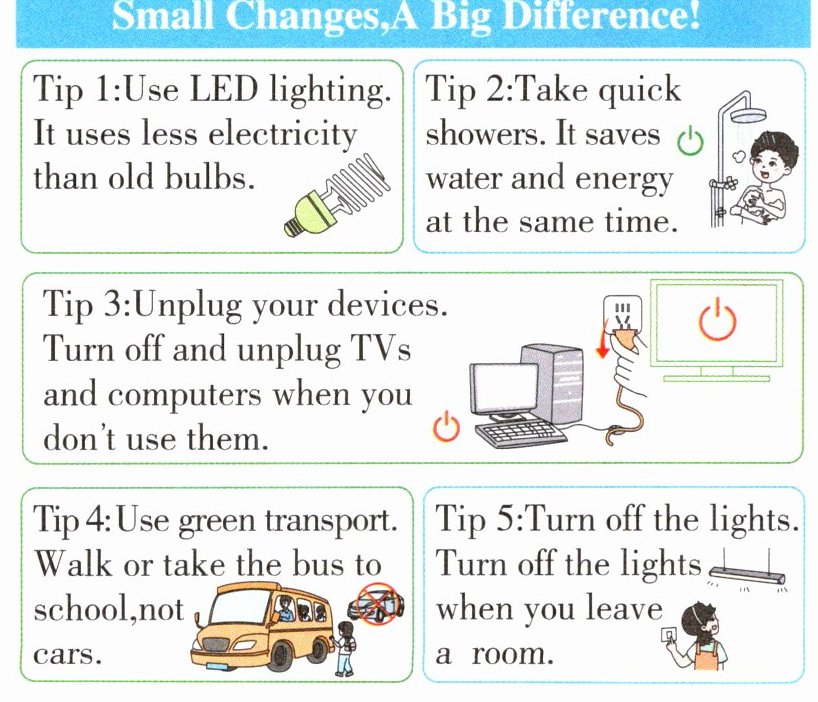
1. How many tips are there in the poster?
2. Why should we use LED lighting?
3. Which way can you save both water and energy according to the poster?
4. What is a “green” way to go to school?
5. What other ways can you think of to save energy?
1. How many tips are there in the poster?
5/Five tips.
2. Why should we use LED lighting?
Because it uses less electricity than old bulbs.
3. Which way can you save both water and energy according to the poster?
Take quick showers.
4. What is a “green” way to go to school?
Walk or take the bus to school.
5. What other ways can you think of to save energy?
示例:Use fans if the weather isn’t too hot.
答案
1. 5/Five tips.
2. Because it uses less electricity than old bulbs.
3. Take quick showers.
4. Walk or take the bus to school.
5. 示例:Use fans if the weather isn’t too hot.
2. Because it uses less electricity than old bulbs.
3. Take quick showers.
4. Walk or take the bus to school.
5. 示例:Use fans if the weather isn’t too hot.
解析
【分析】这是一道英语阅读理解题,需根据海报中的5条提示内容,逐一对应问题提取关键信息。先数海报里的提示数量,再针对每个问题找到对应的提示内容,整理成符合要求的答案。
【解析】1. 海报中共有Tip1到Tip5共5条提示,对应问题1;2. 根据Tip1的内容,使用LED照明的原因是它比旧灯泡耗电少,对应问题2;3. 根据Tip2,快速淋浴可以同时节水和节能,对应问题3;4. 根据Tip4,绿色上学方式是步行或乘公交,对应问题4;5. 结合节能常识,可列举如天气不太热时用风扇这类方式,对应问题5。
【答案】1. Five tips.
2. Because it uses less electricity than old bulbs.
3. Take quick showers.
4. Walk or take the bus to school.
5. 示例:Use fans if the weather isn’t too hot.
【知识点】英语阅读理解,信息提取
【点评】本题为基于海报的英语信息提取题,考查学生快速定位并提取文本关键信息的能力,题目难度较低,适合学生完成。
【难度系数】0.8
【解析】1. 海报中共有Tip1到Tip5共5条提示,对应问题1;2. 根据Tip1的内容,使用LED照明的原因是它比旧灯泡耗电少,对应问题2;3. 根据Tip2,快速淋浴可以同时节水和节能,对应问题3;4. 根据Tip4,绿色上学方式是步行或乘公交,对应问题4;5. 结合节能常识,可列举如天气不太热时用风扇这类方式,对应问题5。
【答案】1. Five tips.
2. Because it uses less electricity than old bulbs.
3. Take quick showers.
4. Walk or take the bus to school.
5. 示例:Use fans if the weather isn’t too hot.
【知识点】英语阅读理解,信息提取
【点评】本题为基于海报的英语信息提取题,考查学生快速定位并提取文本关键信息的能力,题目难度较低,适合学生完成。
【难度系数】0.8
