

 登录
登录
Ⅱ. 阅读理解
Remember Honest Zhou
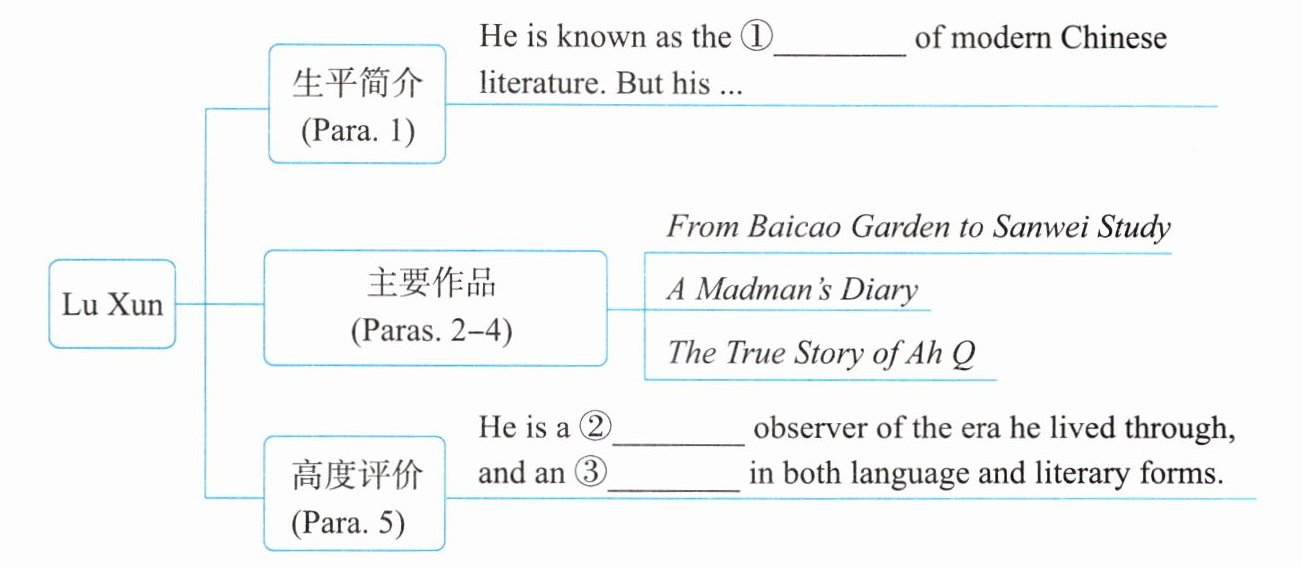
He is known as the father of modern Chinese literature. But his influence has gone beyond literature to the world of ideas, arts and politics. No wonder Chairman Mao Zedong once called him "the sage of modern China". Zhou Shuren is commonly known for his pen name Lu Xun. Today his writing is still widely read and several of his stories and essays are included in China's public school curriculum.
As one of the leaders of the New Culture Movement(1915-1923), Lu Xun is known for making honest comments on Chinese institutions, culture and customs. Take the story From Baicao Garden to Sanwei Study for example. The writer wrote about his youth from his playground Baicao Garden to his school Sanwei Study, where a respected teacher instructed him in Chinese classics. The name "Sanwei", which translates as "three flavours", refers to comparisons of different types of reading to different types of foodstuffs. Confucian classics are like rice. History books are like dishes. And literature is like sauce and seasoning. It was in this strict traditional learning environment that he started to form a solid understanding of Chinese feudal society.
So when he wrote his first short story, A Madman's Diary, he declared war on the broken society. The story made a huge splash(引起轰动) in China's literary world when it was published in 1918 for being among the first to use colloquial(白话的) language together with the hard-to-read classical language that "serious" authors were meant to write in at the time. The story also turned heads for its extremely critical take on the downside of Chinese tradition, which Zhou compared to cannibalism(吃人礼教).
Three years later, another important story, The True Story of Ah Q, was published. It saw Lu Xun look at the Chinese psyche(国民劣根性) at the time. The writer criticized it through Ah Q, a peasant(农民) who always considers himself superior to others even as he is humiliated and finally executed in the end. This characterization was on-the-nose enough that the phrase "the Ah Q spirit" is widely used even today.
"In all of Chinese literature, Lu Xun is ... a sharp observer of the era he lived through, and an innovator in both language and literary forms," commented The Guardian newspaper.
语篇结构
1. What are history books like according to Lu Xun?
A. They are like rice. B. They are like dishes.
C. They are like sauce. D. They are like seasoning.
2. Why did A Madman's Diary make a huge splash in 1918?
A. Because it was Lu Xun's first short story.
B. Because it combined colloquial and classical language.
C. Because it praised Chinese traditions.
D. Because it created the Ah Q spirit.
3. What does Ah Q represent?
A. The Chinese grass-roots people during the feudal period.
B. Lu Xun.
C. Nobles during the feudal period.
D. Royals during the feudal period.
4. What does the underlined word "criticized" mean?
A. Say something good. B. Learn.
C. Show. D. Say something bad.
5. What's the passage mainly about?
A. Lu Xun—the sage of modern China. B. How to write stories.
C. Some influential stories. D. Famous works of Chinese literature.
Remember Honest Zhou
He is known as the father of modern Chinese literature. But his influence has gone beyond literature to the world of ideas, arts and politics. No wonder Chairman Mao Zedong once called him "the sage of modern China". Zhou Shuren is commonly known for his pen name Lu Xun. Today his writing is still widely read and several of his stories and essays are included in China's public school curriculum.
As one of the leaders of the New Culture Movement(1915-1923), Lu Xun is known for making honest comments on Chinese institutions, culture and customs. Take the story From Baicao Garden to Sanwei Study for example. The writer wrote about his youth from his playground Baicao Garden to his school Sanwei Study, where a respected teacher instructed him in Chinese classics. The name "Sanwei", which translates as "three flavours", refers to comparisons of different types of reading to different types of foodstuffs. Confucian classics are like rice. History books are like dishes. And literature is like sauce and seasoning. It was in this strict traditional learning environment that he started to form a solid understanding of Chinese feudal society.
So when he wrote his first short story, A Madman's Diary, he declared war on the broken society. The story made a huge splash(引起轰动) in China's literary world when it was published in 1918 for being among the first to use colloquial(白话的) language together with the hard-to-read classical language that "serious" authors were meant to write in at the time. The story also turned heads for its extremely critical take on the downside of Chinese tradition, which Zhou compared to cannibalism(吃人礼教).
Three years later, another important story, The True Story of Ah Q, was published. It saw Lu Xun look at the Chinese psyche(国民劣根性) at the time. The writer criticized it through Ah Q, a peasant(农民) who always considers himself superior to others even as he is humiliated and finally executed in the end. This characterization was on-the-nose enough that the phrase "the Ah Q spirit" is widely used even today.
"In all of Chinese literature, Lu Xun is ... a sharp observer of the era he lived through, and an innovator in both language and literary forms," commented The Guardian newspaper.
语篇结构
1. What are history books like according to Lu Xun?
A. They are like rice. B. They are like dishes.
C. They are like sauce. D. They are like seasoning.
2. Why did A Madman's Diary make a huge splash in 1918?
A. Because it was Lu Xun's first short story.
B. Because it combined colloquial and classical language.
C. Because it praised Chinese traditions.
D. Because it created the Ah Q spirit.
3. What does Ah Q represent?
A. The Chinese grass-roots people during the feudal period.
B. Lu Xun.
C. Nobles during the feudal period.
D. Royals during the feudal period.
4. What does the underlined word "criticized" mean?
A. Say something good. B. Learn.
C. Show. D. Say something bad.
5. What's the passage mainly about?
A. Lu Xun—the sage of modern China. B. How to write stories.
C. Some influential stories. D. Famous works of Chinese literature.
答案
Ⅱ.本文是一篇说明文。文章介绍了鲁迅的
生平和他的著作,肯定了他在文学上的造诣。
[语篇结构]①father ②sharp ③innovator
1. B 细节理解题。根据"History books are
like dishes."可知,史书如菜肴。故选B。
2. B 细节理解题。根据"The story made a
huge splash in China's literary world ...
for being among the first to use colloquial
language together with the hard-to-read
classical language ... "可知,《狂人日记》引
起轰动是因为它是最早将白话文与文言
文结合起来的作品之一。故选B。
3. A 推理判断题。根据"The writer
criticized it through Ah Q, a peasant who
always considers himself superior to
others even as he is humiliated and finally
executed in the end."可知,小说中的阿Q
是一个农民,结合当时小说反映的社会背
景,可以推断鲁迅笔下的阿Q代表了当时
中国封建社会的底层人民。故选A。
4. D 词义猜测题。根据"It saw Lu Xun
look at the Chinese psyche at the time."可
知,《阿Q正传》中鲁迅在审视中国人的心
灵,在当时中国社会破烂不堪的背景下,
鲁迅用阿Q来表达对这种社会和人心灵
的批判,由此可推断画线单词意为"批
判"。故选D。
5. A 主旨大意题。本文通过"总—分—总"
的结构介绍了鲁迅作为中国现代文学最
有影响力的作家之一,创作了许多著名的
文学作品,并通过这些文学作品来揭露当
时现实的社会,使其影响力不仅仅存在于
文学领域,对现实社会的影响力也是巨大
的。故选A。
生平和他的著作,肯定了他在文学上的造诣。
[语篇结构]①father ②sharp ③innovator
1. B 细节理解题。根据"History books are
like dishes."可知,史书如菜肴。故选B。
2. B 细节理解题。根据"The story made a
huge splash in China's literary world ...
for being among the first to use colloquial
language together with the hard-to-read
classical language ... "可知,《狂人日记》引
起轰动是因为它是最早将白话文与文言
文结合起来的作品之一。故选B。
3. A 推理判断题。根据"The writer
criticized it through Ah Q, a peasant who
always considers himself superior to
others even as he is humiliated and finally
executed in the end."可知,小说中的阿Q
是一个农民,结合当时小说反映的社会背
景,可以推断鲁迅笔下的阿Q代表了当时
中国封建社会的底层人民。故选A。
4. D 词义猜测题。根据"It saw Lu Xun
look at the Chinese psyche at the time."可
知,《阿Q正传》中鲁迅在审视中国人的心
灵,在当时中国社会破烂不堪的背景下,
鲁迅用阿Q来表达对这种社会和人心灵
的批判,由此可推断画线单词意为"批
判"。故选D。
5. A 主旨大意题。本文通过"总—分—总"
的结构介绍了鲁迅作为中国现代文学最
有影响力的作家之一,创作了许多著名的
文学作品,并通过这些文学作品来揭露当
时现实的社会,使其影响力不仅仅存在于
文学领域,对现实社会的影响力也是巨大
的。故选A。
解析
【分析】
本题包含语篇结构填空和阅读理解选择题两部分。语篇结构填空需根据原文对应语句提取关键词:①处对应原文第一段鲁迅被称为“中国现代文学之父”,提取“father”;②处对应原文最后一段鲁迅是“敏锐的时代观察者”,提取“sharp”;③处对应原文最后一段鲁迅是“语言和文学形式的创新者”,提取“innovator”。选择题需分别通过定位原文细节、结合语境推理、猜测词义、概括主旨解答:1题定位史书的描述,2题定位《狂人日记》轰动的原因,3题结合阿Q身份和时代背景推断,4题结合上下文猜测“criticized”词义,5题概括全文核心内容。
【解析】
语篇结构填空
① 定位原文第一段第一句“He is known as the father of modern Chinese literature.”,得出答案为“father”;
② 定位原文最后一段“a sharp observer of the era he lived through”,得出答案为“sharp”;
③ 定位原文最后一段“and an innovator in both language and literary forms”,得出答案为“innovator”。
选择题解析
1. 细节理解题:根据原文第二段“History books are like dishes.”,可知史书如菜肴,选B;
2. 细节理解题:根据原文第三段“The story made a huge splash... for being among the first to use colloquial language together with the hard-to-read classical language...”,可知《狂人日记》因结合白话文与文言文引起轰动,选B;
3. 推理判断题:根据原文第四段“a peasant who always considers himself superior to others...”及时代背景,阿Q代表封建社会底层人民,选A;
4. 词义猜测题:结合上下文鲁迅对国民性的批判,“criticized”意为“批判(说不好的话)”,选D;
5. 主旨大意题:全文围绕鲁迅展开,介绍其地位、作品及影响,核心是鲁迅,选A。
【答案】
语篇结构:①father ②sharp ③innovator;1.B 2.B 3.A 4.D 5.A
【知识点】
英语阅读理解;细节理解;主旨大意
【点评】
本文是关于鲁迅的英语说明文,语篇结构填空考查信息定位能力,选择题涵盖多种阅读题型,全面检测学生的英语阅读理解能力,是常规初中英语阅读练习题。
【难度系数】
0.7
本题包含语篇结构填空和阅读理解选择题两部分。语篇结构填空需根据原文对应语句提取关键词:①处对应原文第一段鲁迅被称为“中国现代文学之父”,提取“father”;②处对应原文最后一段鲁迅是“敏锐的时代观察者”,提取“sharp”;③处对应原文最后一段鲁迅是“语言和文学形式的创新者”,提取“innovator”。选择题需分别通过定位原文细节、结合语境推理、猜测词义、概括主旨解答:1题定位史书的描述,2题定位《狂人日记》轰动的原因,3题结合阿Q身份和时代背景推断,4题结合上下文猜测“criticized”词义,5题概括全文核心内容。
【解析】
语篇结构填空
① 定位原文第一段第一句“He is known as the father of modern Chinese literature.”,得出答案为“father”;
② 定位原文最后一段“a sharp observer of the era he lived through”,得出答案为“sharp”;
③ 定位原文最后一段“and an innovator in both language and literary forms”,得出答案为“innovator”。
选择题解析
1. 细节理解题:根据原文第二段“History books are like dishes.”,可知史书如菜肴,选B;
2. 细节理解题:根据原文第三段“The story made a huge splash... for being among the first to use colloquial language together with the hard-to-read classical language...”,可知《狂人日记》因结合白话文与文言文引起轰动,选B;
3. 推理判断题:根据原文第四段“a peasant who always considers himself superior to others...”及时代背景,阿Q代表封建社会底层人民,选A;
4. 词义猜测题:结合上下文鲁迅对国民性的批判,“criticized”意为“批判(说不好的话)”,选D;
5. 主旨大意题:全文围绕鲁迅展开,介绍其地位、作品及影响,核心是鲁迅,选A。
【答案】
语篇结构:①father ②sharp ③innovator;1.B 2.B 3.A 4.D 5.A
【知识点】
英语阅读理解;细节理解;主旨大意
【点评】
本文是关于鲁迅的英语说明文,语篇结构填空考查信息定位能力,选择题涵盖多种阅读题型,全面检测学生的英语阅读理解能力,是常规初中英语阅读练习题。
【难度系数】
0.7
