

 登录
Ⅲ. 经典句式悟一悟
1. But I have trouble managing my money.
(have trouble doing sth 做某事有困难,动名词作宾语)
译文:
2. I often buy whatever I like without any plans.(without+名词结构,作伴随状语)
译文:
3. But my piggy bank is getting too small to hold all my money.(too... to... 太……而不能……,动词不定式作结果状语)
译文:
1. But I have trouble managing my money.
(have trouble doing sth 做某事有困难,动名词作宾语)
译文:
但我在理财方面有困难。
2. I often buy whatever I like without any plans.(without+名词结构,作伴随状语)
译文:
我经常没有任何计划地买我喜欢的东西。
3. But my piggy bank is getting too small to hold all my money.(too... to... 太……而不能……,动词不定式作结果状语)
译文:
但这个猪形储钱罐太小了,装不下我所有的钱。
答案
1. 但我在理财方面有困难。
2. 我经常没有任何计划地买我喜欢的东西。
3. 但这个猪形储钱罐太小了,装不下我所有的钱。
解析
【分析】本题为英语汉译题,需结合题干标注的句式结构(如have trouble doing sth、without+名词作伴随状语、too...to...结构),准确对应核心词汇,同时符合中文表达习惯完成翻译,确保贴合给定的句式用法要求。
【解析】1. 依据标注的“have trouble doing sth(做某事有困难,动名词作宾语)”,managing my money译为“管理我的钱(即理财)”,组合后得译文;2. 依据“without+名词结构,作伴随状语”,without any plans译为“没有任何计划”,whatever I like译为“我喜欢的任何东西”,组合后得译文;3. 依据“too... to... 太……而不能……,动词不定式作结果状语”,piggy bank译为“猪形储钱罐”,hold all my money译为“装下我所有的钱”,组合后得译文。
【答案】1. 但我在理财方面有困难。2. 我经常没有任何计划地买我喜欢的东西。3. 但这个猪形储钱罐太小了,装不下我所有的钱。
【知识点】固定句式搭配,伴随状语,结果状语
【点评】本题为经典句式翻译基础题,考查对英语常用固定搭配、特殊状语结构的理解与汉译能力,需准确把握标注的句式用法完成翻译。
【难度系数】0.7
Free Talk. Answer the questions with your partner.
1. How do you usually spend your pocket money?
2. Do you ever buy things you don't really need just because they are cheap or on sale?
3. Have you ever run out of money before the end of the month? How did you feel?
Step 2 While-reading
Task 1 Understand the main idea.
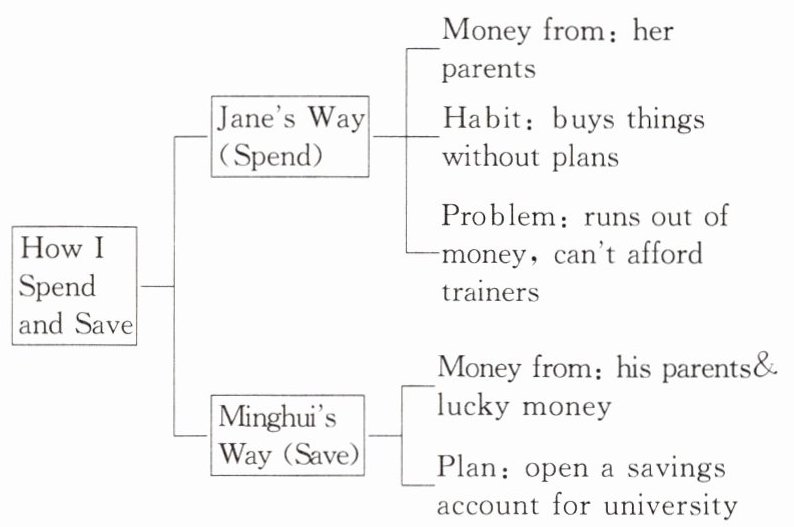
Task 2 Answer the following questions.
1. What trouble does Jane have with her money?
2. Why does Jane say she can't afford the cool trainers?
3. Why does Minghui want to open a savings account?
Task 3 Think and write.
Write a short paragraph expressing your thoughts on spending or saving pocket money, using the text as a reference.
Eg. Jane and Minghui have different ways of managing money. Spending money without plans is not a good habit because
Step 3 Post-reading
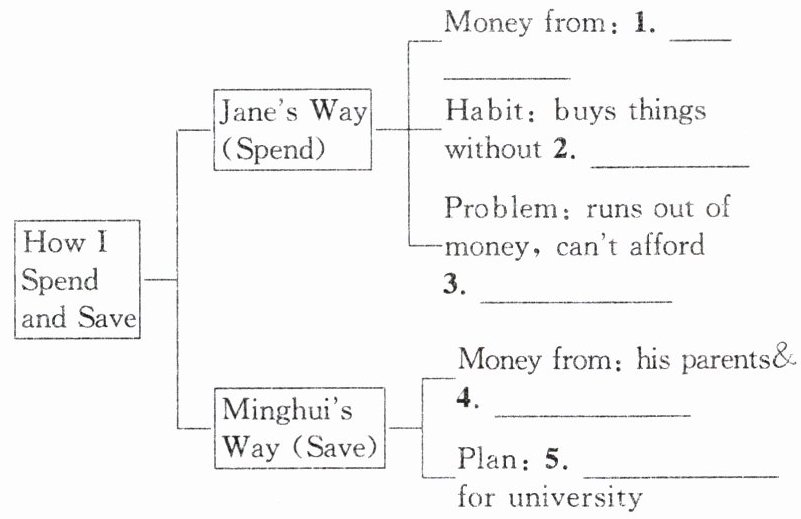
Task 1 Retell & share.
Retell the main ideas of the passage in your own words, using the mind map as a guide.
Task 2 Work in groups.
Discuss the following questions. Then create a list of "Rules for Using Pocket Money Wisely".
1. What are the differences between Jane's and Minghui's money habits?
2. What problems might people have if they spend money like Jane?
3. What can we learn from Minghui's way of saving money?
1. How do you usually spend your pocket money?
I usually spend it on stationery, snacks and small gifts for my friends.(答案不唯一,言之有理即可)
2. Do you ever buy things you don't really need just because they are cheap or on sale?
Yes, I sometimes buy things I don't really need just because they are cheap./No, I never do that.(答案不唯一,言之有理即可)
3. Have you ever run out of money before the end of the month? How did you feel?
Yes, I have. I felt worried because I had no money left for things I really needed./No, I haven't. I always save some money every month.(答案不唯一,言之有理即可)
Step 2 While-reading
Task 1 Understand the main idea.
Task 2 Answer the following questions.
1. What trouble does Jane have with her money?
She has trouble managing her money. She often buys things without plans and runs out of money when she needs it.
2. Why does Jane say she can't afford the cool trainers?
Because she has used up all her pocket money.
3. Why does Minghui want to open a savings account?
Because his piggy bank is too small to hold all his money, and he wants to put his money in the bank for his university life.
Task 3 Think and write.
Write a short paragraph expressing your thoughts on spending or saving pocket money, using the text as a reference.
Eg. Jane and Minghui have different ways of managing money. Spending money without plans is not a good habit because
you may run out of money when you really need it. We should learn to save money and make plans for our pocket money, just like Minghui. It can help us achieve our long-term goals.
.Step 3 Post-reading
Task 1 Retell & share.
Retell the main ideas of the passage in your own words, using the mind map as a guide.
Task 2 Work in groups.
Discuss the following questions. Then create a list of "Rules for Using Pocket Money Wisely".
1. What are the differences between Jane's and Minghui's money habits?
Jane spends money carelessly without plans, while Minghui saves money carefully and has long-term plans.
2. What problems might people have if they spend money like Jane?
They may run out of money when they need it, can't afford the things they really want, and get into financial trouble.(答案不唯一,言之有理即可)
3. What can we learn from Minghui's way of saving money?
We should learn to save money, make plans for our spending, and think about our long-term goals.(答案不唯一,言之有理即可)
答案
1. I usually spend it on stationery, snacks and small gifts for my friends.(答案不唯一,言之有理即可)
2. Yes, I sometimes buy things I don't really need just because they are cheap./No, I never do that.(答案不唯一,言之有理即可)
3. Yes, I have. I felt worried because I had no money left for things I really needed./No, I haven't. I always save some money every month.(答案不唯一,言之有理即可)
Task 2
1. She has trouble managing her money. She often buys things without plans and runs out of money when she needs it.
2. Because she has used up all her pocket money.
3. Because his piggy bank is too small to hold all his money, and he wants to put his money in the bank for his university life.
Task 3
Jane and Minghui have different ways of managing money. Spending money without plans is not a good habit because you may run out of money when you really need it. We should learn to save money and make plans for our pocket money, just like Minghui. It can help us achieve our long-term goals.
Task 1
1. her parents 2. plans 3. trainers
4. lucky money 5. open a savings account
Task 2
1. Jane spends money carelessly without plans, while Minghui saves money carefully and has long-term plans.
2. They may run out of money when they need it, can't afford the things they really want, and get into financial trouble.(答案不唯一,言之有理即可)
3. We should learn to save money, make plans for our spending, and think about our long-term goals.(答案不唯一,言之有理即可)
解析
【分析】这是英语学科的综合练习,分为口语热身、读中、读后三个环节:口语问题围绕零花钱使用习惯,需结合自身实际合理作答;读中任务需从文本提取人物的金钱管理相关关键信息;读后任务需结合文本观点完成写作与小组讨论。解题时要紧扣生活常识(口语)和文本内容(阅读、写作、讨论),答案需符合英语表达习惯且言之有理。
【解析】1. 口语问题:结合自身零花钱的使用情况,用英语清晰表述(如可回答用于文具、零食等),关于是否买非必需的便宜物品、是否月底没钱的问题,需如实且合理作答;2. 读中Task2:①定位文本中Jane的金钱问题,提取“无计划消费、钱不够用”等信息;②找到Jane买不起运动鞋的原因是花光了零花钱;③提取Minghui开储蓄账户的原因(小猪存钱罐太小、为大学存钱);3. 读中Task3:结合文本中“无计划消费的弊端”(钱不够用)和“储蓄的好处”(实现长期目标),组织语句完成写作;4. 读后Task2:①对比Jane的无计划消费与Minghui的储蓄习惯;②分析无计划消费的问题(急需时没钱、买不起必需品等);③总结储蓄的意义(规划消费、实现长期目标)。
【答案】1. I usually spend it on stationery, snacks and small gifts for my friends.(答案不唯一,言之有理即可)
2. Yes, I sometimes buy things I don't really need just because they are cheap./No, I never do that.(答案不唯一,言之有理即可)
3. Yes, I have. I felt worried because I had no money left for things I really needed./No, I haven't. I always save some money every month.(答案不唯一,言之有理即可)
Task2
1. She has trouble managing her money. She often buys things without plans and runs out of money when she needs it.
2. Because she has used up all her pocket money.
3. Because his piggy bank is too small to hold all his money, and he wants to put his money in the bank for his university life.
Task3
Jane and Minghui have different ways of managing money. Spending money without plans is not a good habit because you may run out of money when you really need it. We should learn to save money and make plans for our pocket money, just like Minghui. It can help us achieve our long-term goals.
Task1
1. her parents 2. plans 3. trainers 4. lucky money 5. open a savings account
Task2
1. Jane spends money carelessly without plans, while Minghui saves money carefully and has long-term plans.
2. They may run out of money when they need it, can't afford the things they really want, and get into financial trouble.(答案不唯一,言之有理即可)
3. We should learn to save money, make plans for our spending, and think about our long-term goals.(答案不唯一,言之有理即可)
【知识点】英语口语表达、阅读理解(零花钱话题)、英语观点写作
【点评】本题结合生活实际,考察英语的口语运用、文本信息提取与观点表达能力,引导学生树立合理的零花钱管理观念,符合初中英语的综合训练要求。
【难度系数】0.7
