

 登录
登录
D
① Do you know which gift becomes the most popular in China? Of course, the Chinese knot! With the Chinese cultural development all around the world, when Chinese people go abroad (出国) for business or study, they may choose a Chinese knot as a gift to their foreign friends, which makes it widely spread in the world.
② The Chinese knot is a beautiful handmade artwork. It came to a high point in the Tang Dynasty. There were many knots on the clothes. Later, the Chinese knot became a part of business in the Song Dynasty. Finally, the Chinese knots were in daily use in the Qing Dynasty.
③ It is named according to its different shapes, uses and origins (起源). The Treasure Knot, for example, is like "Yuanbao". The Plum Knot looks like "meihua", which is a kind of beautiful flower. The Kingdee Knot is in a shape of a golden butterfly, and there is a knot called the Wukong Knot which comes from the Incantation of the Golden Hoop (紧箍咒) of Monkey King.
④ We use the Chinese knot to give wishes to others now. The materials can be cotton, nylon (尼龙) and so on, and many of them are red, which stands for good luck in China. So the knots are usually sent as gifts in some important traditional Chinese festivals or on someone's big day to carry people's best wishes to their family or friends.
51. How does the writer start this passage?
A. By asking a question.
B. By giving an example.
C. By telling a story.
D. By singing a song.
52. When were the Chinese knots in daily use?
A. In the Han Dynasty.
B. In the Tang Dynasty.
C. In the Song Dynasty.
D. In the Qing Dynasty.
53. How many kinds of knots are mentioned in this passage?
A. Two.
B. Three.
C. Four.
D. Five.
54. According to the passage, which kind of Chinese knot stands for money?
A. The Treasure Knot.
B. The Plum Knot.
C. The Kingdee Knot.
D. The Wukong Knot.
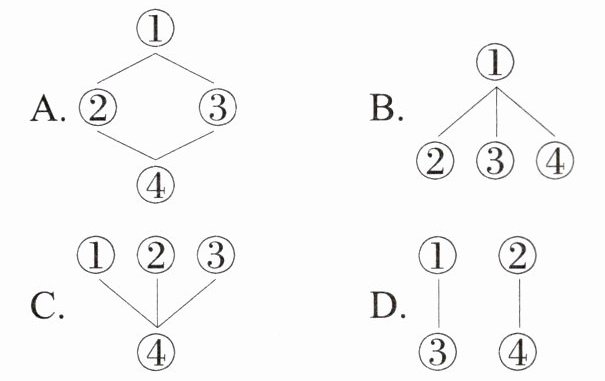
55. Which of the following can show the structure of the passage?
① Do you know which gift becomes the most popular in China? Of course, the Chinese knot! With the Chinese cultural development all around the world, when Chinese people go abroad (出国) for business or study, they may choose a Chinese knot as a gift to their foreign friends, which makes it widely spread in the world.
② The Chinese knot is a beautiful handmade artwork. It came to a high point in the Tang Dynasty. There were many knots on the clothes. Later, the Chinese knot became a part of business in the Song Dynasty. Finally, the Chinese knots were in daily use in the Qing Dynasty.
③ It is named according to its different shapes, uses and origins (起源). The Treasure Knot, for example, is like "Yuanbao". The Plum Knot looks like "meihua", which is a kind of beautiful flower. The Kingdee Knot is in a shape of a golden butterfly, and there is a knot called the Wukong Knot which comes from the Incantation of the Golden Hoop (紧箍咒) of Monkey King.
④ We use the Chinese knot to give wishes to others now. The materials can be cotton, nylon (尼龙) and so on, and many of them are red, which stands for good luck in China. So the knots are usually sent as gifts in some important traditional Chinese festivals or on someone's big day to carry people's best wishes to their family or friends.
51. How does the writer start this passage?
A. By asking a question.
B. By giving an example.
C. By telling a story.
D. By singing a song.
52. When were the Chinese knots in daily use?
A. In the Han Dynasty.
B. In the Tang Dynasty.
C. In the Song Dynasty.
D. In the Qing Dynasty.
53. How many kinds of knots are mentioned in this passage?
A. Two.
B. Three.
C. Four.
D. Five.
54. According to the passage, which kind of Chinese knot stands for money?
A. The Treasure Knot.
B. The Plum Knot.
C. The Kingdee Knot.
D. The Wukong Knot.
55. Which of the following can show the structure of the passage?
答案
51.A 52.D 53.C 54.A 55.B
