

 登录
22.(10分)如图,BD,CE分别是△ABC的边AC和AB上的高,点P在BD的延长线上,BP=AC,点Q在CE上,CQ=AB。
求证:(1)AP=AQ;
(2)AP⊥AQ。
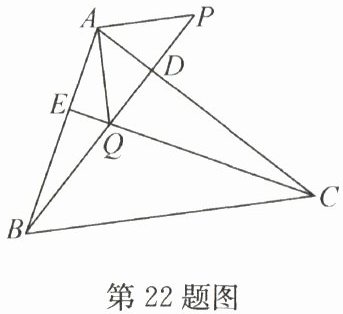
求证:(1)AP=AQ;
(2)AP⊥AQ。
答案
22. 证明:(1)$\because BD⊥ AC,CE⊥ AB$,
$\therefore∠ BEC=∠ BDC=90°$,
$\therefore∠ ABD+∠ BAC=90°,∠ ACE+∠ BAC=90°$,
$\therefore∠ ABD=∠ ACE$.
在$△ ABP$和$△ QCA$中,$\begin{cases}BP=CA,\\∠ ABP=∠ QCA,\\ AB=QC,\end{cases}$
$\therefore△ ABP≌△ QCA,\therefore AP=AQ$.
(2)由(1)可得$∠ CAQ=∠ P$,
$\because BD⊥ AC,\therefore∠ P+∠ CAP=90°$,
$\therefore∠ CAQ+∠ CAP=90°$,即$∠ QAP=90°$,
$\therefore AP⊥ AQ$.
