

 登录
六、阅读还原(共5小题,计5分)
从方框中选择合适的句子补全短文。其中有两项多余。
The Mid-Autumn Festival is also known as the Moon Festival. It is celebrated on the fifteenth day of the eighth month on the Chinese lunar calendar.
The festival dates back over 1,000 years. Ancient Chinese people found out that the moon would be at its fullest in the middle of every lunar month.
For Chinese people, the Mid-Autumn Festival has a special meaning. The round shape of the moon stands for the family reunion and makes people miss the faraway relatives.
The Mid-Autumn Festival is a mixture of customs. Most of the customs have ancient origins (起源). The most important part of the festival celebration is enjoying the full moon. Besides, in ancient China, people believed that the moon was closely related to agricultural (农业的) production.
In modern times, people enjoy mooncakes to celebrate the festival.
A. Early in every month, it’s the smallest.
B. Also, in the middle of autumn, it’s at its brightest.
C. People just get together on the Mid-Autumn Festival.
D. The festival is not just about the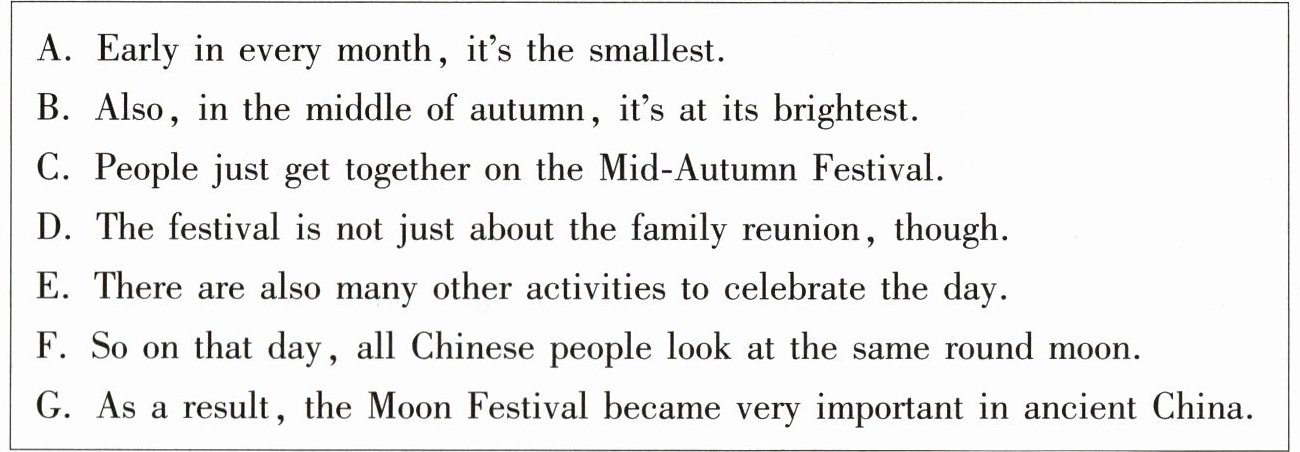 mily reunion, though.
E. There are also many other activities to celebrate the day.
F. So on that day, all Chinese people look at the same round moon.
G. As a result, the Moon Festival became very important in ancient China.
1. 2. 3. 4. 5.
从方框中选择合适的句子补全短文。其中有两项多余。
The Mid-Autumn Festival is also known as the Moon Festival. It is celebrated on the fifteenth day of the eighth month on the Chinese lunar calendar.
The festival dates back over 1,000 years. Ancient Chinese people found out that the moon would be at its fullest in the middle of every lunar month.
B
1 So the date of the festival was decided.For Chinese people, the Mid-Autumn Festival has a special meaning. The round shape of the moon stands for the family reunion and makes people miss the faraway relatives.
F
2 For those who are far away from home, looking at the same moon makes them think of connecting with their beloved people and land.D
3 It’s also about the joy of harvesting and the good relationship between humans and nature.The Mid-Autumn Festival is a mixture of customs. Most of the customs have ancient origins (起源). The most important part of the festival celebration is enjoying the full moon. Besides, in ancient China, people believed that the moon was closely related to agricultural (农业的) production.
G
4In modern times, people enjoy mooncakes to celebrate the festival.
E
5 For example, in some places, people admire the moon and carry bright lanterns. In some other areas, people perform dragon and lion dances.A. Early in every month, it’s the smallest.
B. Also, in the middle of autumn, it’s at its brightest.
C. People just get together on the Mid-Autumn Festival.
D. The festival is not just about the
mily reunion, though.E. There are also many other activities to celebrate the day.
F. So on that day, all Chinese people look at the same round moon.
G. As a result, the Moon Festival became very important in ancient China.
1. 2. 3. 4. 5.
答案
1. B 2. F 3. D 4. G 5. E
七、任务型阅读(共5小题,计10分)
In front of the Great Hall of the People stood a graceful woman in colourful traditional Hani ethnic (民族的) clothes, catching the eyes of reporters.
She is Yang Yuni. Ten years ago, she was only a village girl who loved ethnic culture. Now she’s a famous dancer, a successful businesswoman, and a member of the National Committee of the CPPCC. That’s thanks to her endless efforts to protect and spread the traditional Hani culture.
Born and raised in a Hani village in Honghe County, Yunnan, Yang deeply loves her ethnic culture. Guided by her mother, the county’s first folk dance teacher, and growing up with the inviting Hani terraces (梯田), she came to love dance. After finishing high school, she chose to major in dance performance in college.
In 2015, Yang set up an arts centre to spread Hani dance. Under her guidance and teaching, more and more local kids began to love Hani dance. “The Hani dance has beautiful moves and shows strong life. Why not bring it to a bigger stage?” said Yang.
Later, Yang set up a street dance group with street dancers from other areas of Yunnan. They mixed street dance moves with their local dance style to show their love for their own culture. Her arts centre later set up a recording studio to record the voices of its students and Hani folk singers.
After becoming a CPPCC National Committee member, Yang put forward a proposal (提案) that focuses on the cultural and tourism value of the Cultural Landscape of Honghe Hani Rice Terraces.
1. What is Yang Yuni’s nationality (民族)?
2. Where was Yang Yuni born and raised?
3. What was Yang Yuni’s major when she studied in college?
4. When did Yang Yuni set up the arts centre?
5. What do you think of Yang Yuni?
In front of the Great Hall of the People stood a graceful woman in colourful traditional Hani ethnic (民族的) clothes, catching the eyes of reporters.
She is Yang Yuni. Ten years ago, she was only a village girl who loved ethnic culture. Now she’s a famous dancer, a successful businesswoman, and a member of the National Committee of the CPPCC. That’s thanks to her endless efforts to protect and spread the traditional Hani culture.
Born and raised in a Hani village in Honghe County, Yunnan, Yang deeply loves her ethnic culture. Guided by her mother, the county’s first folk dance teacher, and growing up with the inviting Hani terraces (梯田), she came to love dance. After finishing high school, she chose to major in dance performance in college.
In 2015, Yang set up an arts centre to spread Hani dance. Under her guidance and teaching, more and more local kids began to love Hani dance. “The Hani dance has beautiful moves and shows strong life. Why not bring it to a bigger stage?” said Yang.
Later, Yang set up a street dance group with street dancers from other areas of Yunnan. They mixed street dance moves with their local dance style to show their love for their own culture. Her arts centre later set up a recording studio to record the voices of its students and Hani folk singers.
After becoming a CPPCC National Committee member, Yang put forward a proposal (提案) that focuses on the cultural and tourism value of the Cultural Landscape of Honghe Hani Rice Terraces.
1. What is Yang Yuni’s nationality (民族)?
She is Hani.
2. Where was Yang Yuni born and raised?
In a Hani village in Honghe County, Yunnan.
3. What was Yang Yuni’s major when she studied in college?
Dance performance.
4. When did Yang Yuni set up the arts centre?
In 2015.
5. What do you think of Yang Yuni?
She is hard-working and she devotes herself to spreading Hani traditional culture.(表述合理即可。)
答案
1. She is Hani.
2. In a Hani village in Honghe County, Yunnan.
3. Dance performance.
4. In 2015.
5. She is hard-working and she devotes herself to spreading Hani traditional culture.(表述合理即可。)
