

 登录
阅读短文,完成以下任务。
What facts do you know about the solar system? Let's have a look.
The closest planet to the Sun is not the hottest. The hottest is Venus(金星) with a temperature of about 467 ℃.
The Great Red Spot(大红斑) is the name of a big storm on Jupiter(木星). It is wider than Earth.
Neptune(海王星) has the fastest wind in the solar system. Neptune's winds can reach over 2,000 kilometres per hour.
There is very little water on the planets. So there are no fish out there.
Saturn(土星) has over 200 moons, and scientists may find more.
Footprints on the Moon could stay there for thousands of years!
Thousands of pieces of man-made space junk(太空垃圾) float around Earth. And the number is growing!
任务(一): 根据短文内容,选择正确的答案。
(
A. storm B. footprint C. space junk
(
A. The wind is too fast.
B. There is very little water.
C. It is too hot there.
(
A. It has the fastest wind.
B. It is the hottest planet.
C. It has more than 200 moons.
任务(二):根据短文内容连线。
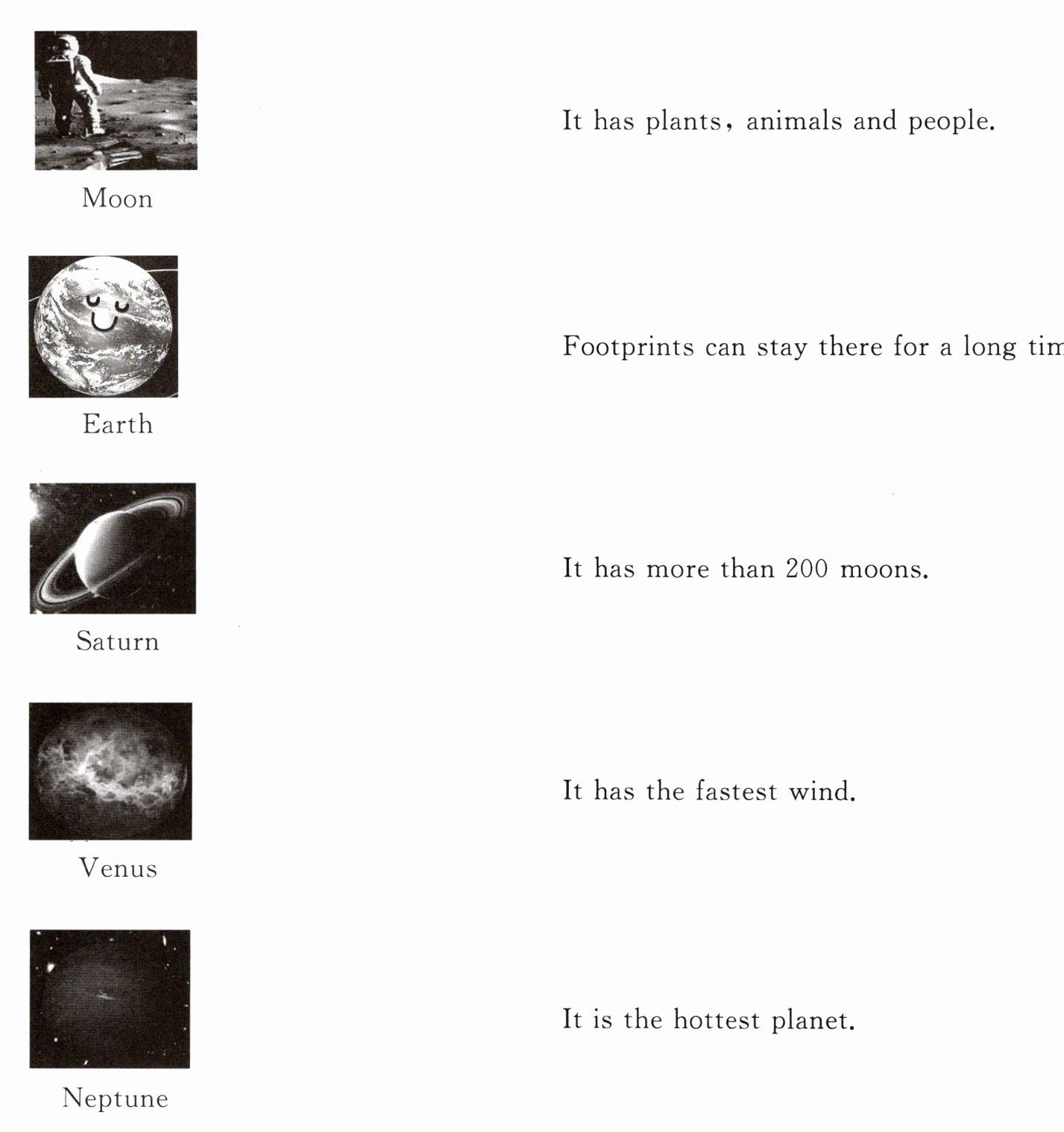
It has plants, animals and people.
Footprints can stay there for a long time.
It has more than 200 moons.
It has the fastest wind.
It is the hottest planet.
任务(三):根据短文内容,判断句子正(T)误(F)。
(
(
(
(
(
What facts do you know about the solar system? Let's have a look.
The closest planet to the Sun is not the hottest. The hottest is Venus(金星) with a temperature of about 467 ℃.
The Great Red Spot(大红斑) is the name of a big storm on Jupiter(木星). It is wider than Earth.
Neptune(海王星) has the fastest wind in the solar system. Neptune's winds can reach over 2,000 kilometres per hour.
There is very little water on the planets. So there are no fish out there.
Saturn(土星) has over 200 moons, and scientists may find more.
Footprints on the Moon could stay there for thousands of years!
Thousands of pieces of man-made space junk(太空垃圾) float around Earth. And the number is growing!
任务(一): 根据短文内容,选择正确的答案。
(
A
) 1. The Great Red Spot on Jupiter is a big .A. storm B. footprint C. space junk
(
B
) 2. Why can't we find fish on other planets?A. The wind is too fast.
B. There is very little water.
C. It is too hot there.
(
C
) 3. Which sentence about Saturn is right?A. It has the fastest wind.
B. It is the hottest planet.
C. It has more than 200 moons.
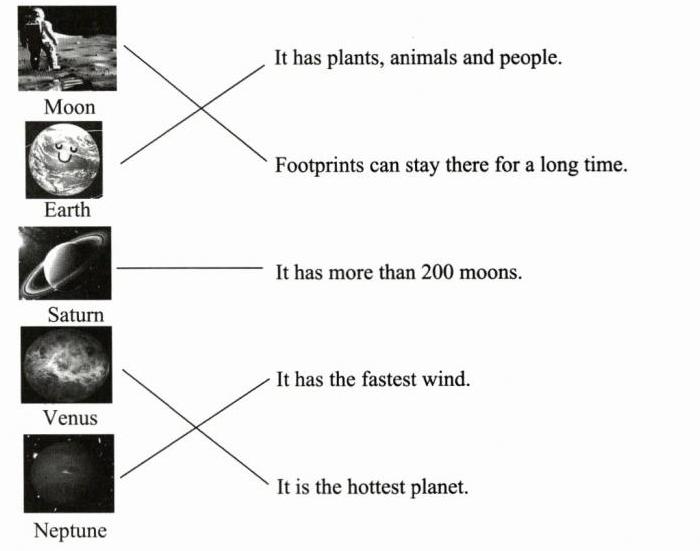
任务(二):根据短文内容连线。
It has plants, animals and people.
Footprints can stay there for a long time.
It has more than 200 moons.
It has the fastest wind.
It is the hottest planet.
任务(三):根据短文内容,判断句子正(T)误(F)。
(
F
) 1. Venus is the closest planet and it has a temperature of about 467 ℃.(
T
) 2. Jupiter is wider than Earth.(
F
) 3. There are some fish living on all the planets.(
F
) 4. Neptune's winds can reach over 2,000 kilometres per minute.(
T
) 5. There is a lot of man-made space junk around Earth.答案
任务(一):
1. A
2. B
3. C
任务(二):
任务(三):
1. F
2. T
3. F
4. F
5. T
