

 登录
三、阅读理解
Reading and writing Chinese characters is often considered the most ambitious challenge that language learners face in order to achieve fluency(流利). Indeed, the process which has shaped this character system over thousands of years is both complex(复杂的) and long.
Although they may appear bewildering at first, Chinese characters are actually made up of different building blocks(块) that form a straight and reasonable structure. Once you catch a basic understanding of the structure of Chinese characters, you will be reading and writing your way across the kingdom of Chinese characters in no time. Read the following and continue along your journey to learn Chinese characters.
Unlike the Roman alphabet(字母), Chinese characters are used to show meaning rather than sound. In fact, most characters were firstly used as visual(视觉的) descriptions of physical elements like trees, houses or humans. Their earliest forms, simplified versions of these symbols, known as character radicals(偏旁), serve as the foundation for modern written Mandarin(普通话).
Making up about 80% of the Chinese characters, radicals—in addition to Chinese Pinyin—are an important starting point for anyone who wants to read or write well in Mandarin. Jump to the list of the 40 most used Chinese radicals and continue learning Chinese characters.
When two or more radicals are connected, they work together to create a single character; the radical on the left shows the character's type or meaning, while the radical on the right might show its pronunciation. Most of the written Chinese language is made up of character compounds, in which several characters are connected to make one word.
An important rule to note is that characters are written according to a standardized stroke order(笔画顺序), which typically moves from left to right, top to bottom and ▲. Although Chinese characters may seem difficult at first, patterns will quickly appear once you develop a basic foundation. So, review your radicals, know about the most commonly used Chinese characters, and watch as your Mandarin skills grow quickly!
(
A. Feeling puzzled. B. Feeling afraid.
C. Feeling touched. D. Feeling amazed.
(
A. The role of Chinese characters.
B. The popularity of Chinese characters.
C. The method of making a Chinese character.
D. The difficulties of using Chinese characters.
(
A. outside to inside B. end to beginning
C. inside to outside D. beginning to end
(
Reading and writing Chinese characters is often considered the most ambitious challenge that language learners face in order to achieve fluency(流利). Indeed, the process which has shaped this character system over thousands of years is both complex(复杂的) and long.
Although they may appear bewildering at first, Chinese characters are actually made up of different building blocks(块) that form a straight and reasonable structure. Once you catch a basic understanding of the structure of Chinese characters, you will be reading and writing your way across the kingdom of Chinese characters in no time. Read the following and continue along your journey to learn Chinese characters.
Unlike the Roman alphabet(字母), Chinese characters are used to show meaning rather than sound. In fact, most characters were firstly used as visual(视觉的) descriptions of physical elements like trees, houses or humans. Their earliest forms, simplified versions of these symbols, known as character radicals(偏旁), serve as the foundation for modern written Mandarin(普通话).
Making up about 80% of the Chinese characters, radicals—in addition to Chinese Pinyin—are an important starting point for anyone who wants to read or write well in Mandarin. Jump to the list of the 40 most used Chinese radicals and continue learning Chinese characters.
When two or more radicals are connected, they work together to create a single character; the radical on the left shows the character's type or meaning, while the radical on the right might show its pronunciation. Most of the written Chinese language is made up of character compounds, in which several characters are connected to make one word.
An important rule to note is that characters are written according to a standardized stroke order(笔画顺序), which typically moves from left to right, top to bottom and ▲. Although Chinese characters may seem difficult at first, patterns will quickly appear once you develop a basic foundation. So, review your radicals, know about the most commonly used Chinese characters, and watch as your Mandarin skills grow quickly!
(
A
) 1. What does the underlined word "bewildering" mean?A. Feeling puzzled. B. Feeling afraid.
C. Feeling touched. D. Feeling amazed.
(
C
) 2. What does the fifth paragraph talk about?A. The role of Chinese characters.
B. The popularity of Chinese characters.
C. The method of making a Chinese character.
D. The difficulties of using Chinese characters.
(
A
) 3. Which of the following can be put into the blank "▲" in the last paragraph?A. outside to inside B. end to beginning
C. inside to outside D. beginning to end
(
C
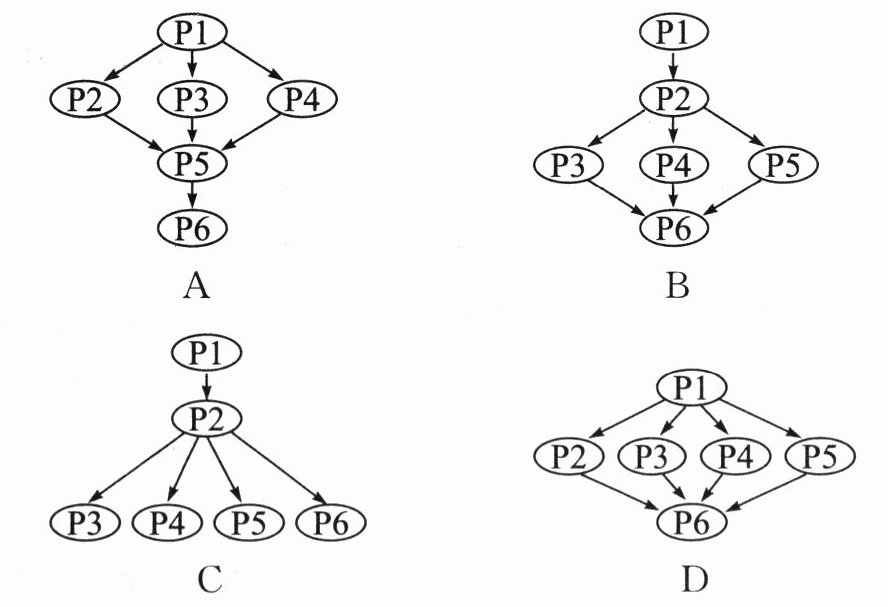
) 4. What is the structure of the text?答案
1. A
2. C
3. A
4. C
解析
【分析】
1. 第1题是词义猜测题,需结合上下文逻辑推断词义:前文提到汉字是语言学习者的挑战,后文转折说明汉字有合理结构,因此“bewildering”应表示“令人困惑的”,对应选项A。
2. 第2题考查段落大意,第五段核心是讲解两个及以上偏旁组合成汉字的规则,即造字方法,对应选项C。
3. 第3题是细节理解题,根据汉字笔画顺序常识,除左到右、上到下,还有“外到内”的规则,对应选项A。
4. 第4题考查文章结构:文章开头引入汉字学习的挑战,中间分述汉字的结构、偏旁、造字方法等内容,对应图C的层级结构,因此选C。
【解析】
1. 词义猜测:由“Although they may appear bewildering at first, Chinese characters are actually made up of different building blocks...”可知,前后为转折关系,“bewildering”与“有合理结构”相对,意为“令人困惑的”,故选A。
2. 段落大意:第五段围绕“偏旁组合造字”展开,讲解汉字的构成方法,故选C。
3. 细节理解:汉字笔画顺序规则为左到右、上到下、外到内,故选A。
4. 文章结构:文章首段总起,中间段落分述汉字相关内容,对应图C的结构,故选C。
【答案】
1. A
2. C
3. A
4. C
【知识点】
词义猜测题、细节理解题、文章结构分析
【点评】
本题为英语阅读理解题,综合考查学生的词义推断、细节查找及文章结构分析能力,需结合文本内容和语言常识解题,难度适中。
【难度系数】
0.6
