

 登录
登录
(
A.live; live
B.alive; live
C.live; lively
D.alive; lively
B
) 1.This one-hour documentary brings birds ______ on screen when it's covered ______.A.live; live
B.alive; live
C.live; lively
D.alive; lively
答案
B
解析
第一空需形容词作宾补,"alive"表“活着的”,符合“使鸟在屏幕上鲜活呈现”;第二空需副词修饰"covered","live"作副词表“现场直播地”,"lively"为形容词不符。故第一空用"alive",第二空用"live"。
(
A.the number of; the number of
B.a number of; the number of
C.a number of; a number of
D.the number of; a number of
B
) 2.There are ______ shops near our school, and ______ of the shops is getting larger and larger.A.the number of; the number of
B.a number of; the number of
C.a number of; a number of
D.the number of; a number of
答案
B
解析
首先分析两个短语的区别,“a number of”表示“许多”,相当于“many”,修饰可数名词复数,作主语时,谓语动词用复数;“the number of”表示“……的数量”,跟复数名词连用作主语时,中心词是number,谓语动词要用单数。第一个空,根据语境“我们学校附近有……商店”,这里表示“许多”商店,所以用“a number of”;第二个空,根据语境“……商店的规模越来越大”,这里表示“……的数量”,所以用“the number of”。
(
A.to go; to ride
B.go; riding
C.going; to ride
D.go; to ride
D
) 3.Rather than ______ to school by bus, he preferred ______ a bike.A.to go; to ride
B.go; riding
C.going; to ride
D.go; to ride
答案
D
解析
本题主要考查prefer to do sth rather than do sth的用法,表示“宁愿做某事而不愿做某事”。题干句子可以还原为“He preferred to ride a bike rather than go to school by bus.”。根据这一结构,第一个空应该填动词原形go,第二个空应该填to ride。对比选项,只有D选项符合这一结构。
(
—Yes. And it included an interview ______ a government officer.
A.for; with
B.about; by
C.on; with
D.by; on
C
) 4.—There was a report ______ the housing situation in yesterday's newspaper.—Yes. And it included an interview ______ a government officer.
A.for; with
B.about; by
C.on; with
D.by; on
答案
C
解析
首先,我们分析第一个空格。描述报道的内容时,常用的介词是“on”或“about”,表示报道“关于”某个主题。在这里,“a report on/about the housing situation”表示“关于住房情况的报道”。由于“for”通常表示目的或对象,“by”表示动作的执行者,它们不适合这个语境。
接着,我们分析第二个空格。描述与某人的访谈时,我们常用“interview with sb”的结构。这里的“with”表示与某人的互动或交流。而“by”通常表示动作的执行者,“on”表示关于,“for”表示目的或对象,它们都不适合这里的语境。
综上所述,第一个空格应填“on”或“about”,第二个空格应填“with”。结合选项,只有C选项“on; with”满足这两个条件。
接着,我们分析第二个空格。描述与某人的访谈时,我们常用“interview with sb”的结构。这里的“with”表示与某人的互动或交流。而“by”通常表示动作的执行者,“on”表示关于,“for”表示目的或对象,它们都不适合这里的语境。
综上所述,第一个空格应填“on”或“about”,第二个空格应填“with”。结合选项,只有C选项“on; with”满足这两个条件。
(
A.is directed; worth
B.directed; worth
C.is directed; is worth
D.directed; is worth
D
) 5.I think the new film ______ by Mr Zhang ______ seeing.A.is directed; worth
B.directed; worth
C.is directed; is worth
D.directed; is worth
答案
D
解析
第一空需用过去分词短语"directed by Mr Zhang"作后置定语修饰"film",排除A、C;第二空"be worth doing"为固定搭配,主语"the new film"是单数,故用"is worth",排除B。
(
A.feeling scared; full of
B.to feel scared; full of
C.feeling scared; filled of
D.to feel scared; filled with
A
) 6.I don't mind ______ because I like films ______ horror and mysteries.A.feeling scared; full of
B.to feel scared; full of
C.feeling scared; filled of
D.to feel scared; filled with
答案
A
解析
首先分析第一个空,“mind”后接动词时,通常用动名词形式,即“mind doing sth.”,表示“介意做某事”,所以第一个空应填“feeling scared”,排除B、D选项。接着分析第二个空,“full of”和“filled with”都表示“充满”,但“filled of”是错误的表达,所以第二个空应填“full of”,排除C选项。
(
A.how; unless
B.what; unless
C.how; if
D.what; until
A
) 7.You could hardly imagine ______ amazing the Great Wall was ______ you saw it with your own eyes.A.how; unless
B.what; unless
C.how; if
D.what; until
答案
A
解析
本题主要考查感叹句和条件状语从句的连词。首先,分析句子结构可知,第一空引导的是一个感叹句,感叹句的结构是“How+形容词+主语+谓语!”或者“What+a/an+形容词+名词+主语+谓语!”。在这里,“amazing”是形容词,“the Great Wall was”是主语和谓语,所以应该用“how”来引导感叹句,表示“多么令人惊叹”。第二空需要填入一个连词来引导条件状语从句,表示“除非你亲眼看到”。在给出的选项中,“unless”表示“除非”,符合语境。而“if”表示“如果”,“until”表示“直到”,都不符合语境。
(
A.when he would travel to Hong Kong
B.how he goes to Shanghai
C.where he has spent his holidays
D.why did he visit Hangzhou
A
) 8.Did your father tell you ______?A.when he would travel to Hong Kong
B.how he goes to Shanghai
C.where he has spent his holidays
D.why did he visit Hangzhou
答案
A
解析
本题考查宾语从句的用法。宾语从句中从句部分要用陈述句语序,D选项“why did he visit Hangzhou”是疑问句语序,不符合要求,所以D选项错误。又因为主句是一般过去时“Did your father tell you”,从句要用相应的过去时态,B选项“how he goes to Shanghai”中“goes”是一般现在时,C选项“where he has spent his holidays”中“has spent”是现在完成时,都不符合时态要求,而A选项“when he would travel to Hong Kong”中“would travel”是过去将来时,符合主句一般过去时,从句用过去时态的要求,且语序是陈述句语序。
三、任务型阅读
Poetry is the forgotten child of literature. Few people read it for pleasure. In Western high schools, poetry is seldom taught because it is considered to be out of date and have little to do with the life of today's students.
In China, however, poetry is still an important part of the curriculum (课程). Recently, the Ministry of Education has increased the number of ancient Chinese poems for students to memorize and recite, from 14 to 72. Why is it important to learn poems?
First of all, poetry is a necessary part of learning traditional Chinese culture. It is a path to understanding your history and your society. It is also the key to understanding the thoughts and feelings that are common to everyone but we may be unable to express—the joy of Li Bai dancing with the moon, for example. Everyone has feelings of joy, love, loneliness, sadness and even anger, and a good poem can help us put those feelings into words and bring us self-understanding.
Poems can also express beauty in a few short lines. Even something common can become beautiful. Here is a poem called Fog: The fog comes / on silent haunches (腰腿) / and then moves on. Yes, fog does move smoothly, silently like a cat, and the poet catches that feeling and image, and makes it beautiful.
Of course, to really enjoy poetry, it has to be read aloud. After all, a poem is really just a song without music. Most ancient poetry, like Homeric Epics and China's Book of Songs, was spoken for hundreds of years before it was written.
A poet once said, "Poetry is when an emotion has found its thought and the thought has found words." You are lucky that you now have seventy-two poems to learn!
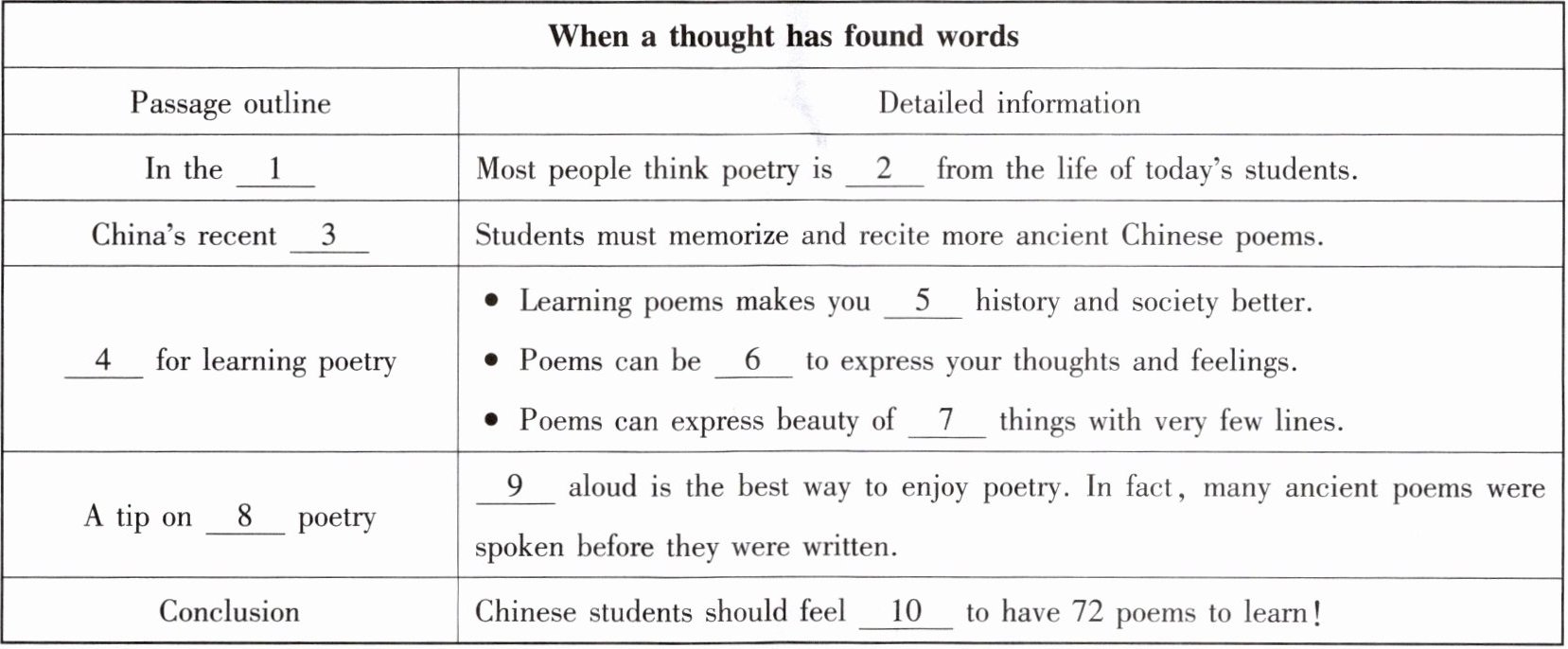
| When a thought has found words | |
| Passage outline | Detailed information |
| In the 1 | Most people think poetry is 2 from the life of today's students. |
| China's recent 3 | Students must memorize and recite more ancient Chinese poems. |
| 4 for learning poetry | • Learning poems makes you 5 history and society better. • Poems can be 6 to express your thoughts and feelings. • Poems can express beauty of 7 things with very few lines. |
| A tip on 8 poetry | 9 aloud is the best way to enjoy poetry. In fact, many ancient poems were spoken before they were written. |
| Conclusion | Chinese students should feel 10 to have 72 poems to learn! |
1.
2.
3.
4.
5.
6.
7.
8.
9.
10.
Poetry is the forgotten child of literature. Few people read it for pleasure. In Western high schools, poetry is seldom taught because it is considered to be out of date and have little to do with the life of today's students.
In China, however, poetry is still an important part of the curriculum (课程). Recently, the Ministry of Education has increased the number of ancient Chinese poems for students to memorize and recite, from 14 to 72. Why is it important to learn poems?
First of all, poetry is a necessary part of learning traditional Chinese culture. It is a path to understanding your history and your society. It is also the key to understanding the thoughts and feelings that are common to everyone but we may be unable to express—the joy of Li Bai dancing with the moon, for example. Everyone has feelings of joy, love, loneliness, sadness and even anger, and a good poem can help us put those feelings into words and bring us self-understanding.
Poems can also express beauty in a few short lines. Even something common can become beautiful. Here is a poem called Fog: The fog comes / on silent haunches (腰腿) / and then moves on. Yes, fog does move smoothly, silently like a cat, and the poet catches that feeling and image, and makes it beautiful.
Of course, to really enjoy poetry, it has to be read aloud. After all, a poem is really just a song without music. Most ancient poetry, like Homeric Epics and China's Book of Songs, was spoken for hundreds of years before it was written.
A poet once said, "Poetry is when an emotion has found its thought and the thought has found words." You are lucky that you now have seventy-two poems to learn!
| When a thought has found words | |
| Passage outline | Detailed information |
| In the 1 | Most people think poetry is 2 from the life of today's students. |
| China's recent 3 | Students must memorize and recite more ancient Chinese poems. |
| 4 for learning poetry | • Learning poems makes you 5 history and society better. • Poems can be 6 to express your thoughts and feelings. • Poems can express beauty of 7 things with very few lines. |
| A tip on 8 poetry | 9 aloud is the best way to enjoy poetry. In fact, many ancient poems were spoken before they were written. |
| Conclusion | Chinese students should feel 10 to have 72 poems to learn! |
1.
West
2.
far
3.
policy
4.
Reasons
5.
understand
6.
used
7.
common
8.
enjoying
9.
Reading
10.
lucky
答案
1. West
2. far
3. policy
4. Reasons
5. understand
6. used
7. common
8. enjoying
9. Reading
10. lucky
2. far
3. policy
4. Reasons
5. understand
6. used
7. common
8. enjoying
9. Reading
10. lucky
