

 登录
登录
Ⅳ. 句子翻译
1. 凯蒂还给她的朋友买了几个钥匙扣。
Kitty also bought a couple of
2. 市场上的苹果以不同大小售卖,以满足顾客的需求。
The apples in the market are sold
3. 让你花的钱值得。
4. 我们可以从这本书中了解很多关于淮安的历史。
1. 凯蒂还给她的朋友买了几个钥匙扣。
Kitty also bought a couple of
key rings
for her friends.2. 市场上的苹果以不同大小售卖,以满足顾客的需求。
The apples in the market are sold
in different sizes
to meet customers' needs.3. 让你花的钱值得。
Get your money's worth.
4. 我们可以从这本书中了解很多关于淮安的历史。
We can learn a lot about the history of Huai'an from this book.
答案
1. key rings 2. in different sizes
3. Get your money's worth.
4. We can learn a lot about the history of Huai'an from this book.
3. Get your money's worth.
4. We can learn a lot about the history of Huai'an from this book.
解析
【分析】
本题为英语句子翻译题,需根据中文含义匹配对应的英文词汇、短语或完整句型:1题需找到“钥匙扣”的固定英文表达,结合名词单复数规则填空;2题需匹配“以不同大小”的常用介词短语;3题需掌握“让你花的钱值得”的标准英文句型;4题需完整组织符合语法的英文句子,注意语序和固定搭配。
【解析】
1. “钥匙扣”的固定英文表达为key rings,a couple of后接可数名词复数,故填key rings;
2. “以不同大小”的正确英文介词短语为in different sizes,符合句子语境;
3. 该句为常用口语表达,标准翻译为Get your money's worth;
4. 组织完整句子:主语We,谓语can learn,宾语a lot about the history of Huai'an,状语from this book,故为We can learn a lot about the history of Huai'an from this book.
【答案】
1. key rings 2. in different sizes
3. Get your money's worth.
4. We can learn a lot about the history of Huai'an from this book.
【知识点】
英语词汇、英语短语、句子翻译
【点评】
本题为基础英语翻译题,考察常用词汇、固定短语及完整句子的翻译,难度适中,适合初中阶段学生巩固基础。
【难度系数】
0.7
本题为英语句子翻译题,需根据中文含义匹配对应的英文词汇、短语或完整句型:1题需找到“钥匙扣”的固定英文表达,结合名词单复数规则填空;2题需匹配“以不同大小”的常用介词短语;3题需掌握“让你花的钱值得”的标准英文句型;4题需完整组织符合语法的英文句子,注意语序和固定搭配。
【解析】
1. “钥匙扣”的固定英文表达为key rings,a couple of后接可数名词复数,故填key rings;
2. “以不同大小”的正确英文介词短语为in different sizes,符合句子语境;
3. 该句为常用口语表达,标准翻译为Get your money's worth;
4. 组织完整句子:主语We,谓语can learn,宾语a lot about the history of Huai'an,状语from this book,故为We can learn a lot about the history of Huai'an from this book.
【答案】
1. key rings 2. in different sizes
3. Get your money's worth.
4. We can learn a lot about the history of Huai'an from this book.
【知识点】
英语词汇、英语短语、句子翻译
【点评】
本题为基础英语翻译题,考察常用词汇、固定短语及完整句子的翻译,难度适中,适合初中阶段学生巩固基础。
【难度系数】
0.7
Ⅴ. 完形填空
There is one really important lesson all children need to learn—it's the value of money, and how hard it is to make money.
All 6-year-old Emmett wanted was a bike, but his father didn't want to ____1____ it to him easily. One day his father got a ____2____ idea. The father told Emmett he needed to make money by himself to buy one. Emmett got some old toys together and then ____3____ them outside. Finally, he made $70 that day. He made \_\_\_\_\_\_4\_\_\_\_\_\_ money to get his bike. The next day, they saw an ice cream machine(冰淇淋机) when they were walking around the supermarket. Emmett asked if he could get that first \_\_\_\_\_\_5\_\_\_\_\_\_ he could start his own business(生意) and make more money.After a discussion(讨论) at the family \_\_\_\_\_\_6\_\_\_\_\_\_, Emmett's parents decided to help him with his business, but he had to sell ice cream for at least one hour every Saturday. ThenEmmett started his business \_\_\_\_\_\_7\_\_\_\_\_\_ only a bag of ice and three flavours(口味). “The first time he made $12, then $17, then $25 ... Then he spent some of the money buying new flavours. Now Emmett has 21 flavours and he is ____8____ to save his money for college,” Emmett's mother said.
Many people on the internet think both Emmett and his parents did a good ____9____.
“Excellent job, Emmett! You should be a role model for other kids of your age.”
“Your son is admirable(可钦佩的), but you are more admirable for being so ____10____. I think your son is going to be a good businessman when he grows up.”
1. A. give B. lose C. agree D. point
2. A. silly B. clever C. lucky D. pretty
3. A. sold B. designed C. practised D. chose
4. A. little B. rich C. easy D. enough
5. A. so that B. at last C. after all D. in fact
6. A. budget B. meeting C. subject D. example
7. A. in B. at C. for D. with
8. A. growing B. studying C. leaving D. planning
9. A. job B. present C. film D. story
10. A. kind B. special C. great D. careful
There is one really important lesson all children need to learn—it's the value of money, and how hard it is to make money.
All 6-year-old Emmett wanted was a bike, but his father didn't want to ____1____ it to him easily. One day his father got a ____2____ idea. The father told Emmett he needed to make money by himself to buy one. Emmett got some old toys together and then ____3____ them outside. Finally, he made $70 that day. He made \_\_\_\_\_\_4\_\_\_\_\_\_ money to get his bike. The next day, they saw an ice cream machine(冰淇淋机) when they were walking around the supermarket. Emmett asked if he could get that first \_\_\_\_\_\_5\_\_\_\_\_\_ he could start his own business(生意) and make more money.After a discussion(讨论) at the family \_\_\_\_\_\_6\_\_\_\_\_\_, Emmett's parents decided to help him with his business, but he had to sell ice cream for at least one hour every Saturday. ThenEmmett started his business \_\_\_\_\_\_7\_\_\_\_\_\_ only a bag of ice and three flavours(口味). “The first time he made $12, then $17, then $25 ... Then he spent some of the money buying new flavours. Now Emmett has 21 flavours and he is ____8____ to save his money for college,” Emmett's mother said.
Many people on the internet think both Emmett and his parents did a good ____9____.
“Excellent job, Emmett! You should be a role model for other kids of your age.”
“Your son is admirable(可钦佩的), but you are more admirable for being so ____10____. I think your son is going to be a good businessman when he grows up.”
1. A. give B. lose C. agree D. point
2. A. silly B. clever C. lucky D. pretty
3. A. sold B. designed C. practised D. chose
4. A. little B. rich C. easy D. enough
5. A. so that B. at last C. after all D. in fact
6. A. budget B. meeting C. subject D. example
7. A. in B. at C. for D. with
8. A. growing B. studying C. leaving D. planning
9. A. job B. present C. film D. story
10. A. kind B. special C. great D. careful
答案
1.A 2.B 3.A 4.D 5.A 6.B 7.D 8.D 9.A 10.C
【语篇解读】本文是一篇记叙文,主要通过埃米特的故事讲述了所有孩子都需要学一个非常重要的“课程”——金钱的价值,以及赚钱有多难。
1. A 解析:根据“wanted was a bike”可知,埃米特想要自行车,此处表示爸爸不想轻易给他,give sth. to sb.“给某人某物”。故选 A。
2. B 解析:根据“The father told Emmett he needed to make money by himself to buy one.”可知,让埃米特自己赚钱买一辆自行车是一个聪明的主意。故选 B。
3. A 解析:根据“Finally, he made 70 that day.”可知,埃米特把玩具拿出来卖,挣了 70 美元。故选 A。
4. D 解析:根据“money to get his bike”可知,埃米特赚到了足够买下他的自行车的钱。故选 D。
5. A 解析:根据“if he could get that first ... he could start his own business and make more money”可知,此处用 so that“以便”,表示以便他可以开始自己的生意,赚更多的钱。故选 A。
6. B 解析:根据“Emmett's parents decided to”可知,父母是先经过了家庭会议(的讨论)再做了决定。故选 B。
7. D 解析:根据“only a bag of ice and three flavours”可知,此空表示一袋冰和三种口味。故选 D。
8. D 解析:根据“to save his money for college”可推知,埃米特计划存钱上大学。故选 D。
9. A 解析:根据“both Emmett and his parents did a good”可知,埃米特和他父母都做得很好,do a good job“做得好”。故选 A。
10. C 解析:根据前文父母让他自己赚钱买自行车以及帮助他卖冰淇淋可知,埃米特的父母是伟大的。故选 C。
【语篇解读】本文是一篇记叙文,主要通过埃米特的故事讲述了所有孩子都需要学一个非常重要的“课程”——金钱的价值,以及赚钱有多难。
1. A 解析:根据“wanted was a bike”可知,埃米特想要自行车,此处表示爸爸不想轻易给他,give sth. to sb.“给某人某物”。故选 A。
2. B 解析:根据“The father told Emmett he needed to make money by himself to buy one.”可知,让埃米特自己赚钱买一辆自行车是一个聪明的主意。故选 B。
3. A 解析:根据“Finally, he made 70 that day.”可知,埃米特把玩具拿出来卖,挣了 70 美元。故选 A。
4. D 解析:根据“money to get his bike”可知,埃米特赚到了足够买下他的自行车的钱。故选 D。
5. A 解析:根据“if he could get that first ... he could start his own business and make more money”可知,此处用 so that“以便”,表示以便他可以开始自己的生意,赚更多的钱。故选 A。
6. B 解析:根据“Emmett's parents decided to”可知,父母是先经过了家庭会议(的讨论)再做了决定。故选 B。
7. D 解析:根据“only a bag of ice and three flavours”可知,此空表示一袋冰和三种口味。故选 D。
8. D 解析:根据“to save his money for college”可推知,埃米特计划存钱上大学。故选 D。
9. A 解析:根据“both Emmett and his parents did a good”可知,埃米特和他父母都做得很好,do a good job“做得好”。故选 A。
10. C 解析:根据前文父母让他自己赚钱买自行车以及帮助他卖冰淇淋可知,埃米特的父母是伟大的。故选 C。
解析
【分析】
首先通读全文,把握文章主旨:本文讲述6岁的埃米特想要自行车,爸爸让他通过自己赚钱购买,以此让他体会金钱的价值,后续埃米特创业卖冰淇淋并计划存钱上大学的故事。做每个空时,需结合上下文线索、词义辨析、固定搭配来选择答案:如第1题结合前文“想要自行车”和固定搭配“give sth. to sb.”判断;第2题根据爸爸让孩子自己赚钱的做法,判断是“聪明的主意”;其余题目同理,通过前后文逻辑、词汇用法确定选项。
【解析】
1. A 解析:根据前文“Emmett wanted was a bike”,结合固定搭配“give sth. to sb.(给某人某物)”,可知此处指爸爸不想轻易把自行车给他,故选A。
2. B 解析:根据后文“让埃米特自己赚钱买自行车”,可知这是一个能让孩子体会金钱价值的聪明主意,故选B。
3. A 解析:根据后文“他赚了70美元”,可知埃米特把旧玩具卖掉了,故选A。
4. D 解析:结合语境,此处指埃米特赚到了足够买自行车的钱,“enough(足够的)”符合语义,故选D。
5. A 解析:此处需要引导目的,so that表示“以便”,符合语境(他想要冰淇淋机以便开始自己的生意),故选A。
6. B 解析:根据后文父母做决定,可知是经过家庭会议讨论,“meeting(会议)”符合语境,故选B。
7. D 解析:此处表示“用一袋冰和三种口味”,介词with表示“用”,符合用法,故选D。
8. D 解析:根据后文“存钱上大学”,可知他计划存钱,“plan to do sth.(计划做某事)”符合语境,故选D。
9. A 解析:固定搭配“do a good job(做得好)”,符合语境(埃米特和父母都做得好),故选A。
10. C 解析:根据前文父母让孩子自己赚钱、帮助他创业的做法,可知父母是伟大的,故选C。
【答案】
1.A 2.B 3.A 4.D 5.A 6.B 7.D 8.D 9.A 10.C
【知识点】
词汇辨析、固定搭配、语境理解
【点评】
本文是贴近生活的记叙文,通过埃米特的成长故事传递金钱价值的道理,考查学生对语境的理解、词汇及固定搭配的运用能力,有助于引导学生树立正确金钱观,难度适中。
【难度系数】
0.7
首先通读全文,把握文章主旨:本文讲述6岁的埃米特想要自行车,爸爸让他通过自己赚钱购买,以此让他体会金钱的价值,后续埃米特创业卖冰淇淋并计划存钱上大学的故事。做每个空时,需结合上下文线索、词义辨析、固定搭配来选择答案:如第1题结合前文“想要自行车”和固定搭配“give sth. to sb.”判断;第2题根据爸爸让孩子自己赚钱的做法,判断是“聪明的主意”;其余题目同理,通过前后文逻辑、词汇用法确定选项。
【解析】
1. A 解析:根据前文“Emmett wanted was a bike”,结合固定搭配“give sth. to sb.(给某人某物)”,可知此处指爸爸不想轻易把自行车给他,故选A。
2. B 解析:根据后文“让埃米特自己赚钱买自行车”,可知这是一个能让孩子体会金钱价值的聪明主意,故选B。
3. A 解析:根据后文“他赚了70美元”,可知埃米特把旧玩具卖掉了,故选A。
4. D 解析:结合语境,此处指埃米特赚到了足够买自行车的钱,“enough(足够的)”符合语义,故选D。
5. A 解析:此处需要引导目的,so that表示“以便”,符合语境(他想要冰淇淋机以便开始自己的生意),故选A。
6. B 解析:根据后文父母做决定,可知是经过家庭会议讨论,“meeting(会议)”符合语境,故选B。
7. D 解析:此处表示“用一袋冰和三种口味”,介词with表示“用”,符合用法,故选D。
8. D 解析:根据后文“存钱上大学”,可知他计划存钱,“plan to do sth.(计划做某事)”符合语境,故选D。
9. A 解析:固定搭配“do a good job(做得好)”,符合语境(埃米特和父母都做得好),故选A。
10. C 解析:根据前文父母让孩子自己赚钱、帮助他创业的做法,可知父母是伟大的,故选C。
【答案】
1.A 2.B 3.A 4.D 5.A 6.B 7.D 8.D 9.A 10.C
【知识点】
词汇辨析、固定搭配、语境理解
【点评】
本文是贴近生活的记叙文,通过埃米特的成长故事传递金钱价值的道理,考查学生对语境的理解、词汇及固定搭配的运用能力,有助于引导学生树立正确金钱观,难度适中。
【难度系数】
0.7
Ⅵ. 任务型阅读
阅读下面的短文,根据所读内容,在文章后表格的空格里填入最恰当的内容。1—8题每个空格只填一个单词,第9题词数不限。
Have you ever wished you could grow up fast so you could use your own money? Earning money isn't
just for adults; teenagers can get in on the action too.
Money gives you choices. Perhaps you want to buy a better birthday present for your grandfather. Then the extra money you make helps.
Money gives you independence. When you make your own money, you don't have to depend on someone else. 100 yuan that you make by yourself feels a lot better than 160 yuan from your parents.
Moreover, making money is a learning process. By working for your own money, you'll learn the skills needed to succeed in the real world more actively. This includes managing money, communicating with other people, applying knowledge from school, and managing your time wisely.
You can start making money by trying the following:
• Collect soft drink cans. You can sell the cans and use the money for a new basketball. Plus, you'll help with a cleaner and more pleasant environment(环境)!
• Sell home-made goods. If you have a talent for DIY or baking, you can make and sell items like art pieces and cupcakes. To set a proper price, consider both the cost of materials and the time spent making the item.
• Sell used books. You may have some books that you have read but you don't want to keep. Selling them can be a way to earn money and support a green lifestyle.
• Want to be a teacher in the future? Begin practising now. Are you skilled in Maths, reading, or creating music? You can teach younger children how to get better grades or provide winter music lessons.
What are you good at? What do you like to do? Whatever you choose should be safe and lawful. Discuss your plans with your parents; you'll need them to say "yes".
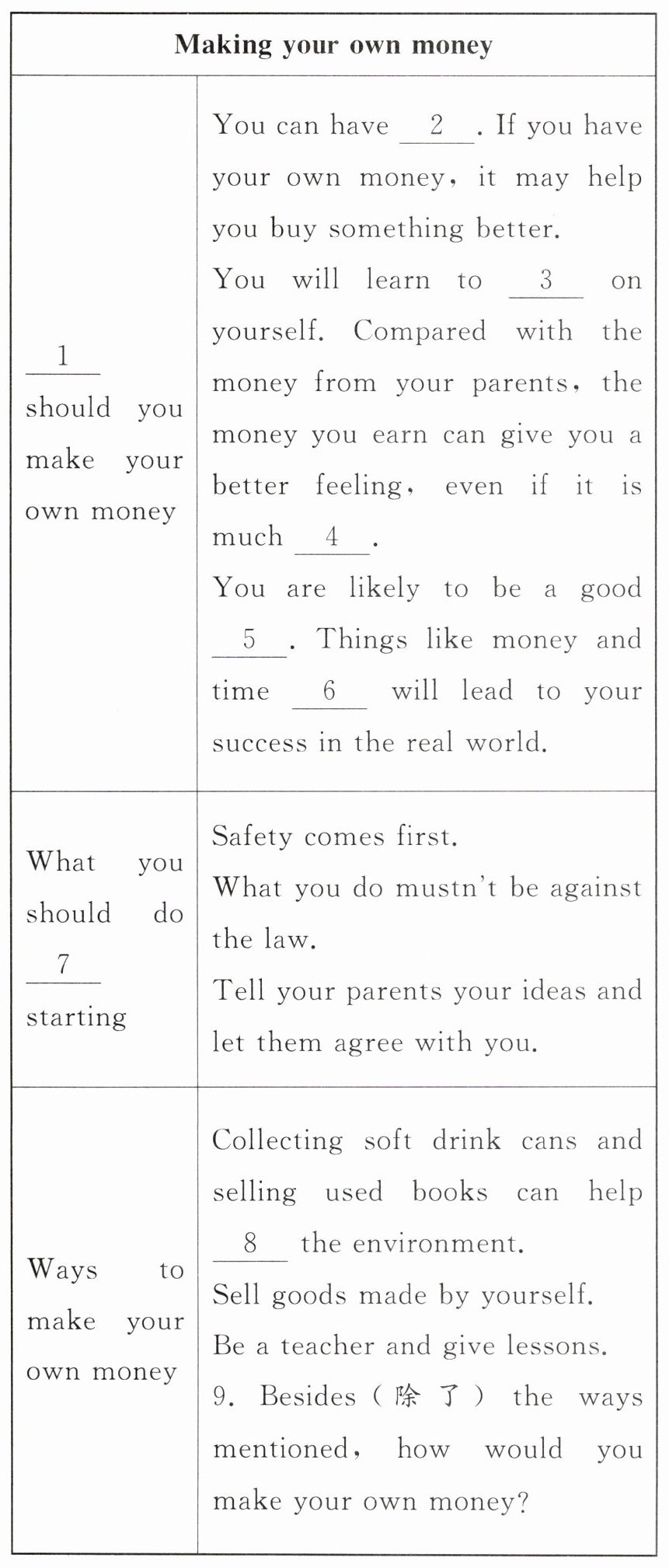
阅读下面的短文,根据所读内容,在文章后表格的空格里填入最恰当的内容。1—8题每个空格只填一个单词,第9题词数不限。
Have you ever wished you could grow up fast so you could use your own money? Earning money isn't
just for adults; teenagers can get in on the action too.
Money gives you choices. Perhaps you want to buy a better birthday present for your grandfather. Then the extra money you make helps.
Money gives you independence. When you make your own money, you don't have to depend on someone else. 100 yuan that you make by yourself feels a lot better than 160 yuan from your parents.
Moreover, making money is a learning process. By working for your own money, you'll learn the skills needed to succeed in the real world more actively. This includes managing money, communicating with other people, applying knowledge from school, and managing your time wisely.
You can start making money by trying the following:
• Collect soft drink cans. You can sell the cans and use the money for a new basketball. Plus, you'll help with a cleaner and more pleasant environment(环境)!
• Sell home-made goods. If you have a talent for DIY or baking, you can make and sell items like art pieces and cupcakes. To set a proper price, consider both the cost of materials and the time spent making the item.
• Sell used books. You may have some books that you have read but you don't want to keep. Selling them can be a way to earn money and support a green lifestyle.
• Want to be a teacher in the future? Begin practising now. Are you skilled in Maths, reading, or creating music? You can teach younger children how to get better grades or provide winter music lessons.
What are you good at? What do you like to do? Whatever you choose should be safe and lawful. Discuss your plans with your parents; you'll need them to say "yes".
答案
1. Why 2. choices 3. depend 4. less 5. learner 6. management 7. before 8. protect
9. By washing cars for neighbours.(答案合理即可)
【语篇解读】本文是一篇说明文,介绍了青少年自己赚钱的原因、好处以及几种可行的方法,并提醒注意安全和合法性。
1. Why 解析:表格左侧问“为什么要自己赚钱”,故填 Why。
2. choices 解析:由“Money gives you choices.”可知,自己有钱可以有更多选择。
3. depend 解析:由“you don't have to depend on someone else”可知,学会依靠自己,depend on oneself。
4. less 解析:文中说自己挣的 100 元比父母给的 160 元更好,说明自己挣的钱更少但感觉更好。
5. learner 解析:通过赚钱学习管理技能,可成为一个好的学习者。
6. management 解析:金钱和时间的“管理”能帮助你成功。填 management。
7. before 解析:开始赚钱之前要做的准备工作(安全、合法、与父母商量)。
8. protect 解析:捡软饮料罐和卖旧书有助于“保护”环境。
9. By washing cars for neighbours.(答案合理即可)
9. By washing cars for neighbours.(答案合理即可)
【语篇解读】本文是一篇说明文,介绍了青少年自己赚钱的原因、好处以及几种可行的方法,并提醒注意安全和合法性。
1. Why 解析:表格左侧问“为什么要自己赚钱”,故填 Why。
2. choices 解析:由“Money gives you choices.”可知,自己有钱可以有更多选择。
3. depend 解析:由“you don't have to depend on someone else”可知,学会依靠自己,depend on oneself。
4. less 解析:文中说自己挣的 100 元比父母给的 160 元更好,说明自己挣的钱更少但感觉更好。
5. learner 解析:通过赚钱学习管理技能,可成为一个好的学习者。
6. management 解析:金钱和时间的“管理”能帮助你成功。填 management。
7. before 解析:开始赚钱之前要做的准备工作(安全、合法、与父母商量)。
8. protect 解析:捡软饮料罐和卖旧书有助于“保护”环境。
9. By washing cars for neighbours.(答案合理即可)
解析
【分析】
解题时,先通读全文和表格内容,明确每个空格的语境:1-8题需结合原文对应语句,依据固定搭配或上下文逻辑填写恰当的单词;第9题为开放性题目,结合原文提到的赚钱方式,给出合理的例子即可。
【解析】
1. 表格左侧询问自己赚钱的原因,对应原文介绍青少年赚钱的缘由,故填Why;
2. 原文第二段第一句“Money gives you choices”,对应表格中“You can have ___”,故填choices;
3. 原文第三段“you don't have to depend on someone else”,结合固定搭配depend on,对应“learn to ___ on yourself”,故填depend;
4. 原文提到自己赚的100元比父母给的160元感觉更好,说明自己赚的钱更少,故填less;
5. 原文第四段指出赚钱是学习过程,对应“be a good ___”,故填learner;
6. 原文第四段提到赚钱涉及管理金钱等技能,对应“money and time ___”,故填management;
7. 表格左侧是开始赚钱前的准备事项,对应原文最后一段的准备内容,故填before;
8. 原文提到收集罐子、卖旧书有助于环境,结合固定搭配protect the environment,故填protect;
9. 开放性题目,结合原文提到的赚钱方式,合理即可,如帮邻居洗车,故填By washing cars for neighbours.
【答案】
1. Why 2. choices 3. depend 4. less 5. learner 6. management 7. before 8. protect 9. By washing cars for neighbours.(答案合理即可)
【知识点】
任务型阅读、词汇运用
【点评】
本题为任务型阅读题,考查学生的阅读理解、信息定位及词汇运用能力,1-8题需精准匹配原文细节与固定搭配,第9题考查发散思维,整体难度适中。
【难度系数】
0.7
解题时,先通读全文和表格内容,明确每个空格的语境:1-8题需结合原文对应语句,依据固定搭配或上下文逻辑填写恰当的单词;第9题为开放性题目,结合原文提到的赚钱方式,给出合理的例子即可。
【解析】
1. 表格左侧询问自己赚钱的原因,对应原文介绍青少年赚钱的缘由,故填Why;
2. 原文第二段第一句“Money gives you choices”,对应表格中“You can have ___”,故填choices;
3. 原文第三段“you don't have to depend on someone else”,结合固定搭配depend on,对应“learn to ___ on yourself”,故填depend;
4. 原文提到自己赚的100元比父母给的160元感觉更好,说明自己赚的钱更少,故填less;
5. 原文第四段指出赚钱是学习过程,对应“be a good ___”,故填learner;
6. 原文第四段提到赚钱涉及管理金钱等技能,对应“money and time ___”,故填management;
7. 表格左侧是开始赚钱前的准备事项,对应原文最后一段的准备内容,故填before;
8. 原文提到收集罐子、卖旧书有助于环境,结合固定搭配protect the environment,故填protect;
9. 开放性题目,结合原文提到的赚钱方式,合理即可,如帮邻居洗车,故填By washing cars for neighbours.
【答案】
1. Why 2. choices 3. depend 4. less 5. learner 6. management 7. before 8. protect 9. By washing cars for neighbours.(答案合理即可)
【知识点】
任务型阅读、词汇运用
【点评】
本题为任务型阅读题,考查学生的阅读理解、信息定位及词汇运用能力,1-8题需精准匹配原文细节与固定搭配,第9题考查发散思维,整体难度适中。
【难度系数】
0.7
