

 登录
登录
一、根据括号内所给汉语注释写出单词的正确形式(每空一词)
1. The little boy is the old man's only
2. If that is the
3. What will
4. Do not
5. John
6. The
7. We need a
1. The little boy is the old man's only
grandson
(外孙).2. If that is the
case
(情况;事实), we need more workers.3. What will
happen
(发生) to you if you don't follow the school rules?4. Do not
mix
(混合) the red paint with the yellow paint carelessly.5. John
ran
out of(用完) his money before the next month came.6. The
chain
(链条) of my bicycle is broken and I need to repair it.7. We need a
stable
(稳固) table to put our books and computers.答案
1. grandson 2. case 3. happen 4. mix
5. ran 6. chain 7. stable
5. ran 6. chain 7. stable
解析
【分析】
本题为根据汉语提示写单词的题型,解题思路如下:1. 准确理解括号内汉语注释的含义,确定对应的英文核心单词;2. 结合句子的语境、时态、固定搭配等调整单词的正确形式(如第5题需根据过去时态变形);3. 确保每个空仅填一个单词,符合题目要求。
【解析】
1. “外孙”对应的英文单词为grandson,符合语境;
2. “情况;事实”对应名词case,固定搭配the case表示“情况”;
3. “发生”对应动词happen,will后接动词原形;
4. “混合”对应动词mix,祈使句否定形式don't后接动词原形;
5. “用完”为固定搭配run out of,由后面的came可知用一般过去时,故填ran;
6. “链条”对应名词chain;
7. “稳固”对应形容词stable,修饰名词table。
【答案】
1. grandson 2. case 3. happen 4. mix 5. ran 6. chain 7. stable
【知识点】
英语单词拼写、动词时态、名词词义
【点评】
本题考查基础词汇的掌握与运用,需熟悉常见词汇的词义及形式变化,难度适中,适合基础阶段学生巩固练习。
【难度系数】
0.7
本题为根据汉语提示写单词的题型,解题思路如下:1. 准确理解括号内汉语注释的含义,确定对应的英文核心单词;2. 结合句子的语境、时态、固定搭配等调整单词的正确形式(如第5题需根据过去时态变形);3. 确保每个空仅填一个单词,符合题目要求。
【解析】
1. “外孙”对应的英文单词为grandson,符合语境;
2. “情况;事实”对应名词case,固定搭配the case表示“情况”;
3. “发生”对应动词happen,will后接动词原形;
4. “混合”对应动词mix,祈使句否定形式don't后接动词原形;
5. “用完”为固定搭配run out of,由后面的came可知用一般过去时,故填ran;
6. “链条”对应名词chain;
7. “稳固”对应形容词stable,修饰名词table。
【答案】
1. grandson 2. case 3. happen 4. mix 5. ran 6. chain 7. stable
【知识点】
英语单词拼写、动词时态、名词词义
【点评】
本题考查基础词汇的掌握与运用,需熟悉常见词汇的词义及形式变化,难度适中,适合基础阶段学生巩固练习。
【难度系数】
0.7
二、单句语法填空
1. You look
2. You should follow
3. In
4. Please keep
5. Their problems may get
6. He is going
7. The old man loves his three
8. What
9. We should read more books instead
1. You look
worried
(worry) about your exam. What's wrong?2. You should follow
what
the doctor says.3. In
his
(he) case, we should try to give him more help.4. Please keep
in
mind that safety always comes first.5. Their problems may get
worse
(bad) if they don't face them bravely.6. He is going
through
a hard time these days.7. The old man loves his three
grandsons
(grandson) very much and often tells them stories.8. What
happened
(happen) to you yesterday? You looked so sad.9. We should read more books instead
of
playing computer games all day.答案
1. worried 2. what 3. his 4. in 5. worse
6. through 7. grandsons 8. happened 9. of
6. through 7. grandsons 8. happened 9. of
解析
【分析】
本题为单句语法填空,需结合语法规则逐一分析:
1. look是系动词,后接形容词作表语,需将动词worry转换为形容词;
2. follow后接宾语从句,从句中says缺宾语,需用连接代词what引导;
3. 修饰名词case需用形容词性物主代词,对应人称代词he的形容词性物主代词;
4. 考查固定短语,需填入构成“记住”含义的介词;
5. get是系动词,结合语境需用形容词bad的比较级;
6. 考查固定动词短语,需填入表示“经历”含义的介词;
7. 数词three后需接可数名词复数;
8. 时间状语yesterday提示用一般过去时,需填动词happen的过去式;
9. 考查固定短语,需填入构成“代替”含义的介词。
【解析】
1. 系动词后接形容词作表语,worry的形容词形式为worried,故填worried;
2. follow后接宾语从句,从句中says缺少宾语,用连接代词what引导从句并作says的宾语,故填what;
3. 形容词性物主代词修饰名词case,he的形容词性物主代词为his,故填his;
4. 固定搭配keep in mind意为“记住”,故填in;
5. 结合语境“不勇敢面对问题会变得更糟”,bad的比较级为worse,故填worse;
6. 固定短语go through意为“经历”,故填through;
7. 数词three后接可数名词复数,grandson的复数形式为grandsons,故填grandsons;
8. 由时间状语yesterday可知用一般过去时,happen的过去式为happened,故填happened;
9. 固定搭配instead of意为“代替、而不是”,故填of。
【答案】
1. worried 2. what 3. his 4. in 5. worse 6. through 7. grandsons 8. happened 9. of
【知识点】
固定短语搭配、词性转换、一般过去时
【点评】
本题为基础语法填空题,考察初中阶段核心语法知识点,覆盖词性转换、从句、固定搭配、时态等内容,难度适中,适合巩固基础语法,学生掌握度较高。
【难度系数】
0.8
本题为单句语法填空,需结合语法规则逐一分析:
1. look是系动词,后接形容词作表语,需将动词worry转换为形容词;
2. follow后接宾语从句,从句中says缺宾语,需用连接代词what引导;
3. 修饰名词case需用形容词性物主代词,对应人称代词he的形容词性物主代词;
4. 考查固定短语,需填入构成“记住”含义的介词;
5. get是系动词,结合语境需用形容词bad的比较级;
6. 考查固定动词短语,需填入表示“经历”含义的介词;
7. 数词three后需接可数名词复数;
8. 时间状语yesterday提示用一般过去时,需填动词happen的过去式;
9. 考查固定短语,需填入构成“代替”含义的介词。
【解析】
1. 系动词后接形容词作表语,worry的形容词形式为worried,故填worried;
2. follow后接宾语从句,从句中says缺少宾语,用连接代词what引导从句并作says的宾语,故填what;
3. 形容词性物主代词修饰名词case,he的形容词性物主代词为his,故填his;
4. 固定搭配keep in mind意为“记住”,故填in;
5. 结合语境“不勇敢面对问题会变得更糟”,bad的比较级为worse,故填worse;
6. 固定短语go through意为“经历”,故填through;
7. 数词three后接可数名词复数,grandson的复数形式为grandsons,故填grandsons;
8. 由时间状语yesterday可知用一般过去时,happen的过去式为happened,故填happened;
9. 固定搭配instead of意为“代替、而不是”,故填of。
【答案】
1. worried 2. what 3. his 4. in 5. worse 6. through 7. grandsons 8. happened 9. of
【知识点】
固定短语搭配、词性转换、一般过去时
【点评】
本题为基础语法填空题,考察初中阶段核心语法知识点,覆盖词性转换、从句、固定搭配、时态等内容,难度适中,适合巩固基础语法,学生掌握度较高。
【难度系数】
0.8
三、将方框中所给词语的适当形式填入句中,每词仅用一次
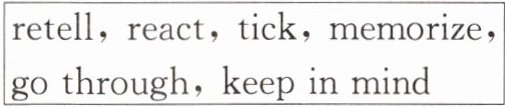
1.
2. Listen carefully and
3. She
4. It's necessary to learn to
5. Don't worry.
6. Try to
1.
Memorizing
new words is a great challenge for English learners.2. Listen carefully and
tick
the correct answers after you hear the dialogue.3. She
went through
a terrible time when she worked alone in another city.4. It's necessary to learn to
react
properly in different situations.5. Don't worry.
Keep in mind
that things will change for the better.6. Try to
retell
the story without looking at the book.答案
1. Memorizing 2. tick 3. went through
4. react 5. Keep in mind 6. retell
4. react 5. Keep in mind 6. retell
解析
【分析】
首先明确方框内各词汇/短语的含义:retell(复述)、react(反应)、tick(打钩,标记)、memorize(记忆)、go through(经历,度过)、keep in mind(记住)。解题时需先分析每个句子的语法结构(如主语类型、时态、祈使句、非谓语结构等)和语境,再结合词汇词义,选择合适的词并调整为正确形式,确保每词仅用一次。
【解析】
1. 句中缺少主语,需用动名词作主语,方框中memorize的动名词形式为memorizing,符合“记忆新单词是英语学习者的挑战”的语境,故填Memorizing。
2. 该句为祈使句,Listen与空格处动词并列,需用动词原形;结合语境“听到对话后标记正确答案”,选tick,故填tick。
3. 由从句worked可知时态为一般过去时,结合语境“在另一个城市独自工作时度过糟糕时光”,go through的过去式为went through,故填went through。
4. 固定搭配learn to do sth.,需用动词原形;结合语境“在不同情况恰当反应”,选react,故填react。
5. 该句为祈使句,句首单词首字母大写;结合语境“记住情况会变好”,选Keep in mind,故填Keep in mind。
6. 固定搭配try to do sth.,需用动词原形;结合语境“不看书复述故事”,选retell,故填retell。
【答案】
1. Memorizing 2. tick 3. went through 4. react 5. Keep in mind 6. retell
【知识点】
动名词作主语、一般过去时、动词短语辨析
【点评】
本题考查动词及动词短语的词义辨析与形式运用,需结合句子语法结构和语境选择正确形式,是初中英语常见的词汇运用基础题型,注重对核心词汇的掌握。
【难度系数】
0.5
首先明确方框内各词汇/短语的含义:retell(复述)、react(反应)、tick(打钩,标记)、memorize(记忆)、go through(经历,度过)、keep in mind(记住)。解题时需先分析每个句子的语法结构(如主语类型、时态、祈使句、非谓语结构等)和语境,再结合词汇词义,选择合适的词并调整为正确形式,确保每词仅用一次。
【解析】
1. 句中缺少主语,需用动名词作主语,方框中memorize的动名词形式为memorizing,符合“记忆新单词是英语学习者的挑战”的语境,故填Memorizing。
2. 该句为祈使句,Listen与空格处动词并列,需用动词原形;结合语境“听到对话后标记正确答案”,选tick,故填tick。
3. 由从句worked可知时态为一般过去时,结合语境“在另一个城市独自工作时度过糟糕时光”,go through的过去式为went through,故填went through。
4. 固定搭配learn to do sth.,需用动词原形;结合语境“在不同情况恰当反应”,选react,故填react。
5. 该句为祈使句,句首单词首字母大写;结合语境“记住情况会变好”,选Keep in mind,故填Keep in mind。
6. 固定搭配try to do sth.,需用动词原形;结合语境“不看书复述故事”,选retell,故填retell。
【答案】
1. Memorizing 2. tick 3. went through 4. react 5. Keep in mind 6. retell
【知识点】
动名词作主语、一般过去时、动词短语辨析
【点评】
本题考查动词及动词短语的词义辨析与形式运用,需结合句子语法结构和语境选择正确形式,是初中英语常见的词汇运用基础题型,注重对核心词汇的掌握。
【难度系数】
0.5
四、阅读理解
A
As internet users become more dependent on the internet to store information, do
people remember less? If you know your computer will store information, why do you
store it in your own personal memory, your brain? Experts are wondering if the internet is changing what we remember and how.
In a recent study, Professor Betsy Sparrow did some experiments. She and her research team wanted to know how the internet is changing memory.
In the first experiment, they gave two groups of people 40 unimportant facts to type into a computer. The first group of people understood that the computer would store the information. The second group understood that the computer would not store it. Later, the second group remembered the information better. People in the first group knew they could find the information again, so they did not try to remember it.
In the second experiment, the researchers gave people facts to remember, and told them where to find the information on the internet. The information was in a specific computer folder(文件夹). Surprisingly, people later remembered where the folder was better than the facts. When people use the internet, they do not remember the information. However, they remember how to find it. This is called "transactive(交互的) memory".
According to Sparrow, we are not becoming people with poor memories as a result of the internet. Instead, computer users are developing stronger transactive memories; that is, people are learning how to organize a lot of information so that they are able to get it at a later date. This doesn't mean we are becoming either more or less clever, but there is no doubt that the way we use memory is changing.
( )1. Why does the writer begin the text with two questions?
A. To explain some thoughts.
B. To introduce the main topic.
C. To show an opinion.
D. To draw the readers' attention.
(
A. Sparrow typed the information into the computer.
B. Both groups remember the information well.
C. Group 1 remembered the information faster.
D. Group 2 remembered the information better.
(
A. People organize the information like a computer.
B. People remember how to find the information.
C. People remember how to make a folder.
D. People keep the information in mind.
(
A. People become more and more clever.
B. The way people use memory is changing.
C. The way people do experiments is changing.
D. People's memories become poorer than before.
B
A
As internet users become more dependent on the internet to store information, do
people remember less? If you know your computer will store information, why do you
store it in your own personal memory, your brain? Experts are wondering if the internet is changing what we remember and how.
In a recent study, Professor Betsy Sparrow did some experiments. She and her research team wanted to know how the internet is changing memory.
In the first experiment, they gave two groups of people 40 unimportant facts to type into a computer. The first group of people understood that the computer would store the information. The second group understood that the computer would not store it. Later, the second group remembered the information better. People in the first group knew they could find the information again, so they did not try to remember it.
In the second experiment, the researchers gave people facts to remember, and told them where to find the information on the internet. The information was in a specific computer folder(文件夹). Surprisingly, people later remembered where the folder was better than the facts. When people use the internet, they do not remember the information. However, they remember how to find it. This is called "transactive(交互的) memory".
According to Sparrow, we are not becoming people with poor memories as a result of the internet. Instead, computer users are developing stronger transactive memories; that is, people are learning how to organize a lot of information so that they are able to get it at a later date. This doesn't mean we are becoming either more or less clever, but there is no doubt that the way we use memory is changing.
( )1. Why does the writer begin the text with two questions?
A. To explain some thoughts.
B. To introduce the main topic.
C. To show an opinion.
D. To draw the readers' attention.
(
D
)2. What can we learn from the first experiment?A. Sparrow typed the information into the computer.
B. Both groups remember the information well.
C. Group 1 remembered the information faster.
D. Group 2 remembered the information better.
(
B
)3. What do we know about transactive memory from the second experiment?A. People organize the information like a computer.
B. People remember how to find the information.
C. People remember how to make a folder.
D. People keep the information in mind.
(
B
)4. What's Professor Betsy Sparrow's conclusion?A. People become more and more clever.
B. The way people use memory is changing.
C. The way people do experiments is changing.
D. People's memories become poorer than before.
B
答案
1.B 2.D 3.B 4.B
解析
【分析】
解答这篇阅读理解需结合原文内容,针对每个问题定位关键信息:第1题考查文章开头问句的作用,需联系后文引出的主题判断;第2题对应第一个实验的结果,直接找两组记忆情况的描述;第3题考查“交互记忆”的定义,定位实验结论句;第4题考查专家的结论,对应最后一段的总结句。
【解析】
1. 文章开头两个问句后,引出核心主题“互联网是否在改变我们记忆的内容和方式”,因此开头问句的作用是引入文章主题,故选B。
2. 第一个实验中明确提到“Later, the second group remembered the information better”,即第二组记忆更好,故选D。
3. 第二个实验结论指出“they remember how to find it. This is called 'transactive memory'”,即交互记忆是记住找信息的方法,故选B。
4. 最后一段专家总结“the way we use memory is changing”,即人们使用记忆的方式正在改变,故选B。
【答案】
1.B 2.D 3.B 4.B
【知识点】
英语阅读理解、细节理解题、主旨大意题
【点评】
本文围绕互联网对人类记忆的影响展开,通过两个实验考查学生的信息定位与理解能力,题目设置以细节题为主,难度适中。
【难度系数】
0.7
解答这篇阅读理解需结合原文内容,针对每个问题定位关键信息:第1题考查文章开头问句的作用,需联系后文引出的主题判断;第2题对应第一个实验的结果,直接找两组记忆情况的描述;第3题考查“交互记忆”的定义,定位实验结论句;第4题考查专家的结论,对应最后一段的总结句。
【解析】
1. 文章开头两个问句后,引出核心主题“互联网是否在改变我们记忆的内容和方式”,因此开头问句的作用是引入文章主题,故选B。
2. 第一个实验中明确提到“Later, the second group remembered the information better”,即第二组记忆更好,故选D。
3. 第二个实验结论指出“they remember how to find it. This is called 'transactive memory'”,即交互记忆是记住找信息的方法,故选B。
4. 最后一段专家总结“the way we use memory is changing”,即人们使用记忆的方式正在改变,故选B。
【答案】
1.B 2.D 3.B 4.B
【知识点】
英语阅读理解、细节理解题、主旨大意题
【点评】
本文围绕互联网对人类记忆的影响展开,通过两个实验考查学生的信息定位与理解能力,题目设置以细节题为主,难度适中。
【难度系数】
0.7
