

 登录
登录
1. take place
【感知】
» What changes have taken place around you?(教材第2页)
你周围发生了什么变化?
» The school art festival takes place every October. 学校艺术节每年十月举行。
» Accidents like this happen all the time. 此类事故经常发生。
【探究】
(1)take place 不及物动词,意为“发生;举行”。
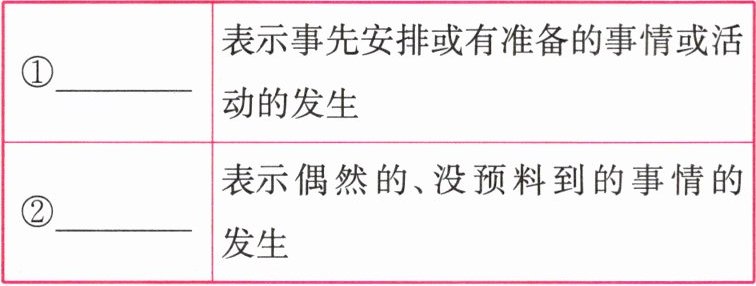
(2)take place 与 happen 都有“发生”的含义,且均无被动语态。区别如下:
【应用】
完成句子
①该面谈是在一个星期五下午进行的。
The interview
②发生什么事了?有什么问题吗?
【感知】
» What changes have taken place around you?(教材第2页)
你周围发生了什么变化?
» The school art festival takes place every October. 学校艺术节每年十月举行。
» Accidents like this happen all the time. 此类事故经常发生。
【探究】
(1)take place 不及物动词,意为“发生;举行”。
(2)take place 与 happen 都有“发生”的含义,且均无被动语态。区别如下:
【应用】
完成句子
①该面谈是在一个星期五下午进行的。
The interview
took
place
on a Friday afternoon.②发生什么事了?有什么问题吗?
What happened
What's happening
? Is anything wrong?答案
1. [探究](2)①take place ②happen
[应用]①took place ②What happened / What's happening
[应用]①took place ②What happened / What's happening
解析
【分析】
首先明确take place和happen的用法差异:take place侧重表示事先安排、有准备的事件或活动的发生;happen侧重表示偶然、未预料到的事情的发生,二者均为不及物动词,无被动语态。解题时需先根据语境判断事件是否为事先安排,再选择对应短语,并结合时态要求变形。
【解析】
1. 探究部分:根据语义,①对应“事先安排的事情发生”,填take place;②对应“偶然发生的事情”,填happen。
2. 应用部分:①句中“面谈”是事先安排的,且动作发生在过去,故用take place的过去式took place;②句询问发生的事,常用表达为What happened(一般过去时,表过去发生的事)或What's happening(现在进行时,表此刻正在发生的事)。
【答案】
[探究](2)①take place ②happen;[应用]①took place ②What happened / What's happening
【知识点】
动词短语辨析;一般过去时;现在进行时
【点评】
本题考查易混动词短语take place与happen的用法区别,同时涉及时态的正确运用,需准确把握短语语义差异,结合语境作答,难度适中。
【难度系数】
0.6
首先明确take place和happen的用法差异:take place侧重表示事先安排、有准备的事件或活动的发生;happen侧重表示偶然、未预料到的事情的发生,二者均为不及物动词,无被动语态。解题时需先根据语境判断事件是否为事先安排,再选择对应短语,并结合时态要求变形。
【解析】
1. 探究部分:根据语义,①对应“事先安排的事情发生”,填take place;②对应“偶然发生的事情”,填happen。
2. 应用部分:①句中“面谈”是事先安排的,且动作发生在过去,故用take place的过去式took place;②句询问发生的事,常用表达为What happened(一般过去时,表过去发生的事)或What's happening(现在进行时,表此刻正在发生的事)。
【答案】
[探究](2)①take place ②happen;[应用]①took place ②What happened / What's happening
【知识点】
动词短语辨析;一般过去时;现在进行时
【点评】
本题考查易混动词短语take place与happen的用法区别,同时涉及时态的正确运用,需准确把握短语语义差异,结合语境作答,难度适中。
【难度系数】
0.6
2. support
【感知】
» They began planting it in sandy areas,
with the government's support.(教材第3页)在政府的支持下,他们开始在沙质地区种植它(小灌木)。
» He gave a speech in support of the project.
他发表演讲支持这个项目。
» Most students support this new rule.
大多数学生支持这条新规定。
» Mark works hard to support his happy family.
马克努力工作,供养他幸福的家庭。
【探究】
(1)support作名词,意为“支持”时,为不可数名词。
(2)support作动词,意为“支持;养活”。
【应用】
①完成句子:只有几个人表示支持这一提议。
Only a few people spoke
②用所给单词的适当形式填空:Thanks a lot for
【感知】
» They began planting it in sandy areas,
with the government's support.(教材第3页)在政府的支持下,他们开始在沙质地区种植它(小灌木)。
» He gave a speech in support of the project.
他发表演讲支持这个项目。
» Most students support this new rule.
大多数学生支持这条新规定。
» Mark works hard to support his happy family.
马克努力工作,供养他幸福的家庭。
【探究】
(1)support作名词,意为“支持”时,为不可数名词。
in support of
支持;为了支持(2)support作动词,意为“支持;养活”。
【应用】
①完成句子:只有几个人表示支持这一提议。
Only a few people spoke
in
support
of
the proposal.②用所给单词的适当形式填空:Thanks a lot for
supporting
(support) me in my work, Jenny.答案
2. [探究](1)in support of
[应用]①in support of ②supporting
[应用]①in support of ②supporting
解析
【分析】
本题考查英语核心词汇support的词性辨析及相关固定搭配、非谓语动词用法。解题思路:1. 明确support作名词表“支持”时的固定短语;2. 应用①需填“表示支持”的固定搭配;3. 应用②中,介词后接动词需用动名词形式。
【解析】
1. 探究(1):support作名词意为“支持”时,固定短语“in support of”表示“支持;为了支持”,故此处填in support of。
2. 应用①:“表示支持”的固定表达为“speak in support of”,故填in support of。
3. 应用②:介词for后接动词时,需使用其动名词形式,support的动名词为supporting,故填supporting。
【答案】
[探究](1)in support of;[应用]①in support of;②supporting
【知识点】
固定搭配;动名词
【点评】
本题围绕基础词汇support的用法展开,考查固定短语搭配和介词后动词的形式,属于英语基础题型,需熟练掌握常见词汇的固定用法。
【难度系数】
0.7
本题考查英语核心词汇support的词性辨析及相关固定搭配、非谓语动词用法。解题思路:1. 明确support作名词表“支持”时的固定短语;2. 应用①需填“表示支持”的固定搭配;3. 应用②中,介词后接动词需用动名词形式。
【解析】
1. 探究(1):support作名词意为“支持”时,固定短语“in support of”表示“支持;为了支持”,故此处填in support of。
2. 应用①:“表示支持”的固定表达为“speak in support of”,故填in support of。
3. 应用②:介词for后接动词时,需使用其动名词形式,support的动名词为supporting,故填supporting。
【答案】
[探究](1)in support of;[应用]①in support of;②supporting
【知识点】
固定搭配;动名词
【点评】
本题围绕基础词汇support的用法展开,考查固定短语搭配和介词后动词的形式,属于英语基础题型,需熟练掌握常见词汇的固定用法。
【难度系数】
0.7
3. product
【感知】
» We can now sell local products to tourists.(教材第4页)
我们现在可以向游客出售当地产品。
» This factory produces environmentally friendly paper. 这家工厂生产环保纸张。
» We watched a video about the production of silk during the history class. 历史课上,我们观看了一段关于丝绸生产过程的视频。
【探究】
(1)product 名词,意为“
(2)product 的词形变化
①
②
【应用】
用所给单词的适当形式填空
①Our
②The factory
③The
【感知】
» We can now sell local products to tourists.(教材第4页)
我们现在可以向游客出售当地产品。
» This factory produces environmentally friendly paper. 这家工厂生产环保纸张。
» We watched a video about the production of silk during the history class. 历史课上,我们观看了一段关于丝绸生产过程的视频。
【探究】
(1)product 名词,意为“
产品
”。(2)product 的词形变化
①
produce
v. 生产;制造②
production
n. 生产;产量【应用】
用所给单词的适当形式填空
①Our
products
(product) are now traded worldwide.②The factory
produces
(produce) over 10,000 computers a month.③The
production
(produce) of electric cars has grown rapidly in recent years.答案
3. [探究](1)产品
(2)①produce ②production
[应用]①products ②produces
③production
(2)①produce ②production
[应用]①products ②produces
③production
解析
【分析】
这道题考查product相关的词义、词形变化及词汇运用,解题时先结合例句理解product的含义,再根据名词与动词的词形转换规则确定对应词汇,最后结合句子的语法要求(如主谓一致、名词单复数)完成填空。
【解析】
探究
(1) 从例句“We can now sell local products to tourists.”可推断,product作名词时意为“产品”;
(2) ①product对应的动词(生产、制造)为produce;②product对应的名词“生产;产量”为production;
应用
①句中be动词为are,主语需用名词复数,故填products;
②主语the factory是第三人称单数,一般现在时中动词用第三人称单数形式,故填produces;
③定冠词the后接名词,故填production。
【答案】
3. [探究](1)产品
(2)①produce ②production
[应用]①products ②produces ③production
【知识点】
英语名词词义、英语词形转换、英语语法应用
【点评】
本题围绕product的基础词汇知识展开,侧重考查词义识记和词形变化的掌握,是英语学习的基础内容,难度较低,适合巩固词汇基础。
【难度系数】
0.8
这道题考查product相关的词义、词形变化及词汇运用,解题时先结合例句理解product的含义,再根据名词与动词的词形转换规则确定对应词汇,最后结合句子的语法要求(如主谓一致、名词单复数)完成填空。
【解析】
探究
(1) 从例句“We can now sell local products to tourists.”可推断,product作名词时意为“产品”;
(2) ①product对应的动词(生产、制造)为produce;②product对应的名词“生产;产量”为production;
应用
①句中be动词为are,主语需用名词复数,故填products;
②主语the factory是第三人称单数,一般现在时中动词用第三人称单数形式,故填produces;
③定冠词the后接名词,故填production。
【答案】
3. [探究](1)产品
(2)①produce ②production
[应用]①products ②produces ③production
【知识点】
英语名词词义、英语词形转换、英语语法应用
【点评】
本题围绕product的基础词汇知识展开,侧重考查词义识记和词形变化的掌握,是英语学习的基础内容,难度较低,适合巩固词汇基础。
【难度系数】
0.8
