

 登录
一、阅读理解。
阅读下面四篇语言材料,然后按文后要求做题。
A
On UN Chinese Language Day (Guyu, the 6th of the 24 solar terms), people around the world celebrate the beauty of the Chinese language. Here are three Chinese learners sharing their learning experiences.
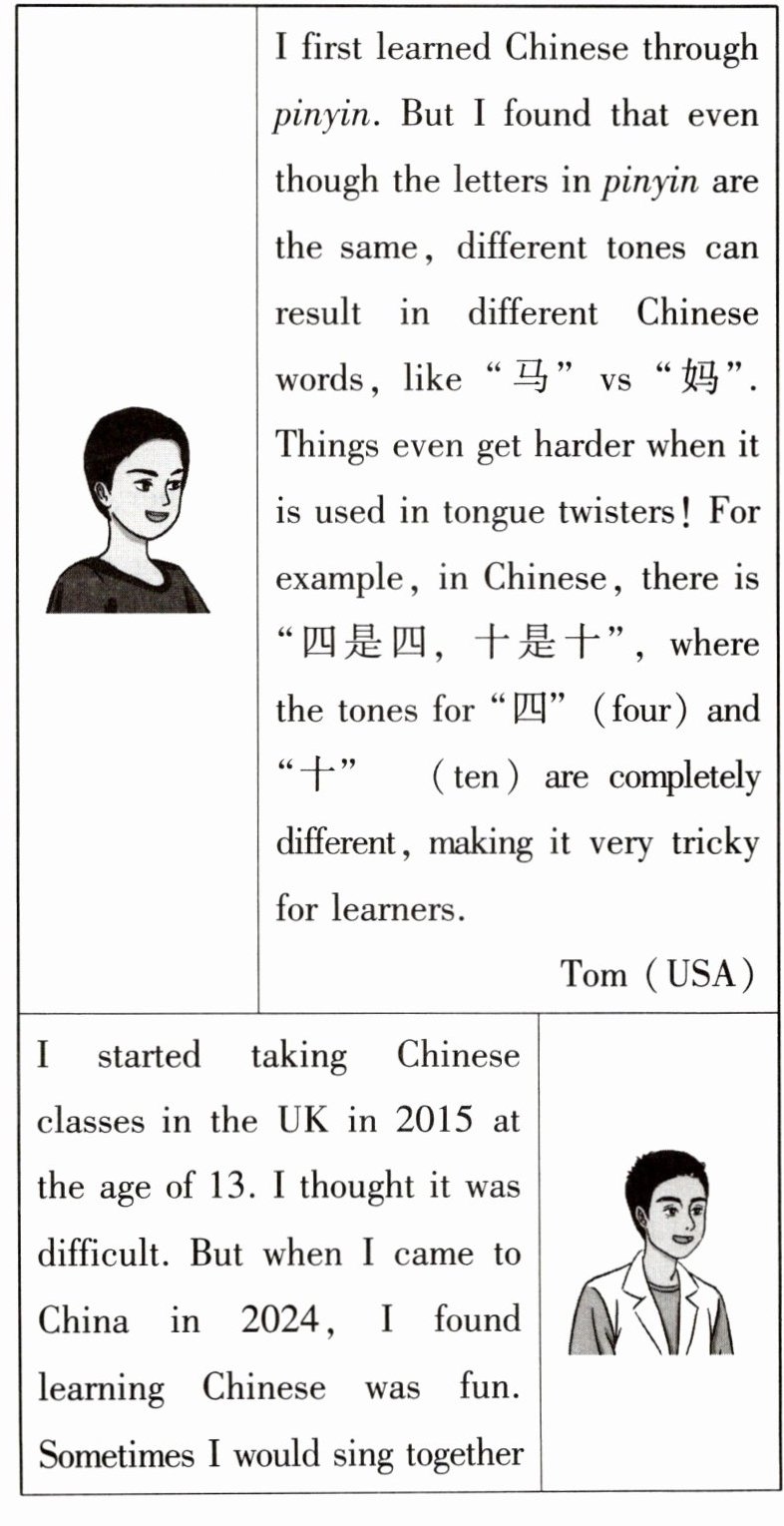
I first learned Chinese through pinyin. But I found that even though the letters in pinyin are the same, different tones can result in different Chinese words, like “马” vs “妈”. Things even get harder when it is used in tongue twisters! For example, in Chinese, there is “四是四,十是十”, where the tones for “四” (four) and “十” (ten) are completely different, making it very tricky for learners.
Tom (USA)
I started taking Chinese classes in the UK in 2015 at the age of 13. I thought it was difficult. But when I came to China in 2024, I found learning Chinese was fun. Sometimes I would sing together with my Chinese friends. With every note I sang, I began to understand the characters. It really made my language learning experience more enjoyable.
Alex (UK)

I once worked at a Chinese university as a translator. I think Chinese is more concise (简明的) and expressive than English. For example, a Chinese saying reads, “三人行,必有我师焉”, but the English translation would read, “When I walk along with two others, they may serve as my teachers.” The English sentence is much longer and not as simple as the Chinese saying.
Cooper (Australia)
根据材料内容选择最佳选项。
(
A. A Chinese solar term.
B. A Chinese traditional festival.
C. A Chinese ancient art.
D. A Chinese learning activity.
(
A. Because he couldn't remember pinyin letters at all.
B. Because chinese tongue twisters are too long to read.
C. Because the same pinyin letters with different tones mean different words.
D. Because he had no chance to practice tongue twisters.
(
A. 20. B. 21.
C. 22. D. 23.
(
A. It is difficult to translate into English.
B. It is more concise and expressive than English.
C. It is longer and more difficult than English.
D. It is not as simple as English.
(
A. A Chinese textbook for primary school students.
B. A storybook about foreign travelers in China.
C. A news report about international festivals.
D. A webpage about Chinese language and culture.
阅读下面四篇语言材料,然后按文后要求做题。
A
On UN Chinese Language Day (Guyu, the 6th of the 24 solar terms), people around the world celebrate the beauty of the Chinese language. Here are three Chinese learners sharing their learning experiences.
I first learned Chinese through pinyin. But I found that even though the letters in pinyin are the same, different tones can result in different Chinese words, like “马” vs “妈”. Things even get harder when it is used in tongue twisters! For example, in Chinese, there is “四是四,十是十”, where the tones for “四” (four) and “十” (ten) are completely different, making it very tricky for learners.
Tom (USA)
I started taking Chinese classes in the UK in 2015 at the age of 13. I thought it was difficult. But when I came to China in 2024, I found learning Chinese was fun. Sometimes I would sing together with my Chinese friends. With every note I sang, I began to understand the characters. It really made my language learning experience more enjoyable.
Alex (UK)
I once worked at a Chinese university as a translator. I think Chinese is more concise (简明的) and expressive than English. For example, a Chinese saying reads, “三人行,必有我师焉”, but the English translation would read, “When I walk along with two others, they may serve as my teachers.” The English sentence is much longer and not as simple as the Chinese saying.
Cooper (Australia)
根据材料内容选择最佳选项。
(
A
)1. What does “Guyu” refer to in the text?A. A Chinese solar term.
B. A Chinese traditional festival.
C. A Chinese ancient art.
D. A Chinese learning activity.
(
C
)2. Why did Tom feel it hard to learn Chinese?A. Because he couldn't remember pinyin letters at all.
B. Because chinese tongue twisters are too long to read.
C. Because the same pinyin letters with different tones mean different words.
D. Because he had no chance to practice tongue twisters.
(
C
)3. How old was Alex when he came to China?A. 20. B. 21.
C. 22. D. 23.
(
B
)4. What does Cooper think of Chinese?A. It is difficult to translate into English.
B. It is more concise and expressive than English.
C. It is longer and more difficult than English.
D. It is not as simple as English.
(
D
)5. Where is the text most probably from?A. A Chinese textbook for primary school students.
B. A storybook about foreign travelers in China.
C. A news report about international festivals.
D. A webpage about Chinese language and culture.
答案
1. A 由第一段第一句“联合国中文日(谷雨,二十四节气中的第六个节气)”可知,谷雨是一个中国的节气。
2. C 由表格第一栏可以判断,Tom觉得中文难学的原因是拼音字母相同,声调不同,字形词义不同。
3. C 2015年Alex开始上汉语课的时候他13岁,所以2024年他来中国的时候应该是22岁。
4. B 由表格第三栏第二句可知,相较于英文,中文更简明,而富有感染力。
5. D 本文围绕联合国中国语言日依次展示了三位汉语学习者的留言,所以更有可能来源于有关中国语言文化的网页。
解析
【分析】
本题为英语阅读理解题,解题思路如下:1. 先快速通读全文,明确文章围绕联合国中文日(谷雨),分享三位外国汉语学习者的学习经历;2. 针对每个小题,带着问题回到原文定位对应内容:第1题定位第一段关于Guyu的定义,第2题定位Tom的分享内容,第3题根据Alex的年龄信息计算,第4题定位Cooper的观点,第5题结合文章内容推断出处;3. 对比选项与原文信息,选出最佳答案。
【解析】
1. 根据第一段第一句“On UN Chinese Language Day (Guyu, the 6th of the 24 solar terms)”可知,谷雨是二十四节气之一,对应选项A,故选A。
2. Tom的分享中提到“even though the letters in pinyin are the same, different tones can result in different Chinese words”,这是他觉得中文难学的原因,对应选项C,故选C。
3. Alex2015年开始上汉语课时13岁,2024-2015=9,13+9=22岁,对应选项C,故选C。
4. Cooper明确表示“I think Chinese is more concise (简明的) and expressive than English”,对应选项B,故选B。
5. 文章围绕联合国中文日,呈现三位汉语学习者的分享,内容与中国语言文化相关,最可能来源于相关网页,对应选项D,故选D。
【答案】
1.A 2.C 3.C 4.B 5.D
【知识点】
英语阅读理解、细节理解题、推理判断题
【点评】
本文以联合国中文日为背景,通过三位外国学习者的分享介绍中文学习的相关内容,题型侧重细节信息的查找与理解,辅以简单计算和出处推断,考查学生的信息定位及基础推理能力,难度适中,适合中等水平学生作答。
【难度系数】
0.7
