

 登录
登录
听第2段对话,回答第7小题。
(
A.A ruler.
B.A compass.
C.A watch.
(
B
)7. What does Li Tao want to use?A.A ruler.
B.A compass.
C.A watch.
答案
7. B
听第3段对话,回答第8小题。
(
A.In the room.
B.In the library.
C.In the office.
(
B
)8. Where can Li Wei print the report?A.In the room.
B.In the library.
C.In the office.
答案
8. B
听第4段对话,回答第9小题。
(
A.A red bag.
B.A blue box.
C.A fishing net.
(
C
)9. What is Li Hua looking for?A.A red bag.
B.A blue box.
C.A fishing net.
答案
9. C
听第5段对话,回答第10、11小题。
(
A. A painting work.
B. A class report.
C. A cooking plan.
(
A. Paper-making.
B. Painting.
C. Cooking.
(
B
)10. What is Zhang Lei preparing?A. A painting work.
B. A class report.
C. A cooking plan.
(
A
)11. Which traditional skill does Zhang Lei choose?A. Paper-making.
B. Painting.
C. Cooking.
答案
10. B 11. A
听第6段对话,回答第12、13小题。
(
A. Plastic. B. Wood.
C. Special glass.
(
A. In the city center.
B. Near the lake.
C. Near the mountain.
(
C
)12. What is the skywalk made of?A. Plastic. B. Wood.
C. Special glass.
(
C
)13. Where is the glass skywalk?A. In the city center.
B. Near the lake.
C. Near the mountain.
答案
12. C 13. C
听第7段对话,回答第14、15小题。
(
A. Science. B. Chemistry.
C. Medicine.
(
A. Qinghaosu.
B. A new disease.
C. A chemical.
(
C
)14. What did Tu Youyou do great work with?A. Science. B. Chemistry.
C. Medicine.
(
A
)15. Which thing did Tu Youyou discover?A. Qinghaosu.
B. A new disease.
C. A chemical.
答案
14. C 15. A
第三节 听下面短文,根据你所听到的内容,完成以下表格,每空填一词。(短文读三遍)
Objects Materials Uses
piano 16. Creating beautiful music
laptop Metal, plastic and glass Working, 17. or even watching videos
camera Plastic, glass and metal Taking photos to record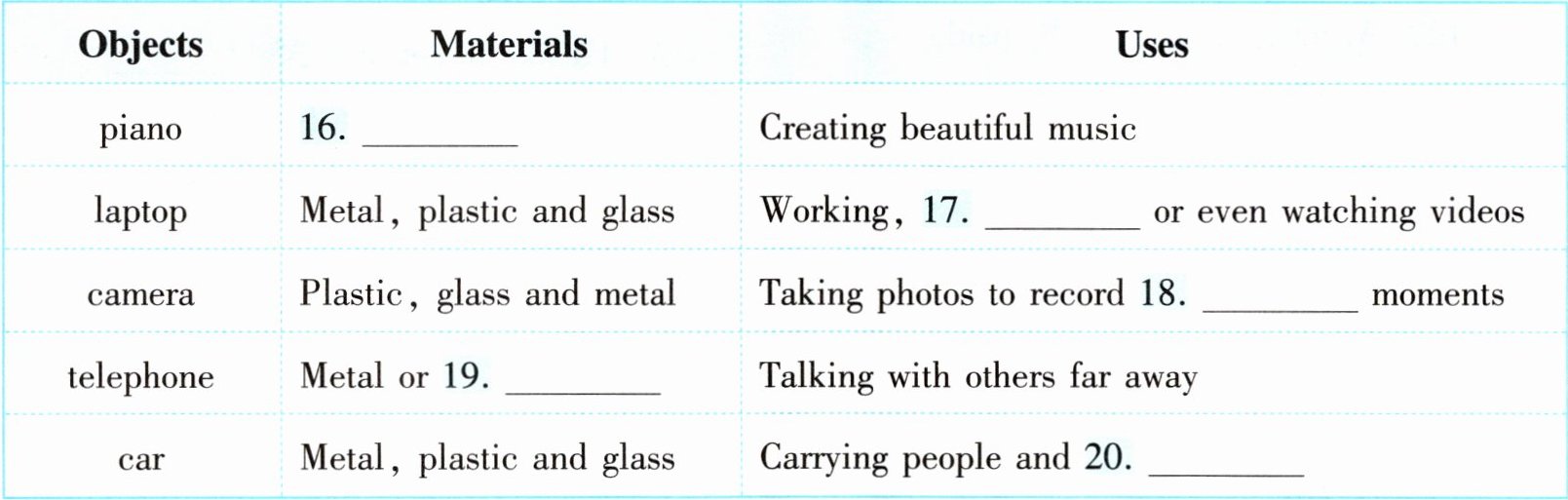 moments
telephone Metal or 19. Talking with others far away
car Metal, plastic and glass Carrying people and 20.
Objects Materials Uses
piano 16. Creating beautiful music
laptop Metal, plastic and glass Working, 17. or even watching videos
camera Plastic, glass and metal Taking photos to record
momentstelephone Metal or 19. Talking with others far away
car Metal, plastic and glass Carrying people and 20.
答案
16. Wood 17. studying 18. special
19. plastic 20. goods
19. plastic 20. goods
二、完形填空
Bi Sheng was an outstanding scientist in ancient China. He lived during the Northern Song Dynasty. He is best-known for his invention of movable type printing(活字印刷术).
Bi Sheng was a very great 21. Before his invention, people had to write or carve every page of a book by hand, which 22 a lot of time. But Bi Sheng's idea changed almost everything.
He carved Chinese 23 on small pieces of clay and heated them 24 they became hard movable characters. When printing a book, people arranged the movable characters in order and then 25 them onto paper to make a copy of the book. This made the printing much faster and 26. After the printing, they separated the characters for 27 later.
Bi Sheng's movable type printing soon became a great step in technology. His invention first 28 eastward to Korea and Japan, and then westward to Persia and Egypt, and finally around the world. 29 Bi Sheng, more people in the world could read books, and 30 could spread more quickly. His movable type printing was one of the greatest inventions in history.
(
(
(
(
(
(
(
(
(
(
Bi Sheng was an outstanding scientist in ancient China. He lived during the Northern Song Dynasty. He is best-known for his invention of movable type printing(活字印刷术).
Bi Sheng was a very great 21. Before his invention, people had to write or carve every page of a book by hand, which 22 a lot of time. But Bi Sheng's idea changed almost everything.
He carved Chinese 23 on small pieces of clay and heated them 24 they became hard movable characters. When printing a book, people arranged the movable characters in order and then 25 them onto paper to make a copy of the book. This made the printing much faster and 26. After the printing, they separated the characters for 27 later.
Bi Sheng's movable type printing soon became a great step in technology. His invention first 28 eastward to Korea and Japan, and then westward to Persia and Egypt, and finally around the world. 29 Bi Sheng, more people in the world could read books, and 30 could spread more quickly. His movable type printing was one of the greatest inventions in history.
(
B
)21. A. teacher B. inventor C. volunteer(
A
)22. A. took B. paid C. cost(
C
)23. A. words B. letters C. characters(
A
)24. A. until B. before C. after(
B
)25. A. created B. pressed C. fell(
A
)26. A. easier B. harder C. slower(
B
)27. A. reread B. reuse C. review(
A
)28. A. spread B. stopped C. disappeared(
C
)29. A. Such as B. Instead of C. Because of(
C
)30. A. trade B. medicine C. knowledge答案
21. B
22. A 三个词均为“花费”的意思。pay 的主语是人;cost 的主语是事(物),但用于指花费钱;take 可用于指花费时间,主语为某事。
23. C
24. A until 意为“直到”;before 意为“在……以前”;after 意为“在……以后”。本句意为“……将其加热,直到它们变成硬的活字”。
25. B 本句意为“……然后把它们按压在纸上……”。故选 B。
26. A
27. B reread 意为“重读”;reuse 意为“再利用”;review 意为“复习”。这里指后期还可以再利用。故选 B。
28. A 29. C
30. C 由常识可知,印刷术的发明促进了人类知识的传播。
22. A 三个词均为“花费”的意思。pay 的主语是人;cost 的主语是事(物),但用于指花费钱;take 可用于指花费时间,主语为某事。
23. C
24. A until 意为“直到”;before 意为“在……以前”;after 意为“在……以后”。本句意为“……将其加热,直到它们变成硬的活字”。
25. B 本句意为“……然后把它们按压在纸上……”。故选 B。
26. A
27. B reread 意为“重读”;reuse 意为“再利用”;review 意为“复习”。这里指后期还可以再利用。故选 B。
28. A 29. C
30. C 由常识可知,印刷术的发明促进了人类知识的传播。
解析
【分析】
先通读全文,明确文章主旨是介绍北宋科学家毕昇及其发明的活字印刷术的意义与影响;解题时需结合上下文语境、词汇词义辨析、固定搭配及相关历史常识,逐一分析每个空格的选项,排除不符合语境的答案,选出最恰当的选项。
【解析】
21. 前文提到毕昇以活字印刷术闻名,说明他是发明家,A(教师)、C(志愿者)不符合语境,选B。
22. 考查“花费”类动词辨析:take主语为事/物,可指花费时间;pay主语为人;cost主语为物,多指花费金钱。此处主语为“刻书、抄书这件事”,花费时间,选A。
23. 结合常识,活字印刷是刻汉字,characters(汉字)符合;words(单词)、letters(字母)不符合,选C。
24. 句意为“加热它们直到变成硬的活字”,until(直到)符合逻辑;before(在……之前)、after(在……之后)不符合,选A。
25. 活字印刷时将活字按压到纸上,press(按压)符合;create(创造)、fall(掉落)不符合,选B。
26. 活字印刷比手工印刷更快更简单,easier(更简单)符合;harder(更难)、slower(更慢)不符合,选A。
27. 印刷后活字可以再利用,reuse(再利用)符合;reread(重读)、review(复习)不符合,选B。
28. 活字印刷传播到东亚等地,spread(传播)符合;stop(停止)、disappear(消失)不符合,选A。
29. 句意为“因为毕昇,世界上更多人能读书”,because of(因为)符合;such as(例如)、instead of(代替)不符合,选C。
30. 印刷术促进知识传播,knowledge(知识)符合;trade(贸易)、medicine(医学)不符合,选C。
【答案】
21.B 22.A 23.C 24.A 25.B 26.A 27.B 28.A 29.C 30.C
【知识点】
完形填空解题技巧、词汇词义辨析、历史常识应用
【点评】
本题围绕中国古代科技成就(活字印刷术)设题,既考查学生的词汇辨析能力(如take/pay/cost的用法、动词词义),也结合了历史常识,要求学生结合上下文语境推理,是一道兼顾语言知识与文化常识的完形填空题,难度适中。
【难度系数】
0.6
先通读全文,明确文章主旨是介绍北宋科学家毕昇及其发明的活字印刷术的意义与影响;解题时需结合上下文语境、词汇词义辨析、固定搭配及相关历史常识,逐一分析每个空格的选项,排除不符合语境的答案,选出最恰当的选项。
【解析】
21. 前文提到毕昇以活字印刷术闻名,说明他是发明家,A(教师)、C(志愿者)不符合语境,选B。
22. 考查“花费”类动词辨析:take主语为事/物,可指花费时间;pay主语为人;cost主语为物,多指花费金钱。此处主语为“刻书、抄书这件事”,花费时间,选A。
23. 结合常识,活字印刷是刻汉字,characters(汉字)符合;words(单词)、letters(字母)不符合,选C。
24. 句意为“加热它们直到变成硬的活字”,until(直到)符合逻辑;before(在……之前)、after(在……之后)不符合,选A。
25. 活字印刷时将活字按压到纸上,press(按压)符合;create(创造)、fall(掉落)不符合,选B。
26. 活字印刷比手工印刷更快更简单,easier(更简单)符合;harder(更难)、slower(更慢)不符合,选A。
27. 印刷后活字可以再利用,reuse(再利用)符合;reread(重读)、review(复习)不符合,选B。
28. 活字印刷传播到东亚等地,spread(传播)符合;stop(停止)、disappear(消失)不符合,选A。
29. 句意为“因为毕昇,世界上更多人能读书”,because of(因为)符合;such as(例如)、instead of(代替)不符合,选C。
30. 印刷术促进知识传播,knowledge(知识)符合;trade(贸易)、medicine(医学)不符合,选C。
【答案】
21.B 22.A 23.C 24.A 25.B 26.A 27.B 28.A 29.C 30.C
【知识点】
完形填空解题技巧、词汇词义辨析、历史常识应用
【点评】
本题围绕中国古代科技成就(活字印刷术)设题,既考查学生的词汇辨析能力(如take/pay/cost的用法、动词词义),也结合了历史常识,要求学生结合上下文语境推理,是一道兼顾语言知识与文化常识的完形填空题,难度适中。
【难度系数】
0.6
