

 登录
登录
D
What is the secret to happiness? In a Ted Talk, psychologist Mihaly Csikszentmihalyi said he had found the answer: flow心流.
Flow is the experience of being fully lost in a certain task. Csikszentmihalyi described it in his Ted Talk as an exciting feeling which happens naturally. He says, "Flow is an ideal state状态 of mind where every part of the mind and body works together towards one purpose. Then we feel our best and we do our best." People can get into a flow state when doing "just about anything", he adds.
After interviewing a lot of people who said they had experienced the flow, Csikszentmihalyi found five conditions in flow states:

A flow state sounds lovely. So how do you achieve a flow state?
"It is impossible to decide when to get into flow," says Norsworthy, a leader of Flow Centre. "But we can get more chances to experience it," he adds.
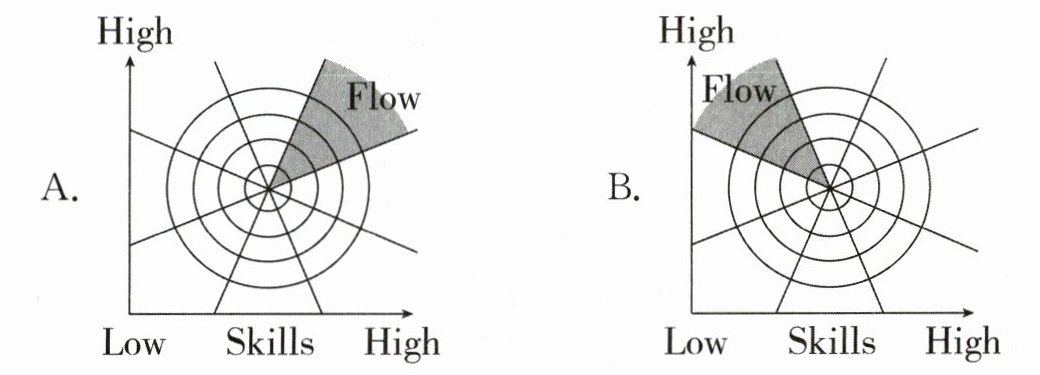
The key to entering a flow state is choosing a proper task according to your ability and skills. A task that doesn't need much skill, like washing the clothes, may lead to little interest. A task with great difficulty where one doesn't have the needed skill may make people nervous. However, if a task is difficult and we have the skills necessary to finish it, there's a higher chance for us to experience flow.
Norsworthy talks about his running practice. "When I first got started, it was not a flow state at all," he says. As he practised more, he began to achieve a flow state. However, he also mentions that there are some actions that may stop you from getting into a flow state. Knowing how to avoid these actions is important.
32. How did Csikszentmihalyi find the conditions of flow?
A. By doing some science tests.
B. By reading books about happiness.
C. By talking about flow in his Ted Talk.
D. By asking people about their experiences.
33. Which of the following shows a person is in a flow state?
A. When I am reading interesting books, I have no sense of time.
B. When I am doing a task, I don't know what I should do next.
C. When I am in a football team, I find myself less important.
D. When I finish a task, my teacher doesn't give me his opinion.
34. According to Csikszentmihalyi's study, which diagram示意图 shows the flow state?

35. What may the writer talk about next?
A. The usages of flow. B. The killers of flow.
C. The examples of flow. D. The activities of flow.
What is the secret to happiness? In a Ted Talk, psychologist Mihaly Csikszentmihalyi said he had found the answer: flow心流.
Flow is the experience of being fully lost in a certain task. Csikszentmihalyi described it in his Ted Talk as an exciting feeling which happens naturally. He says, "Flow is an ideal state状态 of mind where every part of the mind and body works together towards one purpose. Then we feel our best and we do our best." People can get into a flow state when doing "just about anything", he adds.
After interviewing a lot of people who said they had experienced the flow, Csikszentmihalyi found five conditions in flow states:
A flow state sounds lovely. So how do you achieve a flow state?
"It is impossible to decide when to get into flow," says Norsworthy, a leader of Flow Centre. "But we can get more chances to experience it," he adds.
The key to entering a flow state is choosing a proper task according to your ability and skills. A task that doesn't need much skill, like washing the clothes, may lead to little interest. A task with great difficulty where one doesn't have the needed skill may make people nervous. However, if a task is difficult and we have the skills necessary to finish it, there's a higher chance for us to experience flow.
Norsworthy talks about his running practice. "When I first got started, it was not a flow state at all," he says. As he practised more, he began to achieve a flow state. However, he also mentions that there are some actions that may stop you from getting into a flow state. Knowing how to avoid these actions is important.
32. How did Csikszentmihalyi find the conditions of flow?
A. By doing some science tests.
B. By reading books about happiness.
C. By talking about flow in his Ted Talk.
D. By asking people about their experiences.
33. Which of the following shows a person is in a flow state?
A. When I am reading interesting books, I have no sense of time.
B. When I am doing a task, I don't know what I should do next.
C. When I am in a football team, I find myself less important.
D. When I finish a task, my teacher doesn't give me his opinion.
34. According to Csikszentmihalyi's study, which diagram示意图 shows the flow state?
35. What may the writer talk about next?
A. The usages of flow. B. The killers of flow.
C. The examples of flow. D. The activities of flow.
答案
【文章大意】本文是一篇说明文,主要介绍了心流,指人们完全专注
于自身正在做的事情的一种状态。
32. D 细节理解题。根据"After interviewing a lot of people who
said they had experienced the flow, Csikszentmihalyi found
five conditions in flow states"可知,Csikszentmihalyi是通过询
问人们的经历来发现心流状态的条件的。故选D。
33. A 细节理解题。根据"After interviewing a lot of people who
said they had experienced the flow, Csikszentmihalyi found five
conditions in flow states"以及方框中第一个条件"Forgetting
about time"可知,一个人处于心流状态时,会忘记时间。故
选A。
34. A 图示理解题。根据倒数第二段中"However, if a task is
difficult and we have the skills necessary to finish it, there's a
higher chance for us to experience flow."可推知,心流在挑战
和技能水平均较高时,可能会出现。故选A。
35. B 推理判断题。根据"However, he also mentions that there
are some actions that may stop you from getting into a flow
state. Knowing how to avoid these actions is important."可知,
短文最后提到"有些行为可能阻止你进入心流状态,知道如何
避免这些行为很重要"。因此,作者接下来很可能会讨论这些
阻止心流的行为,即"心流的杀手"。故选B。
于自身正在做的事情的一种状态。
32. D 细节理解题。根据"After interviewing a lot of people who
said they had experienced the flow, Csikszentmihalyi found
five conditions in flow states"可知,Csikszentmihalyi是通过询
问人们的经历来发现心流状态的条件的。故选D。
33. A 细节理解题。根据"After interviewing a lot of people who
said they had experienced the flow, Csikszentmihalyi found five
conditions in flow states"以及方框中第一个条件"Forgetting
about time"可知,一个人处于心流状态时,会忘记时间。故
选A。
34. A 图示理解题。根据倒数第二段中"However, if a task is
difficult and we have the skills necessary to finish it, there's a
higher chance for us to experience flow."可推知,心流在挑战
和技能水平均较高时,可能会出现。故选A。
35. B 推理判断题。根据"However, he also mentions that there
are some actions that may stop you from getting into a flow
state. Knowing how to avoid these actions is important."可知,
短文最后提到"有些行为可能阻止你进入心流状态,知道如何
避免这些行为很重要"。因此,作者接下来很可能会讨论这些
阻止心流的行为,即"心流的杀手"。故选B。
解析
【分析】
这是一篇介绍“心流”概念的科普类说明文阅读理解,解题时可以按照“题干定位-原文匹配-排除干扰项”的思路逐步完成:1. 32题属于细节查找题,直接回到原文定位Csikszentmihalyi得出心流条件的研究方式即可;2. 33题需要结合心流“完全沉浸在任务中”的核心定义,匹配符合特征的选项;3. 34题要抓取原文中“高难度任务+匹配的高技能才容易触发心流”的核心规则,对应正确的示意图;4. 35题是语篇推断题,重点看文章末尾的收尾内容,顺着行文逻辑推导作者接下来要讲的内容。
【解析】
32. 细节理解题:根据原文第三段“After interviewing a lot of people who said they had experienced the flow, Csikszentmihalyi found five conditions in flow states”可知,Csikszentmihalyi是通过采访、询问有过心流体验的人的相关经历,总结出心流状态的条件的,对应选项D。A选项“做科学测试”、B选项“读关于幸福的书籍”原文均未提及,C选项“在TED演讲中谈论心流”是他分享心流研究成果的渠道,并非他得出心流条件的方式,均排除。
33. 细节理解题:心流的核心特征是完全沉浸在当前任务中,原文给出的心流状态条件包含“忘记时间流逝”,选项A“读有趣的书时完全投入,没有时间感”完全符合心流的特征。B选项“做任务时不知道下一步该做什么”不符合心流状态下身心朝着同一目标高效协作的描述,C选项“在球队里觉得自己不重要”、D选项“完成任务后老师不给评价”均和心流的定义无关,排除后选A。
34. 图示理解题:根据原文内容“if a task is difficult and we have the skills necessary to finish it, there's a higher chance for us to experience flow”可知,心流状态出现在任务挑战难度较高、同时个人具备完成任务的对应技能的情况下,对应符合该规律的示意图,选A。
35. 推理判断题:文章末尾提到“there are some actions that may stop you from getting into a flow state. Knowing how to avoid these actions is important”,说明作者接下来会具体介绍这些会阻碍进入心流的行为,也就是“心流的杀手”,对应选项B。A“心流的用处”、C“心流的例子”、D“心流的相关活动”均不符合末尾的行文衔接逻辑,排除。
【答案】
32. D
33. A
34. A(对应示意图:)
35. B
【知识点】
细节信息定位,语篇逻辑推理,图示信息匹配
【点评】
本题属于中等难度的科普类阅读题,考点覆盖了阅读理解常见的细节查找、逻辑推断、图文匹配三类题型,既考察学生快速从原文抓取关键信息的能力,也要求学生准确理解概念核心、梳理行文逻辑,题目设置贴合科普类文本的考察特点,同时心流的主题也能让学生了解相关的心理学小知识,兼具知识性和趣味性。
【难度系数】
0.7
这是一篇介绍“心流”概念的科普类说明文阅读理解,解题时可以按照“题干定位-原文匹配-排除干扰项”的思路逐步完成:1. 32题属于细节查找题,直接回到原文定位Csikszentmihalyi得出心流条件的研究方式即可;2. 33题需要结合心流“完全沉浸在任务中”的核心定义,匹配符合特征的选项;3. 34题要抓取原文中“高难度任务+匹配的高技能才容易触发心流”的核心规则,对应正确的示意图;4. 35题是语篇推断题,重点看文章末尾的收尾内容,顺着行文逻辑推导作者接下来要讲的内容。
【解析】
32. 细节理解题:根据原文第三段“After interviewing a lot of people who said they had experienced the flow, Csikszentmihalyi found five conditions in flow states”可知,Csikszentmihalyi是通过采访、询问有过心流体验的人的相关经历,总结出心流状态的条件的,对应选项D。A选项“做科学测试”、B选项“读关于幸福的书籍”原文均未提及,C选项“在TED演讲中谈论心流”是他分享心流研究成果的渠道,并非他得出心流条件的方式,均排除。
33. 细节理解题:心流的核心特征是完全沉浸在当前任务中,原文给出的心流状态条件包含“忘记时间流逝”,选项A“读有趣的书时完全投入,没有时间感”完全符合心流的特征。B选项“做任务时不知道下一步该做什么”不符合心流状态下身心朝着同一目标高效协作的描述,C选项“在球队里觉得自己不重要”、D选项“完成任务后老师不给评价”均和心流的定义无关,排除后选A。
34. 图示理解题:根据原文内容“if a task is difficult and we have the skills necessary to finish it, there's a higher chance for us to experience flow”可知,心流状态出现在任务挑战难度较高、同时个人具备完成任务的对应技能的情况下,对应符合该规律的示意图,选A。
35. 推理判断题:文章末尾提到“there are some actions that may stop you from getting into a flow state. Knowing how to avoid these actions is important”,说明作者接下来会具体介绍这些会阻碍进入心流的行为,也就是“心流的杀手”,对应选项B。A“心流的用处”、C“心流的例子”、D“心流的相关活动”均不符合末尾的行文衔接逻辑,排除。
【答案】
32. D
33. A
34. A(对应示意图:
)35. B
【知识点】
细节信息定位,语篇逻辑推理,图示信息匹配
【点评】
本题属于中等难度的科普类阅读题,考点覆盖了阅读理解常见的细节查找、逻辑推断、图文匹配三类题型,既考察学生快速从原文抓取关键信息的能力,也要求学生准确理解概念核心、梳理行文逻辑,题目设置贴合科普类文本的考察特点,同时心流的主题也能让学生了解相关的心理学小知识,兼具知识性和趣味性。
【难度系数】
0.7
