

 登录
登录
Ⅰ. Choose the words or expressions from the box and complete the dialogue.
soon peaceful hunt museum die
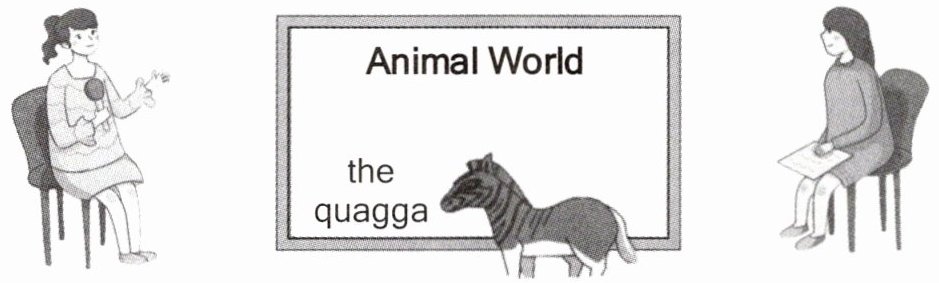
Dale: Welcome to Animal World. I am Dale. Here with us is Doctor Jane. Today she is going to tell us about an extinct animal, the quagga. So, what was it like, Doctor Jane?
Jane: It looked like a zebra. But it had a brown body and was only black and white on its head and neck.
Dale: Why did the quagga 1.
Jane: There aren't any quaggas because in the eighteenth century(世纪), people in South Africa 2.
3.
Dale: Yes. That's why we should protect animals and let them live a 5.
soon peaceful hunt museum die
Dale: Welcome to Animal World. I am Dale. Here with us is Doctor Jane. Today she is going to tell us about an extinct animal, the quagga. So, what was it like, Doctor Jane?
Jane: It looked like a zebra. But it had a brown body and was only black and white on its head and neck.
Dale: Why did the quagga 1.
die
out?Jane: There aren't any quaggas because in the eighteenth century(世纪), people in South Africa 2.
hunted
quaggas for their meat. Then, people from other countries came and killed (杀) them for their skins (皮).3.
Soon
there weren't any quaggas. It is sad that now we can only see them in 4. museums
.Dale: Yes. That's why we should protect animals and let them live a 5.
peaceful
life.答案
1. die 2. hunted 3. Soon 4. museums 5. peaceful
解析
【分析】
本题为选词填空题型,需结合对话语境、固定搭配、时态及词性来选择合适的单词。先通读对话理解大意,再逐一分析每个空格:1. 第一空需填与“灭绝”相关的固定短语;2. 第二空根据时间状语确定时态,选合适动词的过去式;3. 第三空需填表时间的副词,注意句首大写;4. 第四空泛指“博物馆”,用名词复数;5. 第五空需形容词修饰名词life,结合语境选择合适形容词。
【解析】
1. 固定短语die out意为“灭绝”,符合“为什么斑驴灭绝”的语境,故填die;
2. 由时间状语“in the eighteenth century”可知,句子用一般过去时,hunt的过去式为hunted,意为“捕猎”,符合人们捕猎斑驴获取肉的语境,故填hunted;
3. 此处表示时间上的“很快”,位于句首,首字母大写,故填Soon;
4. 此处泛指各类博物馆,应用museum的复数形式museums,故填museums;
5. 此处修饰名词life,需用形容词,peaceful意为“和平的”,符合“让动物过和平生活”的语境,故填peaceful。
【答案】
1. die 2. hunted 3. Soon 4. museums 5. peaceful
【知识点】
动词短语、一般过去时、形容词词义
【点评】
本题考查选词填空,需学生掌握常见动词短语、时态变化及词义辨析,结合上下文语境完成填空,难度适中。
【难度系数】
0.5
本题为选词填空题型,需结合对话语境、固定搭配、时态及词性来选择合适的单词。先通读对话理解大意,再逐一分析每个空格:1. 第一空需填与“灭绝”相关的固定短语;2. 第二空根据时间状语确定时态,选合适动词的过去式;3. 第三空需填表时间的副词,注意句首大写;4. 第四空泛指“博物馆”,用名词复数;5. 第五空需形容词修饰名词life,结合语境选择合适形容词。
【解析】
1. 固定短语die out意为“灭绝”,符合“为什么斑驴灭绝”的语境,故填die;
2. 由时间状语“in the eighteenth century”可知,句子用一般过去时,hunt的过去式为hunted,意为“捕猎”,符合人们捕猎斑驴获取肉的语境,故填hunted;
3. 此处表示时间上的“很快”,位于句首,首字母大写,故填Soon;
4. 此处泛指各类博物馆,应用museum的复数形式museums,故填museums;
5. 此处修饰名词life,需用形容词,peaceful意为“和平的”,符合“让动物过和平生活”的语境,故填peaceful。
【答案】
1. die 2. hunted 3. Soon 4. museums 5. peaceful
【知识点】
动词短语、一般过去时、形容词词义
【点评】
本题考查选词填空,需学生掌握常见动词短语、时态变化及词义辨析,结合上下文语境完成填空,难度适中。
【难度系数】
0.5
Ⅱ. Read the passage and complete the following tasks.
The Chinese paddlefish was one of the world's biggest freshwater fish. It could grow as long as seven metres. Most Chinese paddlefish lived in the Yangtze River, a river with plenty of food for them to eat. We also call it "the panda of the Yangtze River".
However, we cannot see these amazing animals now. Too much fishing was one of the main reasons. For years, people caught lots of Chinese paddlefish for
their meat. In the 1970s, every year people took about 25,000 kg of the fish from the river. Soon the number of the Chinese paddlefish decreased a lot. Then in the 1980s, people built dams(大坝). These dams blocked their ways and stopped them from swimming to the right place to lay(下蛋) eggs. As a result, there were fewer and fewer baby paddlefish. In 2003, our "panda of the Yangtze River" died out.
Now we build ways(通道) near dams, so the fish can swim to the other side to lay eggs. What else can we do? Why not stop overfishing and protect the homes of the freshwater fish, like the rivers and the lakes? If we all work together, we can help them.
Match the words and expressions with their meanings.
(
(
(
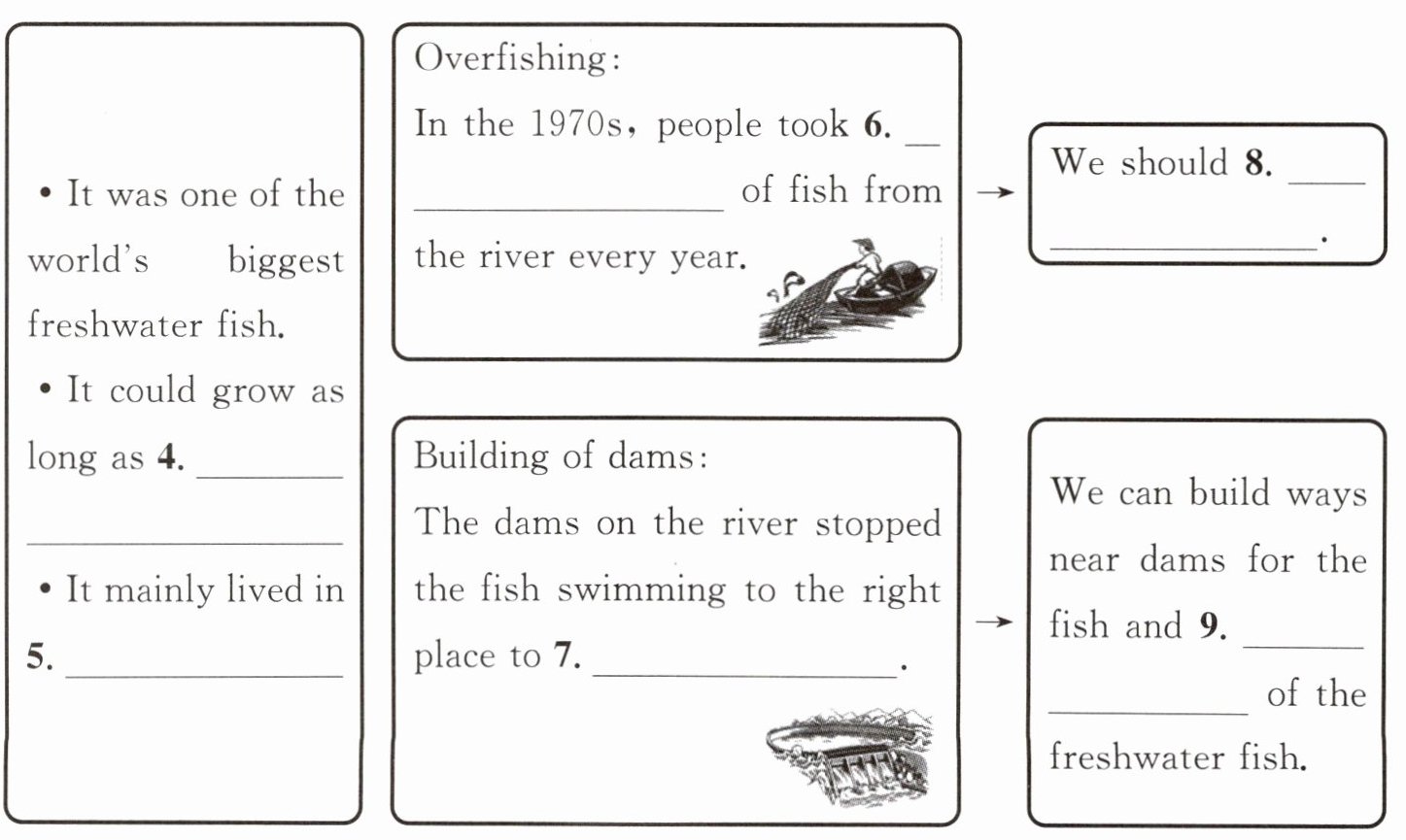
Complete the chart according to the passage. (No more than three words in each blank)
The Chinese Paddlefish
Challenge yourself
10*. As students, what can we do to protect the freshwater fish?
The Chinese paddlefish was one of the world's biggest freshwater fish. It could grow as long as seven metres. Most Chinese paddlefish lived in the Yangtze River, a river with plenty of food for them to eat. We also call it "the panda of the Yangtze River".
However, we cannot see these amazing animals now. Too much fishing was one of the main reasons. For years, people caught lots of Chinese paddlefish for
their meat. In the 1970s, every year people took about 25,000 kg of the fish from the river. Soon the number of the Chinese paddlefish decreased a lot. Then in the 1980s, people built dams(大坝). These dams blocked their ways and stopped them from swimming to the right place to lay(下蛋) eggs. As a result, there were fewer and fewer baby paddlefish. In 2003, our "panda of the Yangtze River" died out.
Now we build ways(通道) near dams, so the fish can swim to the other side to lay eggs. What else can we do? Why not stop overfishing and protect the homes of the freshwater fish, like the rivers and the lakes? If we all work together, we can help them.
Match the words and expressions with their meanings.
(
B
)1. freshwater A. stop something from going somewhere(
C
)2. decrease B. living in rivers or lakes(
A
)3. block C. make something smaller in numberComplete the chart according to the passage. (No more than three words in each blank)
The Chinese Paddlefish
Challenge yourself
10*. As students, what can we do to protect the freshwater fish?
We can stop throwing litter into the river.
We can draw posters to ask people to protect the river.
答案
1. B 2. C 3. A 4. seven metres 5. the Yangtze River 6. about 25,000 kg 7. lay eggs 8. stop overfishing 9. protect the homes
10*. One possible version: We can stop throwing litter into the river. / We can draw posters to ask people to protect the river.
10*. One possible version: We can stop throwing litter into the river. / We can draw posters to ask people to protect the river.
解析
【分析】
本题为英语阅读理解细节填空题,需根据原文内容定位对应信息完成填空。先通读原文,找到每个空格对应的描述:4空对应鱼的长度,5空对应栖息地,6空对应过度捕捞的数量,7空对应大坝阻止的行为,8空对应解决过度捕捞的措施,9空对应保护内容,10*对应学生可采取的保护措施,需确保填空部分(除10*外)不超过三个词。
【解析】
1. 4空:根据原文第一段第二句“It could grow as long as seven metres.”,确定填seven metres;
2. 5空:根据原文第一段第三句“Most Chinese paddlefish lived in the Yangtze River”,确定填the Yangtze River;
3. 6空:根据原文第二段第三句“In the 1970s, every year people took about 25,000 kg of the fish from the river.”,确定填about 25,000 kg;
4. 7空:根据原文第二段倒数第三句“These dams blocked their ways and stopped them from swimming to the right place to lay eggs.”,确定填lay eggs;
5. 8空:根据原文第三段第三句“Why not stop overfishing and protect the homes of the freshwater fish...”,确定填stop overfishing;
6. 9空:根据原文第三段第三句“...protect the homes of the freshwater fish...”,确定填protect the homes;
7. 10*:结合保护淡水鱼的常识,学生可采取合理措施,如停止往河里扔垃圾、制作海报宣传保护河流等。
【答案】
4. seven metres 5. the Yangtze River 6. about 25,000 kg 7. lay eggs 8. stop overfishing 9. protect the homes
10*. We can stop throwing litter into the river. / We can draw posters to ask people to protect the river.
【知识点】
英语阅读理解、细节信息查找、保护动物常识
【点评】
本题考查学生对英语阅读理解中细节信息的提取能力,同时涉及保护淡水生物的相关知识,难度适中,学生通过定位原文可完成大部分填空。
【难度系数】
0.6
本题为英语阅读理解细节填空题,需根据原文内容定位对应信息完成填空。先通读原文,找到每个空格对应的描述:4空对应鱼的长度,5空对应栖息地,6空对应过度捕捞的数量,7空对应大坝阻止的行为,8空对应解决过度捕捞的措施,9空对应保护内容,10*对应学生可采取的保护措施,需确保填空部分(除10*外)不超过三个词。
【解析】
1. 4空:根据原文第一段第二句“It could grow as long as seven metres.”,确定填seven metres;
2. 5空:根据原文第一段第三句“Most Chinese paddlefish lived in the Yangtze River”,确定填the Yangtze River;
3. 6空:根据原文第二段第三句“In the 1970s, every year people took about 25,000 kg of the fish from the river.”,确定填about 25,000 kg;
4. 7空:根据原文第二段倒数第三句“These dams blocked their ways and stopped them from swimming to the right place to lay eggs.”,确定填lay eggs;
5. 8空:根据原文第三段第三句“Why not stop overfishing and protect the homes of the freshwater fish...”,确定填stop overfishing;
6. 9空:根据原文第三段第三句“...protect the homes of the freshwater fish...”,确定填protect the homes;
7. 10*:结合保护淡水鱼的常识,学生可采取合理措施,如停止往河里扔垃圾、制作海报宣传保护河流等。
【答案】
4. seven metres 5. the Yangtze River 6. about 25,000 kg 7. lay eggs 8. stop overfishing 9. protect the homes
10*. We can stop throwing litter into the river. / We can draw posters to ask people to protect the river.
【知识点】
英语阅读理解、细节信息查找、保护动物常识
【点评】
本题考查学生对英语阅读理解中细节信息的提取能力,同时涉及保护淡水生物的相关知识,难度适中,学生通过定位原文可完成大部分填空。
【难度系数】
0.6
