

 登录
登录
一、语法选择。
Have you ever heard of Pang Zhongwang? He was born in 1999 in Hebei. His father had a mental illness, and his mother lost 1 ability to walk and needed long-term care. Pang also had a heart problem. Life was very hard, 2 he never gave up.
From a young age, Pang took on most housework and he looked 3 his mother every day. After finishing housework, he studied late into the night. His bedroom walls were covered with certificates and prizes, showing his 4 grades. In 2017, he got 684 points in the exam and 5 Tsinghua University. Now he's a PhD student there, working hard on research. His story 6 many young people to face difficulties.
Pang's mother taught him to be strong and optimistic. She always smiled even in pain and told him, "Look forward to the future." What his mother said was his 7 in hard times. He never complained about his life. Many people wanted to help him, but he 8 refused. He once said, "Hardship chose 9, but I choose to hug the sunshine." In 2020, his mother passed away, but he kept her words in mind and kept 10 hard.
()1. A. a B. the C. an
()2. A. so B. and C. but
()3. A. after B. for C. at
()4. A. bad B. poor C. excellent
()5. A. entering B. entered C. enters
()6. A. encourages B. encouraging C. encourage
()7. A. lights B. light C. light's
()8. A. polite B. impolitely C. politely
()9. A. mine B. myself C. me
()10. A. working B. works C. worked
Have you ever heard of Pang Zhongwang? He was born in 1999 in Hebei. His father had a mental illness, and his mother lost 1 ability to walk and needed long-term care. Pang also had a heart problem. Life was very hard, 2 he never gave up.
From a young age, Pang took on most housework and he looked 3 his mother every day. After finishing housework, he studied late into the night. His bedroom walls were covered with certificates and prizes, showing his 4 grades. In 2017, he got 684 points in the exam and 5 Tsinghua University. Now he's a PhD student there, working hard on research. His story 6 many young people to face difficulties.
Pang's mother taught him to be strong and optimistic. She always smiled even in pain and told him, "Look forward to the future." What his mother said was his 7 in hard times. He never complained about his life. Many people wanted to help him, but he 8 refused. He once said, "Hardship chose 9, but I choose to hug the sunshine." In 2020, his mother passed away, but he kept her words in mind and kept 10 hard.
()1. A. a B. the C. an
()2. A. so B. and C. but
()3. A. after B. for C. at
()4. A. bad B. poor C. excellent
()5. A. entering B. entered C. enters
()6. A. encourages B. encouraging C. encourage
()7. A. lights B. light C. light's
()8. A. polite B. impolitely C. politely
()9. A. mine B. myself C. me
()10. A. working B. works C. worked
答案
1.B 2.C 3.A 4.C 5.B 6.A 7.B 8.C 9.C 10.A
解析
1. 考查冠词固定搭配,the ability to do sth. 是固定表达,特指“做某事的能力”,此处指行走的能力,选B。
2. 考查连词辨析,前半句“生活非常艰难”和后半句“他从不放弃”是转折关系,用but,选C。
3. 考查动词短语辨析,look after意为“照顾”,符合语境“他每天照顾妈妈”,look for是寻找,look at是看,选A。
4. 考查形容词辨析,前文提到他卧室墙上贴满了证书和奖状,说明他的成绩很优秀,excellent意为“优秀的”,选C。
5. 考查动词时态,and连接并列谓语,前面的got是一般过去时,此处动词也要用过去式entered,选B。
6. 考查一般现在时谓语形式,主语His story是第三人称单数,一般现在时中谓语动词用第三人称单数形式encourages,选A。
7. 考查名词用法,此处表达“妈妈的话是他艰难岁月里的指明灯”,light表示“灯/光”,用单数形式即可,选B。
8. 考查副词用法,修饰动词refused需要用副词,结合语境他是礼貌地拒绝他人的帮助,politely意为“礼貌地”,选C。
9. 考查人称代词宾格,动词chose后面要接人称代词的宾格形式作宾语,me是宾格,选C。
10. 考查非谓语动词,固定搭配keep doing sth. 意为“一直坚持做某事”,后面接动名词形式working,选A。
2. 考查连词辨析,前半句“生活非常艰难”和后半句“他从不放弃”是转折关系,用but,选C。
3. 考查动词短语辨析,look after意为“照顾”,符合语境“他每天照顾妈妈”,look for是寻找,look at是看,选A。
4. 考查形容词辨析,前文提到他卧室墙上贴满了证书和奖状,说明他的成绩很优秀,excellent意为“优秀的”,选C。
5. 考查动词时态,and连接并列谓语,前面的got是一般过去时,此处动词也要用过去式entered,选B。
6. 考查一般现在时谓语形式,主语His story是第三人称单数,一般现在时中谓语动词用第三人称单数形式encourages,选A。
7. 考查名词用法,此处表达“妈妈的话是他艰难岁月里的指明灯”,light表示“灯/光”,用单数形式即可,选B。
8. 考查副词用法,修饰动词refused需要用副词,结合语境他是礼貌地拒绝他人的帮助,politely意为“礼貌地”,选C。
9. 考查人称代词宾格,动词chose后面要接人称代词的宾格形式作宾语,me是宾格,选C。
10. 考查非谓语动词,固定搭配keep doing sth. 意为“一直坚持做某事”,后面接动名词形式working,选A。
二、阅读理解。
When most travelers think of Dunhuang in Gansu Province, they will choose Mogao Grottoes to visit first. But this time, I decided to go to the Gobi Desert.
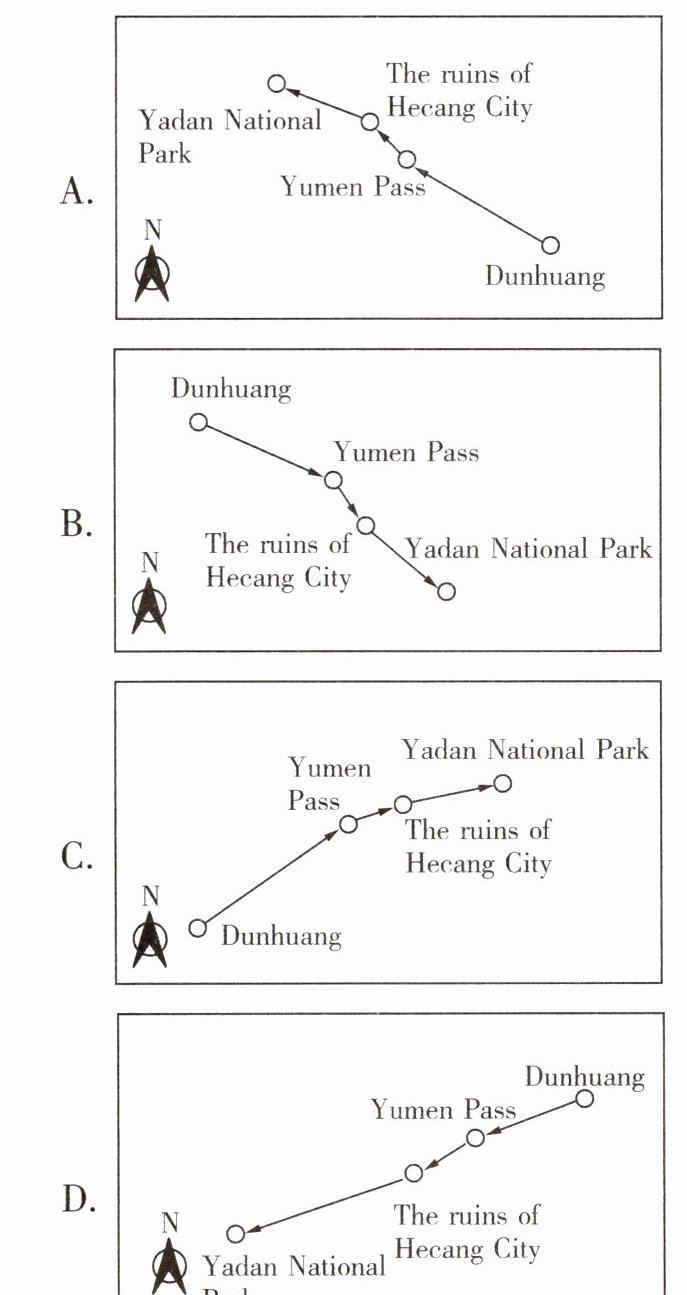
Our journey started with a drive from Dunhuang. The city roads soon turned into the wide, open Gobi Desert. After two hours' driving to the northwest, I reached Yumen Pass, a relic (遗迹) on the ancient Silk Road. Standing here, you can really feel the weight of history. I even thought of the famous poet Wang Zhihuan's line: "Why must the Qiang flute bemoan the willow? The spring wind does not reach Yumen Pass."
After that, I continued to drive northwest until I reached the ruins (遗址) of Hecang City. It is an ancient city from the Western Han Dynasty. As the sun went down, warm light covered the yellow sand and old walls. It looked just like a living painting. I couldn't help thinking what life was like here over 2,000 years ago.
When the sunlight faded (减弱), I went northwest to Yadan National Park. I've watched stars from mountains and other deserts before, but nothing was as amazing as the "Devil City" in the Gobi. When night came, stars filled the sky. Unlike my hometown, the stars here shone brightly, and the desert was so quiet. For the first time, I wished time would stop so I would lose myself in this peace, far from the noisy city.
()1. Why does the writer mention Wang Zhihuan's poem in Paragraph 2?
A. To tell how great the poet was.
B. To explain how Yumen Pass got its name.
C. To show the historical weight of Yumen Pass.
D. To introduce the poet's love for Western China.
()2. What looked like "a living painting" in the writer's eyes?
A. The starry sky at night.
B. Hecang city in ancient times.
C. The wide and open Gobi Desert.
D. Yellow sand and old walls in sunlight.
()3. Which map is about the writer's trip?
When most travelers think of Dunhuang in Gansu Province, they will choose Mogao Grottoes to visit first. But this time, I decided to go to the Gobi Desert.
Our journey started with a drive from Dunhuang. The city roads soon turned into the wide, open Gobi Desert. After two hours' driving to the northwest, I reached Yumen Pass, a relic (遗迹) on the ancient Silk Road. Standing here, you can really feel the weight of history. I even thought of the famous poet Wang Zhihuan's line: "Why must the Qiang flute bemoan the willow? The spring wind does not reach Yumen Pass."
After that, I continued to drive northwest until I reached the ruins (遗址) of Hecang City. It is an ancient city from the Western Han Dynasty. As the sun went down, warm light covered the yellow sand and old walls. It looked just like a living painting. I couldn't help thinking what life was like here over 2,000 years ago.
When the sunlight faded (减弱), I went northwest to Yadan National Park. I've watched stars from mountains and other deserts before, but nothing was as amazing as the "Devil City" in the Gobi. When night came, stars filled the sky. Unlike my hometown, the stars here shone brightly, and the desert was so quiet. For the first time, I wished time would stop so I would lose myself in this peace, far from the noisy city.
()1. Why does the writer mention Wang Zhihuan's poem in Paragraph 2?
A. To tell how great the poet was.
B. To explain how Yumen Pass got its name.
C. To show the historical weight of Yumen Pass.
D. To introduce the poet's love for Western China.
()2. What looked like "a living painting" in the writer's eyes?
A. The starry sky at night.
B. Hecang city in ancient times.
C. The wide and open Gobi Desert.
D. Yellow sand and old walls in sunlight.
()3. Which map is about the writer's trip?
答案
1. C 2. D 3. A
解析
1. 细节理解题:定位文章第二段,作者到达玉门关后提到“Standing here, you can really feel the weight of history”,紧接着引出王之涣的相关诗句,是为了进一步凸显玉门关承载的厚重历史感。A选项“说明诗人有多伟大”、B选项“解释玉门关名字的由来”、D选项“介绍诗人对中国西部的喜爱”均不符合原文逻辑,只有C选项符合题意。
2. 细节理解题:定位文章第三段,原文提到“As the sun went down, warm light covered the yellow sand and old walls. It looked just like a living painting”,句中的It指代前文被暖光笼罩的黄沙与古老城墙,对应D选项。
3. 细节理解题:根据文章内容,作者的行程路线为:从敦煌出发,持续向西北方向行驶,先后抵达玉门关、河仓城遗址、雅丹国家公园。结合指向标(箭头指向为北)判断,西北方向为图的左上方向,只有A选项的路线完全符合该行程顺序与方向。
2. 细节理解题:定位文章第三段,原文提到“As the sun went down, warm light covered the yellow sand and old walls. It looked just like a living painting”,句中的It指代前文被暖光笼罩的黄沙与古老城墙,对应D选项。
3. 细节理解题:根据文章内容,作者的行程路线为:从敦煌出发,持续向西北方向行驶,先后抵达玉门关、河仓城遗址、雅丹国家公园。结合指向标(箭头指向为北)判断,西北方向为图的左上方向,只有A选项的路线完全符合该行程顺序与方向。
