

 登录
登录
三、补全短文
The sun is going down while children laugh and run through the waves. You lift your phone to catch this beautiful moment. A photo seems like the best way to keep the memory. 1
Elizabeth Loftus, a famous scientist, points out that too many photos can lower the brain's ability to remember. We may keep the picture but lose the feeling of the moment itself. 2 When they know a picture is saved, they make less effort to remember. It is like writing down a phone number and then forgetting it because you believe the paper will always stay safe. Another reason is the attention we give to the act of taking a photo. While trying to find the perfect smile and a clear background, our minds are busy with these small things. 3 As a result, the action that seems to protect the memory can steal the chance to experience it fully.
4 If a person takes a picture carefully and focuses on the small things, like the colour of the sky, the shapes of the clouds, it can actually make his memory stronger. Later, when we look at those pictures, they can help us recall events more correctly and even bring back feelings that might be less bright.
So, the next time you raise your phone, stop for a moment. 5 A photo can be a powerful tool to help memory, but only when it is taken with care and purpose.
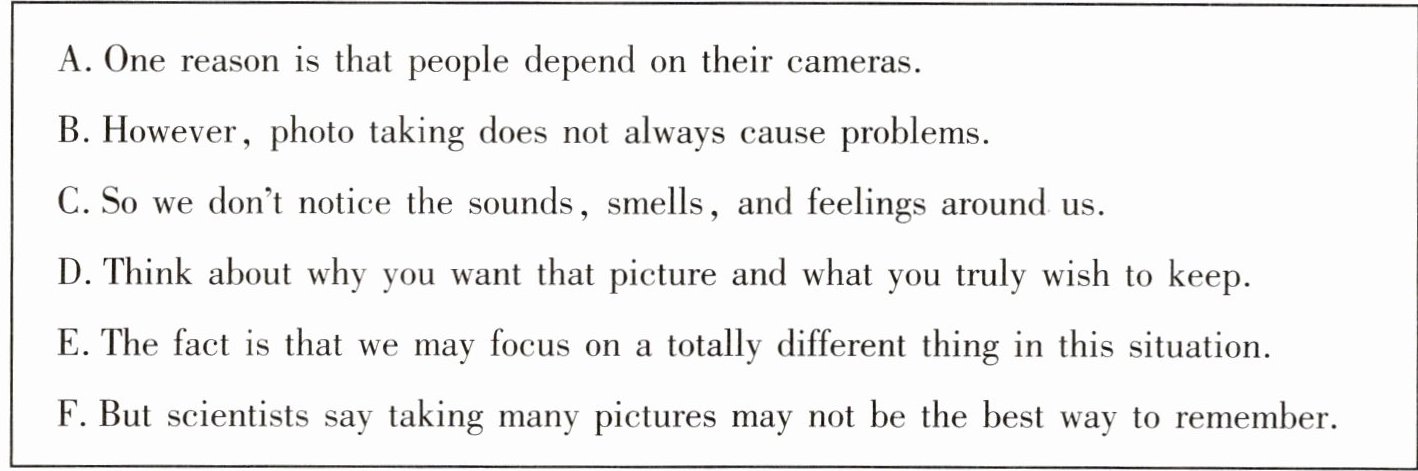
1.
2.
3.
4.
5.
The sun is going down while children laugh and run through the waves. You lift your phone to catch this beautiful moment. A photo seems like the best way to keep the memory. 1
Elizabeth Loftus, a famous scientist, points out that too many photos can lower the brain's ability to remember. We may keep the picture but lose the feeling of the moment itself. 2 When they know a picture is saved, they make less effort to remember. It is like writing down a phone number and then forgetting it because you believe the paper will always stay safe. Another reason is the attention we give to the act of taking a photo. While trying to find the perfect smile and a clear background, our minds are busy with these small things. 3 As a result, the action that seems to protect the memory can steal the chance to experience it fully.
4 If a person takes a picture carefully and focuses on the small things, like the colour of the sky, the shapes of the clouds, it can actually make his memory stronger. Later, when we look at those pictures, they can help us recall events more correctly and even bring back feelings that might be less bright.
So, the next time you raise your phone, stop for a moment. 5 A photo can be a powerful tool to help memory, but only when it is taken with care and purpose.
1.
2.
3.
4.
5.
答案
1.F 2.A 3.C 4.B 5.D
解析
【分析】
本题为英语补全短文题,需结合上下文的逻辑关系(转折、因果等)匹配选项。解题思路:先通读全文把握主旨(拍照对记忆的影响),再逐个分析每个空前后内容,根据逻辑衔接选择合适的句子。第1空需承接前文“照片是保存记忆的好方式”并引出后文科学家的转折观点;第2空需匹配后文“依赖照片就不努力记忆”的原因;第3空需对应前文“注意力在拍照细节”的结果;第4空需转折引出后文“认真拍照有益”的内容;第5空需承接前文“停下”的动作,引出思考拍照目的的内容。
【解析】
1. 第1空:前文提到“照片似乎是保存记忆的最佳方式”,后文转折阐述科学家的观点(过多照片降低记忆能力),需转折引出该观点的句子,对应选项F。
2. 第2空:后文说明“人们知道照片被保存后就不努力记忆”,原因是依赖相机,对应选项A。
3. 第3空:前文提到“注意力在拍照的小细节”,后文是结果“没注意周围的声音、气味等”,对应选项C。
4. 第4空:后文阐述认真拍照的好处,需转折说明拍照不总是有问题,对应选项B。
5. 第5空:前文说“停下片刻”,需引出思考拍照目的的句子,对应选项D。
【答案】
1.F 2.A 3.C 4.B 5.D
【知识点】
英语补全短文;语篇逻辑衔接
【点评】
本题考查学生对语篇上下文逻辑关系的理解与运用,需结合语境推理句子间的衔接,难度适中,注重语篇逻辑思维能力的考查。
【难度系数】
0.6
本题为英语补全短文题,需结合上下文的逻辑关系(转折、因果等)匹配选项。解题思路:先通读全文把握主旨(拍照对记忆的影响),再逐个分析每个空前后内容,根据逻辑衔接选择合适的句子。第1空需承接前文“照片是保存记忆的好方式”并引出后文科学家的转折观点;第2空需匹配后文“依赖照片就不努力记忆”的原因;第3空需对应前文“注意力在拍照细节”的结果;第4空需转折引出后文“认真拍照有益”的内容;第5空需承接前文“停下”的动作,引出思考拍照目的的内容。
【解析】
1. 第1空:前文提到“照片似乎是保存记忆的最佳方式”,后文转折阐述科学家的观点(过多照片降低记忆能力),需转折引出该观点的句子,对应选项F。
2. 第2空:后文说明“人们知道照片被保存后就不努力记忆”,原因是依赖相机,对应选项A。
3. 第3空:前文提到“注意力在拍照的小细节”,后文是结果“没注意周围的声音、气味等”,对应选项C。
4. 第4空:后文阐述认真拍照的好处,需转折说明拍照不总是有问题,对应选项B。
5. 第5空:前文说“停下片刻”,需引出思考拍照目的的句子,对应选项D。
【答案】
1.F 2.A 3.C 4.B 5.D
【知识点】
英语补全短文;语篇逻辑衔接
【点评】
本题考查学生对语篇上下文逻辑关系的理解与运用,需结合语境推理句子间的衔接,难度适中,注重语篇逻辑思维能力的考查。
【难度系数】
0.6
四、阅读理解
New research coming out of Tohoku University says that wasabi(芥末)is good for the ability to remember. Wasabi, a spicy green paste, is widely used in Japanese dishes.
A recent study tested people between the ages of sixty and eighty. Some of the test members took a certain amount of wasabi every night before going to bed. The others were given a placebo(无效对照剂). After three months, the people who took the wasabi had much better results in memory tests. The placebo-takers did not show any improvement.
Wasabi was already known to have an antioxidant and anti-inflammatory called 6-MSITC that is rare(稀少)in other plants. Scientists believe 6-MSITC might change how the brain's memory centre—hippocampus(海马体)works. They will continue researching with the hope that wasabi can help people that are experiencing dementia(痴呆症).
This new research seems to be good news for sushi-eaters. However, ▲. Instead, it is white horseradish(辣根酱)that has been coloured green. Real wasabi is difficult to grow and, as a result, is very expensive. It also needs to be made and served fresh at once before being eaten.
(
A. Early sleepers.
B. Placebo takers.
C. People between 60 and 80.
D. People who keep eating wasabi for 3 months.
(
A. Dishes.
B. 6-MSITC.
C. Placebo.
D. Hippocampus.
(
A. wasabi is not a popular paste around the world
B. most people in Japan don't think the research is true
C. most wasabi that is served in Japan is not real wasabi
D. fresh wasabi is so expensive that people can't eat it very often
(
A. To discuss the health risks of eating spicy food.
B. To explain the way of making sushi with wasabi.
C. To compare real wasabi with green-coloured horseradish.
D. To introduce a new study on wasabi from a Japanese university.
(
A. The Health Benefits of Sushi
B. Wasabi: A Memory-Improving Item
C. The Science behind Japanese Dish
D. The Truth about Wasabi in Japan
New research coming out of Tohoku University says that wasabi(芥末)is good for the ability to remember. Wasabi, a spicy green paste, is widely used in Japanese dishes.
A recent study tested people between the ages of sixty and eighty. Some of the test members took a certain amount of wasabi every night before going to bed. The others were given a placebo(无效对照剂). After three months, the people who took the wasabi had much better results in memory tests. The placebo-takers did not show any improvement.
Wasabi was already known to have an antioxidant and anti-inflammatory called 6-MSITC that is rare(稀少)in other plants. Scientists believe 6-MSITC might change how the brain's memory centre—hippocampus(海马体)works. They will continue researching with the hope that wasabi can help people that are experiencing dementia(痴呆症).
This new research seems to be good news for sushi-eaters. However, ▲. Instead, it is white horseradish(辣根酱)that has been coloured green. Real wasabi is difficult to grow and, as a result, is very expensive. It also needs to be made and served fresh at once before being eaten.
(
D
)1. According to Paragraph 2, who can have better memory?A. Early sleepers.
B. Placebo takers.
C. People between 60 and 80.
D. People who keep eating wasabi for 3 months.
(
B
)2. What in wasabi has something to do with memory improvement?A. Dishes.
B. 6-MSITC.
C. Placebo.
D. Hippocampus.
(
C
)3. Which can be the best to fill in the blank ▲?A. wasabi is not a popular paste around the world
B. most people in Japan don't think the research is true
C. most wasabi that is served in Japan is not real wasabi
D. fresh wasabi is so expensive that people can't eat it very often
(
D
)4. What's the main purpose of the passage?A. To discuss the health risks of eating spicy food.
B. To explain the way of making sushi with wasabi.
C. To compare real wasabi with green-coloured horseradish.
D. To introduce a new study on wasabi from a Japanese university.
(
B
)5. What is the best title for the passage?A. The Health Benefits of Sushi
B. Wasabi: A Memory-Improving Item
C. The Science behind Japanese Dish
D. The Truth about Wasabi in Japan
答案
1.D 2.B 3.C 4.D 5.B
解析
【分析】
本题为英语阅读理解题,共5道小题,涵盖细节理解、推理判断、主旨大意类题型。解题思路为:1. 第1题定位到第二段,查找记忆改善的主体;2. 第2题定位到第三段,查找与记忆相关的成分;3. 第3题结合空格后内容,推断符合逻辑的句子;4. 第4题梳理全文核心内容,确定主旨;5. 第5题提炼文章核心话题,确定最佳标题。每道题需对应原文段落,仔细比对选项与原文信息,避免误选。
【解析】
1. 第1题:根据第二段“Some of the test members took a certain amount of wasabi every night before going to bed...After three months, the people who took the wasabi had much better results in memory tests.”可知,坚持食用芥末3个月的人记忆测试结果更好,故选D。
2. 第2题:根据第三段“Wasabi was already known to have an antioxidant and anti-inflammatory called 6-MSITC...Scientists believe 6-MSITC might change how the brain's memory centre—hippocampus works.”可知,芥末中的6-MSITC与记忆改善有关,故选B。
3. 第3题:空格后提到“Instead, it is white horseradish that has been coloured green. Real wasabi is difficult to grow...”,说明实际供应的大多不是真正的芥末,C选项“most wasabi that is served in Japan is not real wasabi”符合上下文逻辑,故选C。
4. 第4题:全文围绕日本东北大学关于芥末可改善记忆的新研究展开,核心是介绍这项新研究,故选D。
5. 第5题:文章核心话题是芥末有助于改善记忆的新研究,B选项“Wasabi: A Memory-Improving Item”最能概括主旨,故选B。
【答案】
1.D 2.B 3.C 4.D 5.B
【知识点】
阅读理解(细节理解、主旨大意)
【点评】
本题是一篇关于科学研究的英语阅读理解,考查学生快速定位原文信息、理解细节及把握文章主旨的能力,题目设置常规,难度适中,学生只要仔细阅读对应段落,理清逻辑关系即可正确作答。
【难度系数】
0.6
本题为英语阅读理解题,共5道小题,涵盖细节理解、推理判断、主旨大意类题型。解题思路为:1. 第1题定位到第二段,查找记忆改善的主体;2. 第2题定位到第三段,查找与记忆相关的成分;3. 第3题结合空格后内容,推断符合逻辑的句子;4. 第4题梳理全文核心内容,确定主旨;5. 第5题提炼文章核心话题,确定最佳标题。每道题需对应原文段落,仔细比对选项与原文信息,避免误选。
【解析】
1. 第1题:根据第二段“Some of the test members took a certain amount of wasabi every night before going to bed...After three months, the people who took the wasabi had much better results in memory tests.”可知,坚持食用芥末3个月的人记忆测试结果更好,故选D。
2. 第2题:根据第三段“Wasabi was already known to have an antioxidant and anti-inflammatory called 6-MSITC...Scientists believe 6-MSITC might change how the brain's memory centre—hippocampus works.”可知,芥末中的6-MSITC与记忆改善有关,故选B。
3. 第3题:空格后提到“Instead, it is white horseradish that has been coloured green. Real wasabi is difficult to grow...”,说明实际供应的大多不是真正的芥末,C选项“most wasabi that is served in Japan is not real wasabi”符合上下文逻辑,故选C。
4. 第4题:全文围绕日本东北大学关于芥末可改善记忆的新研究展开,核心是介绍这项新研究,故选D。
5. 第5题:文章核心话题是芥末有助于改善记忆的新研究,B选项“Wasabi: A Memory-Improving Item”最能概括主旨,故选B。
【答案】
1.D 2.B 3.C 4.D 5.B
【知识点】
阅读理解(细节理解、主旨大意)
【点评】
本题是一篇关于科学研究的英语阅读理解,考查学生快速定位原文信息、理解细节及把握文章主旨的能力,题目设置常规,难度适中,学生只要仔细阅读对应段落,理清逻辑关系即可正确作答。
【难度系数】
0.6
