

 登录
一、信息配对
请根据图片信息,匹配合适的单词。
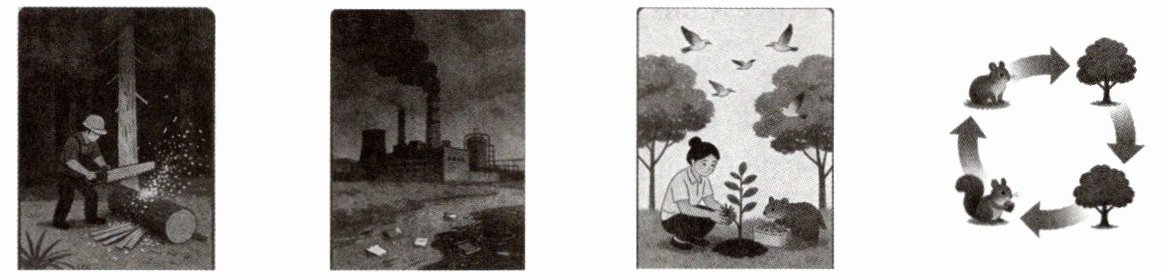
A.cut down trees
B.balance the ecosystem
C.get along with nature
D.cause pollution
请根据图片信息,匹配合适的单词。
A
D
C
B
A.cut down trees
B.balance the ecosystem
C.get along with nature
D.cause pollution
答案
1. A 2. D 3. C 4. B
解析
【分析】
先观察每一幅图的内容,第一幅图是工人砍伐树木,对应“砍伐树木”的短语;第二幅图是工厂排放污染物,对应“造成污染”的短语;第三幅图是人们植树,与自然友好互动,对应“与自然和谐共处”的短语;第四幅图是动植物和树木的循环,体现生态平衡,据此匹配对应选项即可。
【解析】
1. 第一幅图为砍伐树木的场景,对应A.cut down trees;
2. 第二幅图为工厂排放污染物的场景,对应D.cause pollution;
3. 第三幅图为人们植树、与自然友好相处的场景,对应C.get along with nature;
4. 第四幅图为动植物与树木的循环,体现生态平衡,对应B.balance the ecosystem。
【答案】
1.A 2.D 3.C 4.B
【知识点】
人与自然的关系、生态保护
【点评】
本题通过图片匹配短语,考查对不同环保场景的理解,难度较低,需准确识别每幅图的核心含义。
【难度系数】
0.3
二、话题表述
请根据图片内容回答问题。
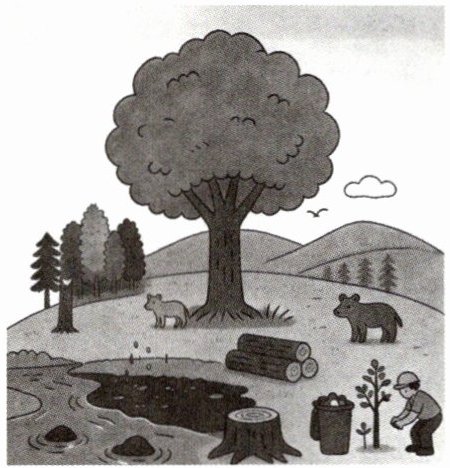
1. What problems do humans bring to nature?
2. What will happen to nature if humans are gone?
请根据图片内容回答问题。
1. What problems do humans bring to nature?
Humans bring many problems to nature. For example, we cut down too many trees and cause pollution in rivers and the air.
2. What will happen to nature if humans are gone?
If humans are gone, nature will become clean and green again.
答案
1. Humans bring many problems to nature. For example, we cut down too many trees and cause pollution in rivers and the air.
2. If humans are gone, nature will become clean and green again.
解析
【分析】先仔细观察图片,图中有被砍伐的树桩、堆放的木材,还有被污染的河流,这些都是人类活动留下的痕迹。第一问需要结合这些现象,总结人类给自然带来的问题,比如过度砍伐树木、污染水源等;第二问要从自然恢复的角度,说明没有人类干预后,自然会逐渐恢复到清洁、充满生机的状态。
【解析】1. 从图片里的树桩、木材可知人类砍伐树木,河流的污染痕迹说明人类造成水污染,这些都是人类给自然带来的问题,按照要求用英语举例说明即可。2. 当人类消失后,之前被破坏的自然环境会慢慢修复,变得干净、绿意盎然,所以自然会重回清洁绿色的状态。
【答案】
1. Humans bring many problems to nature. For example, we cut down too many trees and cause pollution in rivers and the air.
2. If humans are gone, nature will become clean and green again.
【知识点】
环境保护、英语问答、看图表达
【点评】
本题通过图片引导学生观察人类活动对自然的影响,既考查英语话题表述能力,又培养环保意识,作答时需结合图片细节准确回应问题。
【难度系数】
0.3
三、主题阅读
阅读短文,从A、B、C、D四个选项中选出最佳选项。
①Have you heard of the “giant panda of the water”? The Yangtze River is its home. It is a very good swimmer. Flipping, nodding and jumping are easy for it in the
water. It is the Yangtze finless porpoise(江豚), which lives only in the Yangtze River.
②The Yangtze River is the cradle of Chinese civilization(中华文明的摇篮). It starts from the Tangula Mountains on the Qinghai-Tibet Plateau and is over 6, 300 kilometers long. It flows through 11 provincial-level regions and finally runs into the East China Sea. It is China’s longest river and the third longest river in the world.
③However, in recent years, the plants and animals in the Yangtze River have faced problems because of environmental pollution. To solve this, the government made a plan in 2016 to protect the great river. Ten years later, many good changes have taken place.
④Thousands of factories have been closed, improved or moved away to stop polluted water from running into the river. At the same time, new green businesses have appeared. For example, in a park, a company makes paper products in a way that is 100 percent biodegradable(可分解的). Technology also helps a lot. Since 2021, Chongqing has built an AI system to monitor fishing activities and pollution. So far, it has connected over 1, 200 cameras and dozens of drones to find illegal fishing and pollution risks.
⑤Flood control and prevention are also important for people living along the river. Now scientists use a digital twin of the Yangtze to help with floods. The digital twin uses big data, AI and the Internet of Things to collect information and send it to a control center. A 3D model on the computer shows the real conditions of the river. With this system, flood warnings can be sent earlier, so people can move to safe places in time.
⑥ ▲ The main part of the Yangtze River has kept Class II water quality, which is the second best level, for six straight years. Now, we all need to start with ourselves—not littering, not pouring untreated wastewater. If everyone did this, it would make a big difference.
()1. How does the writer introduce the Yangtze River in Paragraph 2?
A. By listing numbers.
B. By telling a story.
C. By comparing opinions.
D. By asking questions.
()2. What do Paragraph 4 and Paragraph 5 mainly talk about?
A. 3D models of the Yangtze River.
B. The location of the Yangtze River.
C. The importance of the Yangtze River.
D. Ways of protecting the Yangtze River.
( )3. Which sentence should be put at the beginning of Paragraph 6?
A. Protection does not stop.
B. All the efforts have paid off.
C. The situation remains serious.
D. The river is facing new challenges.
答案
1. A 2. D 3. B
解析
【分析】
1. 第1题:定位到第二段,该段提到长江长度超6300公里、流经11个省级行政区等具体数字,判断作者用列数字的方式介绍长江,对应选项A。
2. 第2题:第4段讲关闭/整改污染工厂、发展绿色产业、AI监控等保护举措,第5段讲用数字孪生技术防洪的保护手段,两段均围绕保护长江的方法展开,对应选项D。
3. 第3题:第6段提到长江水质连续六年保持二类(良好状态),结合前文的保护措施,需填入体现保护成效的句子,选项B符合语境,起到承上启下作用。
【解析】
1. 第1题:根据题干关键词“Paragraph 2”定位到第二段,段中出现“over 6,300 kilometers long”“flows through 11 provincial-level regions”等具体数据,说明作者通过列数字的方式介绍长江,故答案为A。
2. 第2题:第4段阐述关闭/整改污染企业、发展绿色产业、AI监控非法捕捞与污染等保护举措,第5段介绍利用数字孪生技术防洪的保护方法,两段核心均为保护长江的具体方式,故答案为D。
3. 第3题:第6段后文提到长江水质连续六年保持二类(优良水质),结合前文政府及各方的保护行动,此处需填入体现保护成效的句子,选项B“所有努力都有回报”符合语境,能衔接上下文,故答案为B。
【答案】
1.A 2.D 3.B
【知识点】
阅读理解(细节理解、主旨大意、句子还原)
【点评】
本题为主题阅读类题目,围绕长江保护展开,考查学生对文章细节信息、段落主旨及句子逻辑衔接的理解能力,需学生精准定位原文信息,梳理段落逻辑关系。
【难度系数】
0.5
