

 登录
1. interested
【感知】
» I'm interested in nature.(教材第56页)我对大自然感兴趣。
» I'm really interested in reading all kinds of books.(教材第57页)我对阅读各种各样的书籍很感兴趣。
» There are many interesting places here.(教材第41页)这里有很多有趣的地方。
» His main interests are reading and playing the piano. 他主要的兴趣是读书和弹钢琴。
【探究】
(1)be interested in 为固定搭配,意为“
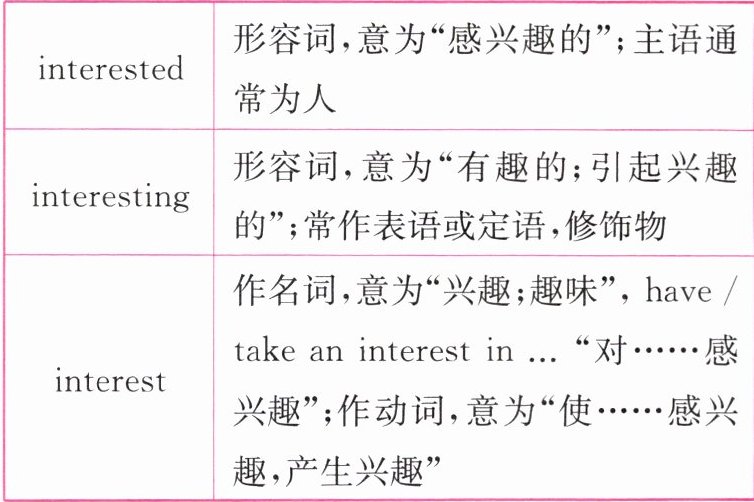
(2)interested, interesting 与 interest 的用法辨析
【应用】
用所给单词的适当形式填空
①The book is
②If you are interested in
【感知】
» I'm interested in nature.(教材第56页)我对大自然感兴趣。
» I'm really interested in reading all kinds of books.(教材第57页)我对阅读各种各样的书籍很感兴趣。
» There are many interesting places here.(教材第41页)这里有很多有趣的地方。
» His main interests are reading and playing the piano. 他主要的兴趣是读书和弹钢琴。
【探究】
(1)be interested in 为固定搭配,意为“
对……感兴趣
”。(2)interested, interesting 与 interest 的用法辨析
【应用】
用所给单词的适当形式填空
①The book is
interesting
and I'm interested
in it. (interest)②If you are interested in
playing
(play) soccer, you can join the sports club.答案
1. [探究](1)对……感兴趣
[应用]①interesting; interested
②playing
解析
【分析】
本题考查interest相关同根词的用法辨析及固定搭配,解题思路如下:
1. 先明确三个词的核心用法:interested修饰人,构成固定搭配be interested in;interesting修饰物;interest可作名词或动词。
2. 探究(1)需回忆固定短语be interested in的含义。
3. 应用部分:①中第一空修饰物book,用interesting;第二空主语是人I,搭配be interested in,用interested;②中be interested in里的in是介词,后接动词动名词形式,故play变playing。
【解析】
1. 探究(1):be interested in是固定搭配,意为“对……感兴趣”。
2. 应用①:第一空修饰名词book(物),需用形容词interesting;第二空主语是人I,结合be interested in结构,用形容词interested。
3. 应用②:be interested in中的in为介词,介词后接动词时需用动名词形式,故play变为playing。
【答案】
[探究](1)对……感兴趣;[应用]①interesting; interested;②playing
【知识点】
形容词辨析,固定搭配,介词用法
【点评】
本题围绕interest相关同根词的用法及固定搭配展开,是初中英语的基础考点,需掌握三个词的修饰对象差异和相关短语用法,难度适中。
【难度系数】
0.3
2. soon
【感知】
» You can soon cook for your family.(教材第56页)你很快就能给家人做饭了。
» How soon will he come back? 他多久之后回来?
【探究】
(1)soon副词,意为“不久;很快”。
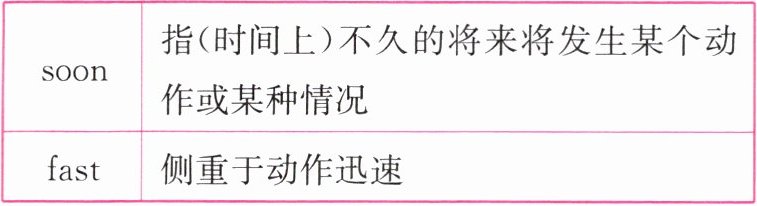
(2)soon与fast的用法辨析
二者均有“快”之意,具体区别如下:
【应用】
完成句子
①我妈妈很快就要回来。
My mum will come back
②不要说得太快。我听不清。
Don't speak
③还有多久你能完成作业?
【感知】
» You can soon cook for your family.(教材第56页)你很快就能给家人做饭了。
» How soon will he come back? 他多久之后回来?
【探究】
(1)soon副词,意为“不久;很快”。
how soon
意为“多久以后,过多久”,谓语动词常用终止性动词,时态多用将来时。(2)soon与fast的用法辨析
二者均有“快”之意,具体区别如下:
【应用】
完成句子
①我妈妈很快就要回来。
My mum will come back
soon
.②不要说得太快。我听不清。
Don't speak
too
fast
. I can't hear you clearly.③还有多久你能完成作业?
How
soon
can you finish your homework?答案
2. [探究](1)how soon
[应用]①soon ②too fast
③How soon
解析
【分析】本题围绕副词soon、fast的用法及疑问词组how soon展开,解题思路为:1. 明确“多久以后”对应的疑问表达是how soon,用于将来时的时间提问;2. 区分soon(侧重时间上的不久)和fast(侧重动作的速度快)的核心差异;3. 结合每个句子的语境,选择正确的词或词组填空。
【解析】1. 探究(1)中,对“将来多久以后发生某事”提问的疑问词组是how soon,符合“谓语动词常用终止性动词,时态多用将来时”的描述;2. 应用①句表达“很快回来”,需用表时间不久的soon;②句“说得太快”,需用表动作速度快的fast,且用too修饰表示“太”;③句询问“还有多久”,句首用How soon(首字母大写)。
【答案】[探究](1)how soon;[应用]①soon ②too fast ③How soon
【知识点】副词用法;疑问词组how soon;词汇辨析
【点评】本题考查初中英语基础词汇的用法辨析,重点区分soon与fast的含义,以及how soon的提问功能,是日常学习中需掌握的基础知识点,难度适中。
【难度系数】0.5
