

 登录
A.图片理解(本题共5小题,每小题1分,满分5分)
听句子,选择与句子内容相符的图片。每个句子读两遍。
A B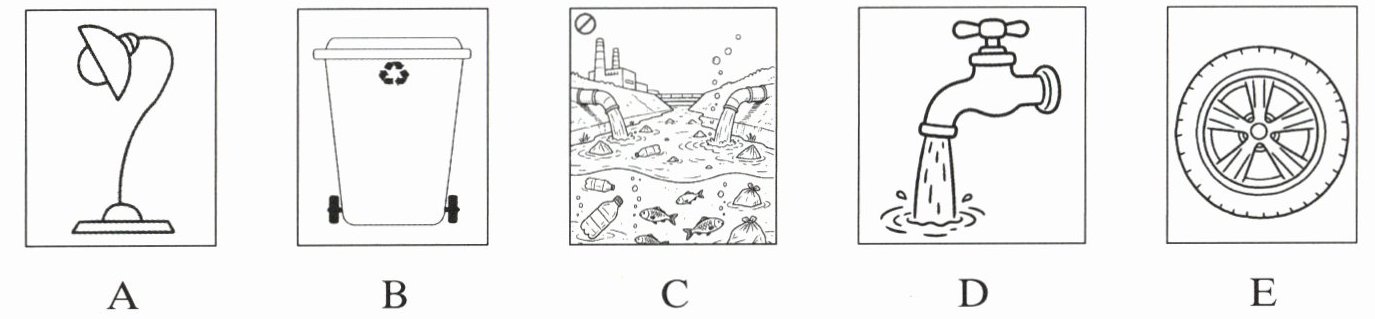 D E
1.
听句子,选择与句子内容相符的图片。每个句子读两遍。
A B
D E1.
D
2. B
3. C
4. A
5. E
答案
1. D 2. B 3. C 4. A 5. E
B. 短文理解(本题共5小题,每小题1分,满分5分)
听短文,选择正确的答案。短文读两遍。
(
A. Pollution. B. Traffic. C. Food.
(
A. Reduce. B. Recycle. C. Rebuild.
(
A. More food.
B. Things with less packaging.
C. Things with too much packaging.
(
A. Clean-up Day. B. Sports Day. C. Shopping Day.
(
A. Old people. B. The next generation. C. Only kids.
听短文,选择正确的答案。短文读两遍。
(
A
)6. What is the big problem talked about?A. Pollution. B. Traffic. C. Food.
(
C
)7. What is NOT one of the three Rs?A. Reduce. B. Recycle. C. Rebuild.
(
B
)8. What kind of things should we buy?A. More food.
B. Things with less packaging.
C. Things with too much packaging.
(
A
)9. What activity helps clean the environment?A. Clean-up Day. B. Sports Day. C. Shopping Day.
(
B
)10. Who will live in the cleaner world?A. Old people. B. The next generation. C. Only kids.
答案
6. A 7. C 8. B 9. A 10. B
Ⅱ.完形填空(本题共15小题,每小题1分,满分15分)
阅读下面短文,从A、B、C三个选项中选择一个最佳答案。
Garbage or trash is a major kind of environmental pollution. Each person produces about two kilograms of trash a day. We are making waste products faster than nature can 11 them down. And we are using up resources faster than they can be 12.
This adds up to trouble 13 the environment. Where does all garbage go? What can be done to help 14 garbage? How can we make less garbage?
Garbage isn’t just the smelly 15 fruits, vegetables or meat that we throw away in our homes. Those are only a small 16 of all the stuff we throw away. We create other kinds of waste, in construction, in mining and in our 17. Did you ever wonder what happened to your garbage? Most garbage is burned or 18 in landfills. Less than a 19 of our waste is recycled.
With a population of 1.41 billion, garbage is a big 20 for China. Chinese cities create around 265 million tons of garbage every year. The amount is growing 21 around 10 percent each year. Once, we used about 3 billion plastic shopping bags every day in China. The result was a great waste of resources and serious 22. So we did something about that. Now we use more cloth bags and shopping baskets 23 we shop.
In the coming years, China will build waste-to-energy plants in cities to clean 24 the garbage. But there’s a lot more that needs to be done. And you can play a 25 in reducing waste.
(
(
(
(
(
(
(
(
(
(
(
(
(
(
(
阅读下面短文,从A、B、C三个选项中选择一个最佳答案。
Garbage or trash is a major kind of environmental pollution. Each person produces about two kilograms of trash a day. We are making waste products faster than nature can 11 them down. And we are using up resources faster than they can be 12.
This adds up to trouble 13 the environment. Where does all garbage go? What can be done to help 14 garbage? How can we make less garbage?
Garbage isn’t just the smelly 15 fruits, vegetables or meat that we throw away in our homes. Those are only a small 16 of all the stuff we throw away. We create other kinds of waste, in construction, in mining and in our 17. Did you ever wonder what happened to your garbage? Most garbage is burned or 18 in landfills. Less than a 19 of our waste is recycled.
With a population of 1.41 billion, garbage is a big 20 for China. Chinese cities create around 265 million tons of garbage every year. The amount is growing 21 around 10 percent each year. Once, we used about 3 billion plastic shopping bags every day in China. The result was a great waste of resources and serious 22. So we did something about that. Now we use more cloth bags and shopping baskets 23 we shop.
In the coming years, China will build waste-to-energy plants in cities to clean 24 the garbage. But there’s a lot more that needs to be done. And you can play a 25 in reducing waste.
(
B
)11. A. put B. break C. take(
A
)12. A. replaced B. returned C. repeated(
A
)13. A. for B. with C. at(
C
)14. A. deal over B. treat in C. dispose of(
B
)15. A. fresh B. rotten C. cheap(
A
)16. A. part B. piece C. pair(
C
)17. A. schools B. farms C. factories(
B
)18. A. kept B. buried C. hidden(
A
)19. A. quarter B. three C. first(
B
)20. A. question B. problem C. matter(
C
)21. A. in B. on C. by(
A
)22. A. pollution B. illness C. danger(
B
)23. A. though B. when C. unless(
B
)24. A. out B. up C. away(
A
)25. A. role B. game C. joke答案
11.B 解析:break down 分解;put down 放下;take down 记下。此处指大自然分解垃圾,故选 B。
12.A 解析:replace 取代、更新;return 归还;repeat 重复。此处指资源再生补给。故选 A。
13.A 解析:句意:这会给环境带来麻烦。故选 A。
14.C 解析:句意:可以做什么来帮助处理垃圾? 故选 C。
15.B 解析:fresh 新鲜的;rotten 腐烂的;cheap 便宜的。此处指腐烂的瓜果蔬菜或肉类,故选 B。
16.A 解析:a small part of...意为“……的一小部分”,符合文意,故选 A。
17.C 解析:由前文建筑、采矿推断此空填入工厂,表示建筑、采矿、工厂产生的垃圾,故选 C。
18.B 解析:keep 保存;bury 掩埋;hide 隐藏。此处指垃圾填埋,故选 B。
19.A 解析:a quarter 意为“四分之一”,是固定表达,故选 A。
20.B 解析:question 要回答的问题;problem 亟待解决的难题;matter 事情、议题。此处指垃圾处理是个环境难题,故选 B。
21.C 解析:“grow by+百分比”表示“以……幅度增长”,故选 C。
22.A 解析:此处指塑料袋造成严重的环境污染。pollution 污染;illness 疾病;danger 危险。故选 A。
23.B 解析:when we shop 意为“当我们购物的时候”,故选 B。
24.B 解析:clean out 清扫内部;clean up 打扫整片区域、清理垃圾;clean away 擦掉、移走表面脏东西。故选 B。
25.A 解析:play a role 意为“发挥作用,尽一份力”,是固定搭配。故选 A。
