

 登录
24. (1)如图1,在△ABC中,∠BAC=90°,AB=AC,直线m经过点A,BD⊥m于D,CE⊥m于E,求证:DE=BD+CE;
(2)如图2,将(1)中的条件改为:在△ABC中,AB=AC,D、A、E三点都在直线m上,并且∠BDA=∠AEC=∠BAC=α,α为任意锐角或钝角.请问:结论DE=BD+CE是否成立?若成立,请证明;若不成立,请说明理由;
(3)如图3,在△ABC中,∠BAC是钝角,AB=AC,∠BAD>∠CAE,∠BDA=∠AEC=∠BAC,直线m与BC的延长线交于点F,若BC=2CF,△ABC的面积是12,求△ABD与△CEF的面积之和.
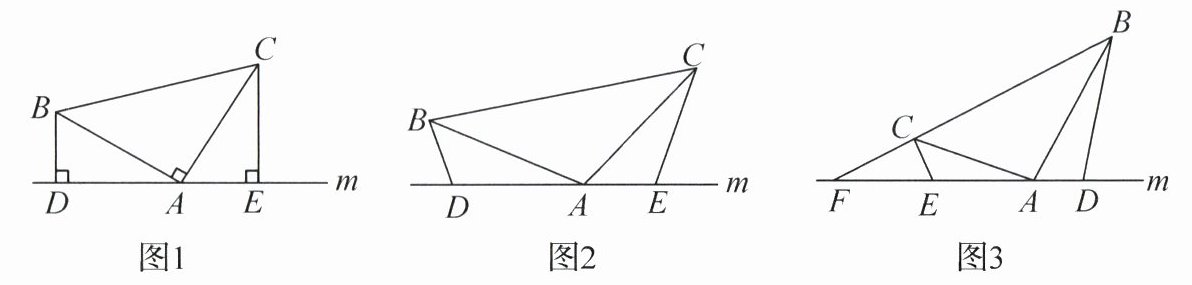
(2)如图2,将(1)中的条件改为:在△ABC中,AB=AC,D、A、E三点都在直线m上,并且∠BDA=∠AEC=∠BAC=α,α为任意锐角或钝角.请问:结论DE=BD+CE是否成立?若成立,请证明;若不成立,请说明理由;
(3)如图3,在△ABC中,∠BAC是钝角,AB=AC,∠BAD>∠CAE,∠BDA=∠AEC=∠BAC,直线m与BC的延长线交于点F,若BC=2CF,△ABC的面积是12,求△ABD与△CEF的面积之和.
答案
24. (1)证明:$\because BD⊥$直线$m,CE⊥$直线$m,\therefore ∠ BDA=∠ CEA=90°$.
$\because ∠ BAC=90°,\therefore ∠ BAD+∠ CAE=90°$.
$\because ∠ BAD + ∠ ABD = 90°, \therefore ∠ CAE = ∠ ABD$.
在$△ ADB$和$△ CEA$中,$\begin{cases} ∠ ABD=∠ CAE, \\ ∠ BDA=∠ AEC, \\ AB=AC, \end{cases}$
$\therefore △ ADB≌△ CEA (\mathrm{AAS}), \therefore AE = BD,AD=CE$,
$\therefore DE=AE+AD=BD+CE$.
(2)解:结论$DE=BD+CE$成立,理由如下:
$\because ∠ BDA=∠ BAC=α,\therefore ∠ DBA+∠ BAD=∠ BAD+∠ CAE=180°-α,\therefore ∠ CAE=∠ ABD$.
在$△ ADB$和$△ CEA$中,$\begin{cases} ∠ ABD=∠ CAE, \\ ∠ ADB=∠ CEA, \\ AB=CA, \end{cases}$
$\therefore △ ADB≌△ CEA (\mathrm{AAS}), \therefore AE = BD,AD=CE$,
$\therefore DE=AE+AD=BD+CE$.
(3)解:$∠ BAD>∠ CAE,∠ BDA=∠ AEC=∠ BAC,\therefore ∠ CAE=∠ ABD$.
在$△ ABD$和$△ CAE$中,$\begin{cases} ∠ ABD=∠ CAE, \\ ∠ BDA=∠ CEA, \\ AB=AC, \end{cases}$
$\therefore △ ABD ≌ △ CAE (\mathrm{AAS}), \therefore S_{△ ABD} = S_{△ CEA}$.
设$△ ABC$的底边$BC$上的高为$h$,则$△ ACF$的底边$CF$上的高为$h$,
$\therefore S_{△ ABC}=\frac{1}{2}BC· h,S_{△ ACF}=\frac{1}{2}CF· h$,
$\therefore h=12. \because BC=2CF$,
$\therefore S_{△ ACF}=6$.
$\because S_{△ ACF}=S_{△ CEF}+S_{△ CEA}=S_{△ CEF}+S_{△ ABD}=6$,
$\therefore △ ABD$与$△ CEF$的面积之和为6.
