

 登录
21. (10分)如图所示,已知等边△ABC和等边△CDE,P,Q分别为AD,BE的中点.
(1)试判断△CPQ的形状,并说明理由.
(2)如果将等边△CDE绕点C旋转,在旋转过程中△CPQ的形状会改变吗? 请你将图②中的图形补画完整并说明理由.
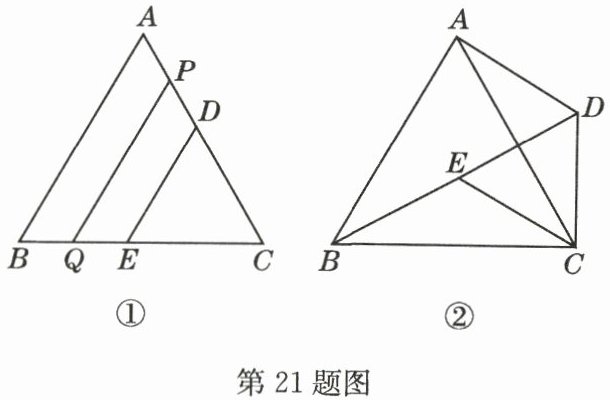
(1)试判断△CPQ的形状,并说明理由.
(2)如果将等边△CDE绕点C旋转,在旋转过程中△CPQ的形状会改变吗? 请你将图②中的图形补画完整并说明理由.
答案
21. 解:(1)$△ CPQ$是等边三角形.理由如下:
∵$△ ABC$和$△ CDE$都是等边三角形,
$\therefore ∠ C=60°$,$AC=BC$,$DC=EC$,
$\therefore AC-DC=BC-EC$,即$AD=BE$.
∵$P,Q$分别为$AD,BE$的中点,$\therefore PD=EQ$,
$\therefore CD+DP=CE+EQ$,即$CP=CQ$,
$\therefore △ CPQ$是等边三角形.
(2)如果将等边$△ CDE$绕点$C$旋转,在旋转过程中$△ CPQ$的形状不会改变.理由如下:
如图所示,
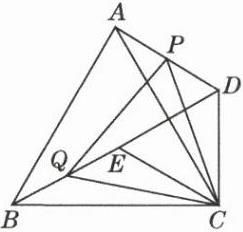 ,
∵$△ ABC$和$△ CDE$都是等边三角形,
$\therefore ∠ ACB=∠ DCE=60°$,$AC=BC$,$DC=EC$.
∵$∠ ACD=∠ DCE-∠ ACE$,$∠ BCE=∠ ACB-∠ ACE$,
$\therefore ∠ ACD=∠ BCE$.在$△ ACD$和$△ BCE$中,
$\begin{cases} AC=BC, \\ ∠ ACD=∠ BCE, \\ DC=EC, \end{cases}$$\therefore △ ACD≌△ BCE(\mathrm{SAS})$.
$\therefore AD=BE$,$∠ CAD=∠ CBE$,即$∠ CAP=∠ CBQ$.
∵$P$是$AD$的中点,$Q$是$BE$的中点,
$\therefore AP=\frac{1}{2}AD$,$BQ=\frac{1}{2}BE$,$\therefore AP=BQ$.
在$△ ACP$和$△ BCQ$中,
$\begin{cases} AC=BC, \\ ∠ CAP=∠ CBQ, \\ AP=BQ, \end{cases}$
$\therefore △ ACP≌△ BCQ(\mathrm{SAS})$.
$\therefore PC=QC$,$∠ ACP=∠ BCQ$.
∵$∠ BCQ+∠ ACQ=∠ ACB=60°$,
$\therefore ∠ ACP+∠ ACQ=60°$,即$∠ PCQ=60°$,
$\therefore △ CPQ$是等边三角形.
